
For years, the wind power story was a simple one. Onshore turbines were cheap, offshore turbines were expensive, and cost decided which one a country built. That story does not hold up anymore. Offshore wind keeps drawing serious capital even though it costs more than double per megawatt to build, and the reason has less to do with price tags and more to do with what each technology delivers over its working life. This is the first part of a two part comparison of offshore and onshore wind. This part covers the basic economics: capital cost, output and the levelised cost of electricity. The second part, to follow, covers financing, risk and where both technologies are headed.
A market growing on two speeds
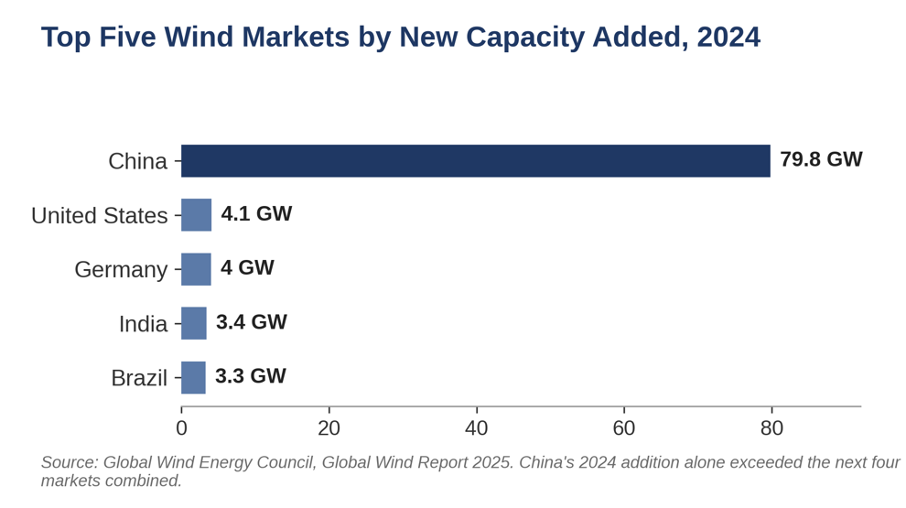
Global wind capacity crossed the 1 terawatt mark in 2024, and the industry had a record year doing it. The Global Wind Energy Council’s latest report puts new installations at 117 GW for the year, made up of 109 GW onshore and 8 GW offshore, taking cumulative installed capacity to 1,136 GW. China alone added close to 80 GW, more than two thirds of the global total, with the United States, Germany, India and Brazil rounding out the top five markets. Wind turbines were commissioned in 55 countries that year, which says something about how widely the technology has spread, even if the bulk of the volume still sits with a handful of large markets.
Independent forecasters such as DNV expect total wind capacity, onshore and offshore combined, to roughly triple to around 3.3 terawatts by 2040, with most of that growth still coming from onshore wind in China, alongside steady offshore expansion in Europe. That forecast matters for how this comparison should be read. Offshore wind is not catching up to onshore in volume terms any time soon, and it does not need to. The two technologies are simply being asked to do different jobs within the same energy system.
Onshore wind does the heavy lifting in these numbers, as it usually does. It remains the cheaper, faster, simpler technology to build, and most countries treat it as the default choice for new renewable capacity. Offshore wind is a much smaller slice of the pie by volume, yet it keeps pulling in capital that is hard to justify on cost alone. Understanding why means looking past the headline figure.
Why offshore costs more to build
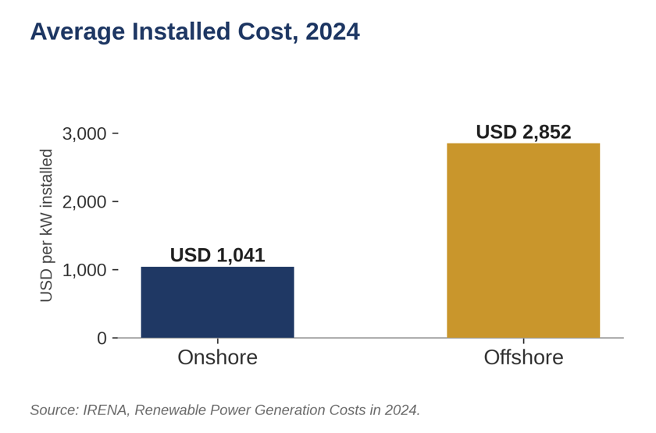
A turbine sitting out at sea needs a great deal that a turbine on a hillside does not: a purpose built foundation, undersea cables, an offshore substation, specialist installation vessels and a longer construction window to put it all together. These costs add up quickly. According to IRENA’s Renewable Power Generation Costs report, the global average installed cost for onshore wind was USD 1,041 per kW in 2024, against USD 2,852 per kW for offshore wind, nearly three times as much. Both figures have actually come down sharply over the past decade and a half, as turbines have grown larger and supply chains have matured, though the 2021 to 2023 stretch of high steel prices, costlier shipping and dearer financing briefly pushed costs back up for both technologies before the decline resumed.
Running costs follow a similar pattern. An onshore turbine can usually be reached by road for routine maintenance, while an offshore turbine needs a vessel, a suitable weather window and a trained crew, which keeps lifetime operating costs higher as well.
Why offshore still earns its keep
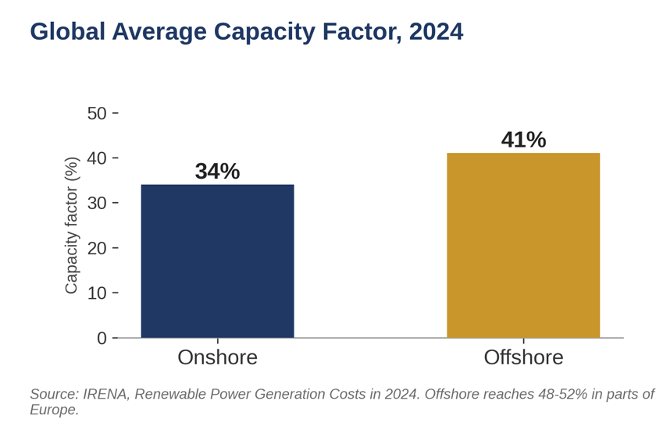
The gap narrows once output enters the picture. IRENA’s data puts the global average capacity factor for onshore wind at 34 per cent in 2024, up from 27 per cent in 2010, while offshore wind ran well above 40 per cent on average, helped by stronger and steadier winds at sea with far less turbulence than most onshore sites see. A turbine that runs more hours in the year earns more revenue in the year. Under long term power purchase agreements or contract for difference schemes, that steadier output also makes offshore projects easier to finance, since lenders can rely on a more predictable cash flow.
What LCOE shows, and what it leaves out
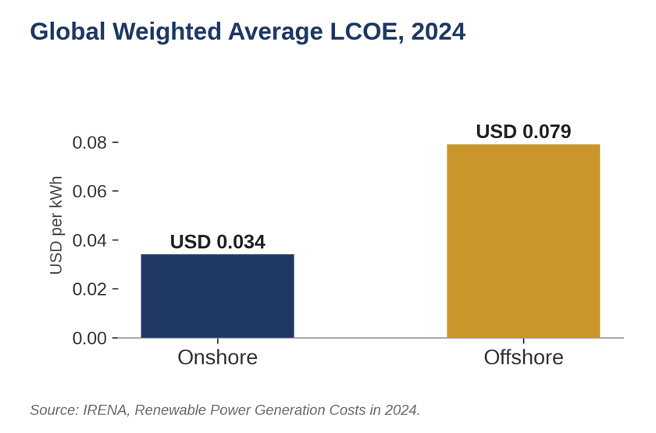
Put cost and output together and you arrive at the levelised cost of electricity, the standard yardstick for comparing power sources. On this measure, onshore wind is still clearly cheaper. IRENA puts the global weighted average LCOE for onshore wind at USD 0.034 per kWh in 2024, against USD 0.079 per kWh for offshore wind, more than double. That gap is real, and it explains why onshore remains the default choice almost everywhere land is available.
But LCOE was built to measure the cost of generating power, not the value of that power once it reaches the grid. It says nothing about when electricity is produced relative to when it is actually needed, how much of it gets curtailed because the local grid cannot absorb it, or how close the generation site sits to the demand it is meant to serve. Offshore wind tends to score better on all three counts in coastal markets with high electricity demand and limited spare land, which is a large part of why utilities in places like the United Kingdom, Japan and Taiwan continue paying a premium for it.Admin
Where each technology is winning
The geography of wind investment tells its own story. China leads on both fronts, adding more onshore and more offshore capacity than any other country. Europe has built the deepest offshore market in the world on the back of stable, long term auctions and a transmission system planned around them, awarding a record 56 GW of offshore capacity through auctions in 2024 alone. Meanwhile, India, Brazil and a number of African markets are doing what makes sense for their own conditions: building onshore wind, because it is faster to permit, faster to connect to the grid and faster to pay back, and because land is available there in a way it simply is not along, say, the UK coastline.
None of this is really a contest between two technologies chasing the same job. A country with a long coastline, concentrated coastal demand and limited inland space has different priorities to a country with wide open plains and a fast growing power deficit. The investment pattern across markets is largely just a reflection of that difference.
What this means going into part two
None of the above means cost has stopped mattering. It means cost alone no longer tells the full story, and developers, utilities and lenders are paying closer attention to lifetime value rather than the price tag on day one. Part two of this series looks at how that shift plays out in financing terms, auction design, transmission planning and the risks that separate a profitable wind project from a stalled one, along with a short look at how the world’s largest offshore project and China’s onshore build out are putting these ideas into practice on the ground.