

How the world’s leading consumer goods companies are turning external partnerships into product pipelines – and what it takes to move from pilot to shelf.
Key Takeaways
- Open innovation is now structural, not experimental. More than half of P&G’s new products carry meaningful external contributions, and Unilever’s Foundry has piloted with more than 100 startups through its pitch–pilot–partner model, scaling roughly half of them across its brands.
- The failure point is not scouting. Most open-innovation programs successfully surface interesting technology. The breakdown happens between pilot and production, where the manufacturing gap, unclear IP arrangements, and lost internal champions quietly kill otherwise promising collaborations.
- Four structural enablers define programs that convert consistently: starting with commercial problems, building a dedicated scale-bridge function, aligning IP and commercial terms before co-development begins, and applying real gate criteria tied to commercial metrics rather than technical performance alone.
- Sustainability is now the primary brief. Green chemistry, biodegradable packaging, and naturally derived surfactants represent an entire generation of open-innovation challenges structured around transitions rather than performance improvement.
- The capability compounds over time. Companies that treat open innovation as a long-term organizational capability, rather than a series of discrete experiments, generate compounding returns on conversion rates, time-to-market, and R&D cost efficiency.
| 50%+
of P&G product innovations include external contributions |
$270M
Unilever New Haven Global Innovation Center (opening 2029): skin care, fragrance, AI |
| 60%
R&D productivity gain at P&G since adopting open innovation |
€39B
Unilever Home & Personal Care revenue, FY2025 – now its core business |
Why This Category, Why Now?
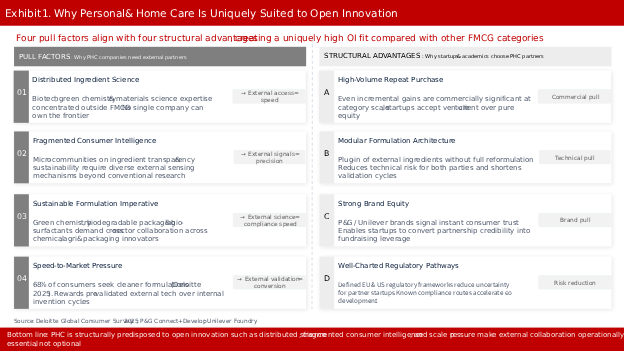
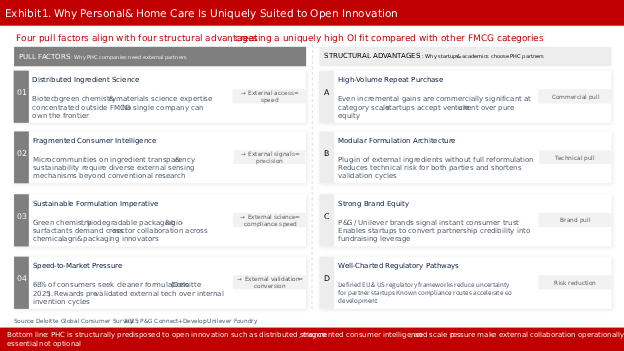
Consumer goods categories are not equal when it comes to open innovation. Personal & Home Care sits at an unusual intersection of distributed science, fragmented consumer intelligence, and structural scale pressure – conditions that make external partnership not merely useful but, for the most competitive players, operationally essential.
The science behind real product differentiation in this space – advanced biotechnology, green chemistry, high-performance surfactants, and novel actives – is spread across hundreds of specialist firms, university laboratories, and materials-science startups. No major FMCG company carries all of it in-house, and the smarter players stopped trying to. Instead, they have built the organizational muscle to find, assess, and integrate those external capabilities faster than anyone else.
Consumer intelligence is similarly dispersed. The communities driving early-mover demand on ingredient transparency, refillable formats, or performance-first formulations tend to exist in pockets that conventional market research does not easily reach. Brands with genuine external sensing networks pick up those signals earlier and with greater precision.
Scale adds urgency. Following its decision to separate the Foods business, Unilever is reshaping itself into a focused Home & Personal Care company, with HPC revenues of €39 billion in FY2025. The pipeline must keep moving, and open innovation is central to how that happens. Consumer expectations are shifting in the same direction: a clear majority of global consumers now actively seek healthier or cleaner formulations – a structural change in the baseline that internal R&D alone cannot meet at the pace the market demands.
Where the Pipeline Actually Breaks
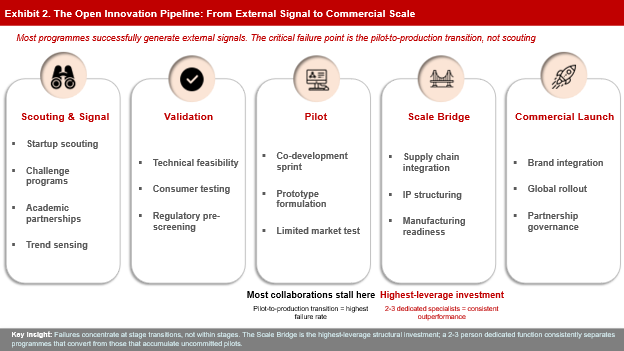
The failure point in most open-innovation programs is not the scouting stage. Most organizations have figured out how to run challenge programs, scan startup ecosystems, and surface interesting technology. The problem is what happens next.
The journey from an external signal to a shelf-ready product runs through five stages: scouting and signal detection; technical and consumer validation; co-development pilot; scale bridge; and commercial launch. Failures concentrate at the transitions between stages, and the move from pilot to production carries the single highest rate of stall or collapse for otherwise promising collaborations.
The Manufacturing Gap
A formulation that performs perfectly in a 500-kilogram pilot batch can behave in entirely unpredictable ways when produced at commercial volumes measured in tens of thousands of tonnes. Supply-chain relationships, raw-material sourcing at commercial volume, and manufacturing-process compatibility all require dedicated rebuilding for each novel ingredient or technology that enters through an external partner. This is not a failure of ambition; it is a capability gap. Organizations that have built a dedicated function to bridge it consistently outperform those that rely on borrowed time from brand or R&D teams managing competing priorities.
IP Left Too Late
The second most common failure driver is unclear IP ownership at the point where meaningful joint development begins. Both P&G’s Connect + Develop and Unilever’s Foundry set IP frameworks in the very first engagement meeting, treating them as a commercial foundation rather than a legal formality to resolve later. Organizations that delay this step lose weeks or months in negotiation precisely when momentum matters most.
The Internal Champion Problem
A failure mode that receives less attention than it deserves is the departure of the internal sponsor who originally identified or championed the partnership. When that person changes roles, exits the business, or is pulled onto a higher-priority initiative, the collaboration loses its internal advocate – at precisely the moment it needs one most, during the long, difficult stretch between a successful pilot and a product a factory can manufacture at volume.
What Good Looks Like: A Framework
Four structural enablers separate open-innovation programs that consistently convert partnerships into commercial launches from those that generate interesting pilots and poor delivery rates.
- Start with commercial problems, not technology landscapes. The programs with the strongest conversion rates begin by defining the specific innovation their commercial strategy requires – a plant-based surfactant at a defined cost target, or a packaging format that achieves a particular sustainability credential without sacrificing shelf appeal. The brief comes first; the solution search follows. Working in the opposite direction – scanning for interesting technology and then seeking a commercial home for it – generates a broad pipeline of tangentially relevant ideas and a low conversion rate.
- Build a dedicated scale-bridge function. The gap between a validated pilot and a commercially deployable product requires a dedicated team, not borrowed capacity from brand managers or R&D scientists with competing mandates. A scale-bridge function – even two or three specialists with an explicit remit – resolves the manufacturing, regulatory, and supply-chain constraints that stand between a promising external technology and a product that can be made at volume within acceptable margins.
- Align IP and commercial terms before the work begins. P&G Connect + Develop and Unilever Foundry have both built standardized early-stage engagement templates into their processes. These reduce negotiation timelines from months to weeks while preserving flexibility for strategically important partnerships. Treating IP alignment as an administrative step to handle later is one of the more reliably expensive mistakes in open innovation.
- Use real gate criteria, not open-ended exploration. Time-bounded stages with defined go/no-go criteria tied to commercial metrics – not just technical performance – keep programs honest and maintain internal credibility. Consumer validation, cost-at-scale modeling, and regulatory-pathway assessment should all be completed before any scale-bridge investment is committed. Programs without these mechanisms tend to accumulate interesting but commercially uncommitted pilots indefinitely.
Case Study – P&G: Connect + Develop
Launched in 2001, P&G’s Connect + Develop remains the most extensively documented open-innovation model in consumer goods. It grew from an honest internal assessment: even P&G’s R&D function, one of the largest and most capable in the industry, could not sustain the pace and breadth of innovation the business required on its own. P&G’s Connect + Develop program was built on the premise that the company could tap into a global pool of approximately 1.5 million scientists and engineers outside its organization, making its innovation needs accessible to external innovators through an open innovation platform.
The results are well established. External contribution to the innovation pipeline rose from 10-15% at launch to more than 50% today, R&D productivity increased by roughly 60%, and more than 2,000 partnership agreements have been completed globally.Products including Tide PODS were either originated or meaningfully accelerated through external collaborations, and the 2024 Connect + Develop Euro Awards recognized standout external partnerships in areas such as predictive cleaning and formulation stability.
Case Study – Unilever: Foundry and Innovation Center
Unilever’s open-innovation model has evolved considerably from its startup-engagement origins. It now combines venture-client relationships, AI-driven formulation R&D, and a newly announced Global Innovation Center in New Haven, Connecticut, representing a $270 million investment. Scheduled to open in 2029, the planned facility will integrate formulation science, fragrance creation, packaging design, and consumer insights under one roof, including a global center for skin care and cleansing, a polycultural skin and hair center of excellence, a human-performance laboratory, and a packaging-innovation studio.
The commercial results are already visible. In Q1 2026, Unilever’s Home Care segment delivered 6.1% underlying sales growth and 6.2% volume growth, driven partly by innovations like Persil Wonder Wash that respond to consumer demand for convenience and performance.Dove’s first refillable anti-perspirant collection – developed through a process that included acquiring the refillable personal-care brand Wild – shows how open-innovation partnerships can evolve into full portfolio moves.
Case Study – Henkel, L’Oréal, Beiersdorf, and Colgate-Palmolive
Beyond P&G and Unilever, several other major players have developed distinctive open-innovation architectures. Henkel’s Spark platform drives external collaboration across its consumer brands, including Persil and Schwarzkopf, while its J-Beauty Hub in Tokyo integrates Schwarzkopf with Shiseido Professional – the professional-hair business Henkel acquired in 2022 – to fuse Asian and Western hair-care expertise. Separately, Henkel Ventures runs a €300 million fund with typical tickets of €0.5-5 million per startup, investing from early stage through Series B.
L’Oréal’s €100 million L’AcceleratOR – a five-year sustainability accelerator run with the University of Cambridge Institute for Sustainability Leadership (CISL) – selected 13 startups for its first cohort, focused on low-carbon technologies, water resilience, nature-based solutions, alternative ingredients and materials, and circularity; its BOLD venture fund invests separately across the portfolio. Beiersdorf, in turn, launched the second generation of its corporate venture fund in 2026: a €100 million Skin Care Innovation Fund that invests from seed to Series B (typically €0.5-5 million per deal) across life sciences, sustainability, AI, and digital health. Colgate-Palmolive’s Open Innovation Portal, managed through yet2, spans oral, personal, home, pet, and packaging categories, with connected-toothbrush co-development with Baracoda among its notable partnerships.
Indovinya: Challenge-Driven Scouting
A practical illustration of scouting done well comes from Indovinya, the specialty-chemicals division of Indorama Ventures. The company recently launched an open-innovation challenge targeting fragrance solubilization for personal-care products, with a specific focus on sustainable, ethoxylate-free solutions. Run in partnership with corporate-innovation firm AEVO, the program invited researchers and startups to submit predictive models and green-chemistry approaches against a clearly defined technical brief.
The challenge-driven format consistently outperforms open-portal models for one simple reason: defining precisely what problem needs solving – and what success looks like – attracts partners with genuine commercial fit, rather than generating a broad and unmanageable pipeline of tangentially relevant ideas. The quality of the brief determines the quality of the applicant pool.
The Sustainability Dimension
Green chemistry, biodegradable packaging, naturally derived surfactants, and waterless formulation technologies are all areas where specialist startups and academic groups hold knowledge that incumbents cannot replicate internally at any reasonable speed. Indovinya’s fragrance-solubilization challenge, with its specific focus on eliminating ethoxylates, reflects an entire generation of open-innovation briefs now structured around sustainability transitions rather than pure performance improvement.
This is not a peripheral trend. The regulatory direction of travel across the EU, the UK, and increasingly across key Asian markets is toward tighter restrictions on synthetic surfactants, microplastics, and non-biodegradable packaging. Companies that have built external networks reaching into green-chemistry research and sustainable-materials science are better positioned to adapt than those still relying on internal formulation teams to respond reactively.
Sustainability briefs also attract a different quality of external partner. Startups with genuine technical differentiation in bio-surfactants or packaging biodegradability are not looking for any FMCG company – they are looking for the one that has constructed a credible, serious commercial pathway for their technology. A well-structured sustainability challenge signals exactly that.
Building the Capability: A Phased Roadmap
The following roadmap outlines a practical sequencing for organizations building or restructuring an open-innovation capability in Personal & Home Care. The phases overlap by design; structural work should not wait for earlier phases to complete entirely before beginning.
| Phase | Timeframe | Key actions |
| Phase 1 | Months 1-3 | Define the three to five highest-priority innovation needs. Convert each into a structured challenge brief with clear technical requirements, cost targets, timelines, and commercial success criteria. This becomes the foundation for all subsequent external engagement – the single most important investment in the program. |
| Phase 2 | Months 2-6 | Establish systematic connections with startup ecosystems, academic research groups, ingredient suppliers, and innovation intermediaries. Unilever’s Foundry and P&G’s Singapore Innovation Center offer useful structural reference points for building these networks at scale without creating unmanageable inbound volume. |
| Phase 3 | Months 3-6 | Develop template NDAs, IP term sheets, and pilot-agreement frameworks that can be executed quickly without sacrificing appropriate legal and commercial protection. The goal is to move from first contact to funded pilot in weeks rather than months. Standardization is the lever; without it, every partnership restarts the clock on negotiations. |
| Phase 4 | Months 6-12 | Appoint a dedicated scale-bridge team – even two or three specialists – whose explicit mandate is to shepherd promising technologies through manufacturing integration, supply-chain development, and regulatory clearance. This is the single highest-leverage organizational investment in open-innovation capability. |
| Phase 5 | Ongoing | Track what matters at the commercial level: conversion rate from pilot to launch, revenue contribution from externally sourced innovations, and time-to-market versus the internal development baseline. Report to the executive level on a regular cadence. Programs without commercial-level measurement lose internal credibility and budget priority. |
Why Most Open Innovation Does Not Scale
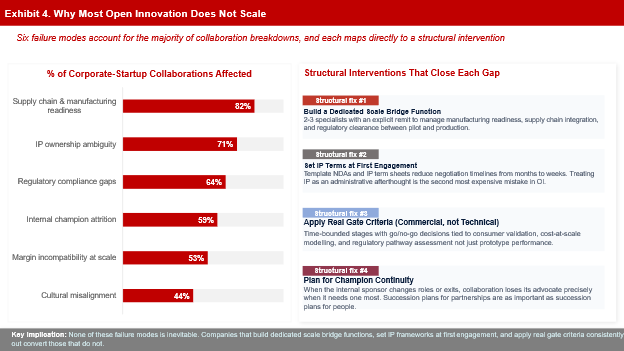
Understanding the failure modes in concrete terms helps organizations prioritize where to invest their structural attention. Research across FMCG open-innovation programs points consistently to a cluster of failure drivers that, taken together, account for the majority of collaboration breakdowns.
Supply-chain and manufacturing-readiness issues affect the largest share of corporate-startup collaborations that fail after the pilot stage. Regulatory complexity ranks second, followed by IP disputes that emerge late in the relationship, margin erosion that makes the proposition commercially unattractive at scale, and the loss of internal champions at critical junctures. Culture mismatch – the friction between a startup’s operating pace and a large company’s governance requirements – rounds out the primary failure cluster.
None of these failure modes is inevitable. Each maps directly to a structural intervention: a dedicated manufacturing-readiness function, early-stage regulatory pre-screening, IP frameworks established at first engagement, cost-at-scale modeling before pilot commitment, internal-champion continuity planning, and structured onboarding that bridges operating-culture differences. The companies that have built these interventions consistently out-convert those that have not.
Strategic Outlook
The Personal & Home Care sector is entering a period of compressed timelines and converging pressures. The sustainability transition, meaningful advances in formulation science and AI-driven product development, shifting demographics, and the premiumization of once purely functional categories are all arriving simultaneously.
P&G’s evolution from a closed invention model to one where more than half of every new product carries external contribution, alongside Unilever’s transformation into a focused HPC business built around partnership-driven innovation, points to the same structural conclusion. The most durable competitive advantage in this environment is the organizational capability to find, evaluate, integrate, and scale the best ideas wherever they originate.
The gap between collaboration and commercial impact is real, and it does not close by itself. Bridging it requires structural investment, management discipline, and a genuine commitment to treating open innovation as a long-term organizational capability rather than a series of experiments to be wound down when the next strategic priority arrives. For companies that build this capability properly, the returns compound over time and across cycles.
The question most organizations should be asking is not whether to collaborate with outside partners – that answer is settled. It is whether the organization has built the specific structural and process infrastructure that turns collaboration into commercial impact at scale. That gap remains wider than most leadership teams realize, and closing it is the defining innovation challenge for the category over the next five years.