
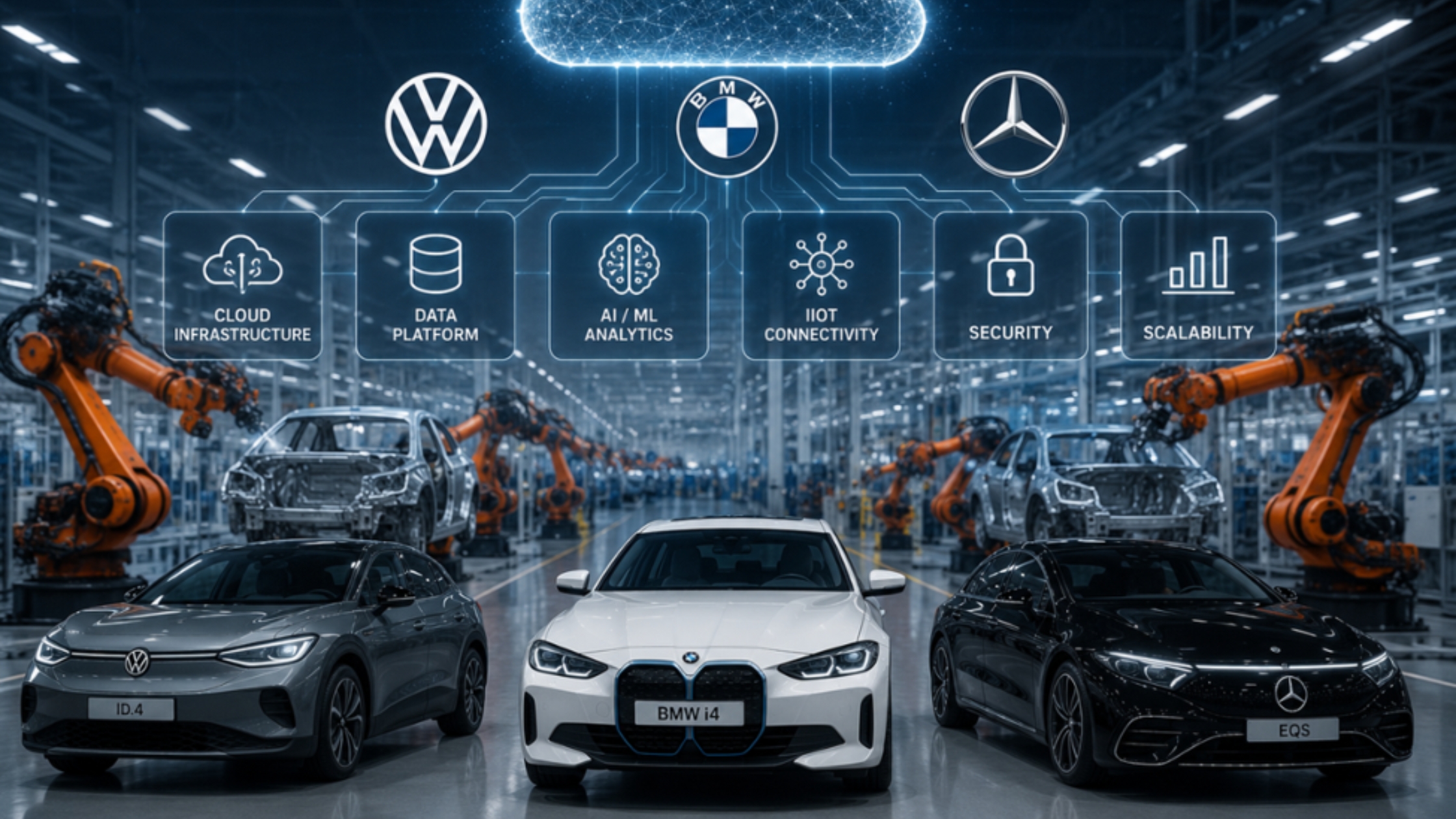
The automotive factory has always been a study in controlled complexity. Thousands of components, hundreds of suppliers, assembly lines calibrated to tolerances measured in fractions of a millimetre, and until recently, managed through a patchwork of on-premise software systems that could not speak to one another across plants, let alone across continents. What has changed in the last five years is not the scale of that complexity.
It has only grown, as platforms multiply, EV architectures introduce new supplier dependencies, and production schedules are squeezed by cost pressures on one side and customer expectations on the other. What has changed is the infrastructure available to manage it.
Cloud computing has moved from being an IT cost-efficiency play into becoming the operational backbone of automotive manufacturing and the decisions Europe’s three largest automakers have made in this space are beginning to define what a competitive factory will look like through 2030.
For CXOs, manufacturing leaders, and digital transformation executives, understanding how leading automotive OEMs are leveraging industrial cloud platforms has become critical to shaping future manufacturing strategies.
This article explores how Volkswagen, BMW, and Mercedes-Benz are transforming their manufacturing operations through cloud-enabled smart factory initiatives. It provides insights into how industrial cloud platforms address challenges such as fragmented manufacturing data, operational inefficiencies, and production complexity while enabling AI-driven decision-making, predictive maintenance, and scalable digital manufacturing.
The Industrial Cloud Imperative: Why Factories Need a Digital Nervous System
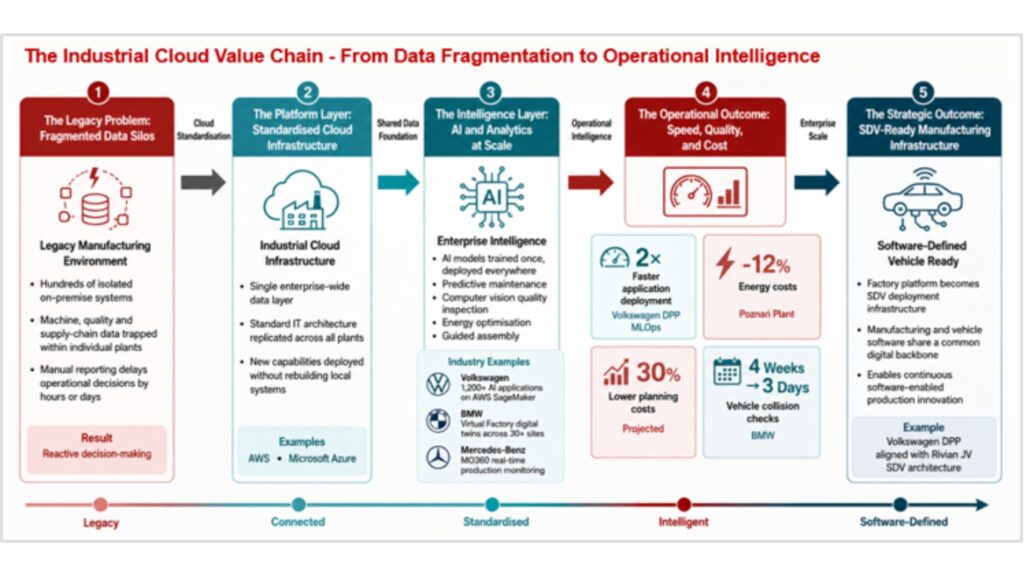
The fundamental problem that cloud addresses in manufacturing is not storage or compute, though both matter. It is fragmentation. A large automaker operating 100-plus production sites globally generates enormous volumes of machine data, quality metrics, supply chain signals, and process logs, but traditionally, that data has sat in silos within individual plants, in formats incompatible with systems at the next site.
Decisions that should be made in real time, such as rerouting production when a supplier delivers a defective batch or predicting when a machine will fail before it does, are instead made hours or days later, after manual data aggregation.
The industrial cloud solves this by creating a single, standardised data layer across the entire manufacturing network one where AI models can be trained once and deployed everywhere, and where a plant in São Paulo and a plant in Wolfsburg are drawing from the same operational intelligence.
For automakers, the stakes are direct and financial. Every unplanned minute of production downtime on a high-volume line represents significant cost. Every recall triggered by a quality issue that should have been caught earlier represents both direct cost and reputational damage. And every week shaved off a new model launch cycle represents revenue brought forward. Cloud-enabled smart manufacturing touches all three.
Volkswagen’s Digital Production Platform – The 43-Plant Nervous System
Volkswagen’s approach to this challenge is the most extensively documented in the industry and the most instructive. The company’s Digital Production Platform, developed in partnership with Amazon Web Services since 2019, now serves as what Volkswagen’s own board has described as “the digital nervous system” of its global factories.
As of August 2025, when Volkswagen and AWS announced a five-year extension of the partnership, the platform was live across 43 of Volkswagen’s 114 production sites spanning Europe, North America, and South America, with more in the rollout pipeline.
What makes the DPP consequential is not its scale alone but its architecture. Rather than simply moving data to the cloud, Volkswagen has used the platform to standardise IT systems across factories – so the same application, once validated at one plant, can be deployed across all connected sites without rebuilding it from scratch.
This standardisation is the foundation on which the company’s more than 1,200 AI applications now operate. One example is KI4UPS, an AI tool that assists assembly line teams in vehicle software deployment, identifying potential electronic issues before they create faults downstream.
Another set of AI applications handles real-time quality inspection using computer vision, trained on AWS SageMaker. At the Poznań plant in Poland, AI-driven energy optimisation has reduced electricity consumption by 12 percent and cut CO₂ emissions, a result that illustrates how the industrial cloud delivers sustainability outcomes alongside operational ones.
The financial case is also clear. Volkswagen has cited medium-term savings in the double-digit million euro range from the DPP’s standardisation and AI-driven efficiencies, with reductions in manual workload and energy costs as the primary contributors.
The 2025 partnership renewal signals that Volkswagen views the DPP not as a completed project but as the platform on which its software-defined vehicle future will be built, the same infrastructure is being positioned to support SDV software deployment directly during manufacturing.
BMW and Mercedes – Complementary Approaches to the Same Problem
While Volkswagen’s strategy centres on AWS, BMW and Mercedes-Benz have arrived at comparable outcomes through partnerships with Microsoft Azure, demonstrating that the strategic logic is durable across providers.
BMW’s Open Manufacturing Platform, developed with Microsoft Azure, is built on an open-source architecture designed to allow third-party developers and suppliers to contribute applications effectively making BMW’s factory cloud a platform ecosystem rather than a closed system.
The infrastructure powers digital twins of BMW’s assembly lines, enabling engineers to simulate process changes virtually before committing to physical reconfiguration.
BMW’s private cloud environment, built on OpenStack, handles sensitive production data locally while non-critical analytics workloads are pushed to Azure, a hybrid architecture that reflects both the data sovereignty requirements of automotive manufacturing and the scalability advantages of public cloud.
Mercedes-Benz’s MO360 Data Platform, also on Microsoft Azure, takes a somewhat different angle, with its emphasis on AI-based quality management as the primary value driver. Connected across global plants, MO360 gives Mercedes’s operations teams real-time visibility into production performance and predictive maintenance signals across the manufacturing network.
The platform forms part of Mercedes’s broader push toward what it describes as its “MO360 ecosystem”, a cloud-connected view of the entire manufacturing value chain from supplier to finished vehicle.
Comparison: Industry 4.0 Cloud Platforms of Europe’s Three Largest OEMs
The Business Case Beyond Efficiency
The strategic significance of what these three OEMs are building runs deeper than operational metrics. By creating cloud-native manufacturing platforms, they are constructing a foundation that makes future transformations the deployment of software-defined vehicles, the integration of new EV architectures, the onboarding of new suppliers faster and cheaper than they would otherwise be.
When Volkswagen launches a new model on its future electronics architecture developed jointly with Rivian, the DPP is designed to be the infrastructure through which that model’s software is deployed and managed at scale from day one of production. That changes the economics of the entire product development cycle.
There is also a competitive dimension that OEMs and investors should not overlook. The automotive industry is under sustained pressure from technology-first entrants who do not carry the legacy infrastructure burden of established manufacturers.
The industrial cloud is one of the primary mechanisms through which traditional automakers are closing that speed gap, not by becoming technology companies, but by embedding technology capability deeply enough into their manufacturing core that innovation cycles become comparable.
Future Outlook
Through 2030, according to our analysis the automotive cloud landscape identifies smart manufacturing and digital twins as a growth opportunity category in the USD 100 million to USD 500 million range over the next five years, a figure that reflects the deployment phase, not the long-term operational savings generated.
OEMs that delay integration risk not just operational inefficiency but structural disadvantage in launch timelines, quality metrics, and cost structure relative to peers who have already embedded cloud as a manufacturing standard.
Connecting to the Broader Cloud Strategy
The industrial cloud is one layer of what has become a comprehensive automotive cloud architecture, the same OEMs building smart factories are simultaneously deploying connected vehicle platforms, generative AI assistants, and software-defined update pipelines, all on cloud infrastructure.
Understanding how automakers balance public, private, and hybrid cloud deployments across these different use cases is the next question this strategy raises, and one that shapes every vendor relationship and technology investment decision an automotive enterprise makes today.
Conclusion
The smart factory is no longer a concept under development, it is operational at scale at Volkswagen, BMW, and Mercedes-Benz, and it is generating returns that show up on the balance sheet. What these deployments make plain is that cloud adoption in automotive manufacturing has moved well past the pilot stage; it is now core infrastructure, built into how these companies run their factories every day.
For OEMs that have not yet committed to this path, the window for a measured, unhurried transition is closing. The gap between those who have an industrial cloud platform running and those who do not is already a competitive variable in launch timelines, in cost structure, and in quality performance. For investors and technology partners, the direction of travel is unambiguous: manufacturing competitiveness through 2030 will be decided, in no small part, on the factory floor.