
Key Insights
- Battery storage isn’t just a backup plan anymore – it’s turned into an asset that makes utilities and industrial operators’ real money. Storage now captures value across energy, capacity, and ancillary service markets, not just reliability.
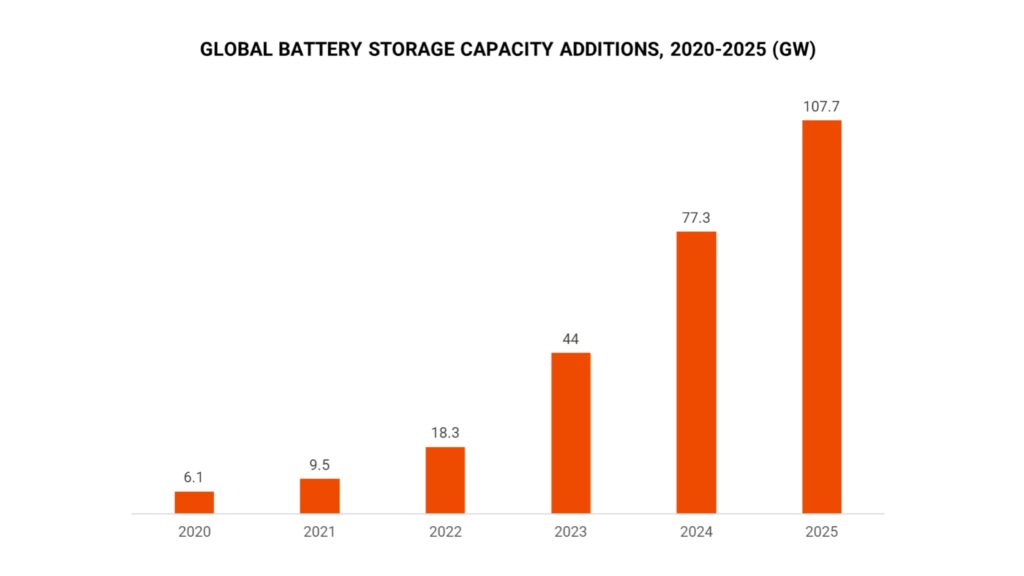
- The pace of deployment is outrunning most forecasts. More than 108 GW of battery storage came online worldwide in 2025 alone, up 40% from the year before, making it the fastest-growing power technology on the planet.
- Grid congestion, curtailed renewables, and surging demand are opening new doors. Data centers, electrification, and renewable buildout are all pushing up the value of flexible energy assets.
- The best returns come from stacking revenue streams. Projects that combine arbitrage, peak shaving, capacity payments, renewable integration, and grid services tend to outperform single-purpose deployments.
- Storage is turning into core infrastructure. Done right, it cuts costs, delays expensive grid upgrades, boosts sustainability metrics, and shores up long-term energy security.
A $5 Billion Signal the Market Can No Longer Ignore
In June 2026, NatPower and Tesla announced a partnership to install 25 GWh of battery storage across Italy and the United Kingdom, the first phase of a program that could eventually be worth $5 billion. Even more striking: the companies project these assets could bring in more than $15 billion in revenue over the next two decades.
Three dollars back for every dollar spent. That ratio goes a long way toward explaining why energy storage has stopped being a nice-to-have and started looking like a genuine investment opportunity. The conversation has shifted.
Five years ago, most people were asking whether batteries could actually support renewables. Now the question is different: how do utilities, industrial operators, and infrastructure investors squeeze the most value out of storage while keeping the grid reliable? The answer is to stop thinking of storage as a single-purpose technology and start treating it as a multi-functional business platform, one that delivers economic, operational, and sustainability payoffs all at once.
The Scale of the Opportunity Is Expanding Faster Than Most Forecasts
Battery storage is, right now, the fastest-growing segment in the entire power sector.
The International Energy Agency puts global battery storage deployment at 108 GW of new capacity in 2025, about 40% more than 2024, and eleven times what was installed in 2021. Roughly 80% of that new capacity is utility-scale.
A handful of forces are driving this growth:
- Renewable generation is expanding fast
- Transportation and industry are electrifying
- Data centers are multiplying
- Grid congestion is worsening
- Extreme weather is becoming more frequent
- Transmission infrastructure is aging
Together, these trends are widening the gap between when electricity gets generated and when people actually use it. Utilities used to close that gap by building more generation and transmission. Storage is often faster and cheaper.
The Netherlands is a good case study. Several regions have put connection moratoriums in place because grid buildout simply can’t keep pace with renewable deployment and rising demand. Some grid projects take up to 12 years to complete; batteries can go in within months. That speed is turning into one of storage’s biggest selling points.
Why Traditional ROI Calculations Undervalue Storage
The most common mistake companies make when evaluating storage is treating it like a single-benefit asset. Most capital projects earn their return through one channel. Storage earns it through several at once. Take a utility-scale battery paired with a renewable project. It can:
- Store excess solar during low-demand hours
- Sell power back during peak pricing
- Provide frequency regulation
- Support voltage management
- Cut renewable curtailment
- Participate in capacity markets
- Push back the need for transmission upgrades
- Improve grid resilience
Each of those functions adds to the bottom line on its own. The IEA has noted that battery projects are increasingly built around multiple revenue streams rather than a single use case, a sign that the market has caught on to how much better the economics get when an asset is optimized across several services at once. Developers have taken notice too: batteries are turning from cost centers into revenue-optimization platforms.
The Utility Sector’s New Financial Equation
Utilities are stuck in a tough spot. They need to bring on more renewables without sacrificing reliability or driving up customer bills. That used to mean pouring money into peaker plants, transmission expansion, and reserve capacity. Storage changes that math.
Reducing Renewable Curtailment
Solar and wind often generate the most power exactly when demand is lowest. Without storage, that extra generation just gets curtailed, wasted, essentially, and a drag on project returns. Batteries capture it and release it later when demand and prices are higher. In regions with a lot of renewables on the grid, the financial upside can be significant. Back in 2015, only about 40% of battery projects were built for energy shifting; by 2025 that figure was over 90%, a clear sign storage has become central to integrating renewables.
Deferring Infrastructure Investments
Upgrading transmission and distribution lines is expensive and slow, often tangled in permitting for years. Batteries placed strategically can ease congestion, shave peak loads, and push those costly upgrades further down the road. A storage project costing tens of millions can sometimes delay grid investments worth hundreds of millions, a serious lever for utilities working with tight capital budgets.
Improving Capacity Economics
Storage is also an alternative to building new peaker plants. Instead of constructing gas-fired capacity that only runs during a handful of peak hours a year, utilities can install batteries that discharge stored power on demand. That means better asset utilization and less exposure to fuel prices and emissions costs.
Industrial Facilities Are Discovering a Different Value Proposition
Utilities tend to think about storage in terms of grid optimization. Industrial operators think about it differently, as an operational and financial tool. Their priorities usually come down to:
- Cutting electricity bills
- Better power quality
- More resilience
- Hitting sustainability targets
- Managing demand charges
Demand Charge Reduction
Peak demand charges eat up a big chunk of many industrial electricity bills. Batteries can discharge during those peak windows, lowering measured demand and the monthly bill that comes with it. For manufacturing, mining, chemicals, and data centers, those savings can make or break a project’s economics.
Energy Price Arbitrage
Facilities in deregulated markets can buy power when it’s cheap and draw on stored energy when prices spike. And as more renewables come online, wholesale prices are getting more volatile, which only creates more opportunities for storage-driven arbitrage.
Business Continuity
A power outage often costs more than the electricity itself would ever cost. It can shut down a production line, snarl logistics, damage equipment, or ruin a batch of product. Battery storage provides instant backup power and keeps operations running. When downtime costs run into the thousands, or even millions, of dollars per hour, resilience alone can pay for the system.
Falling Costs Have Transformed the Economics
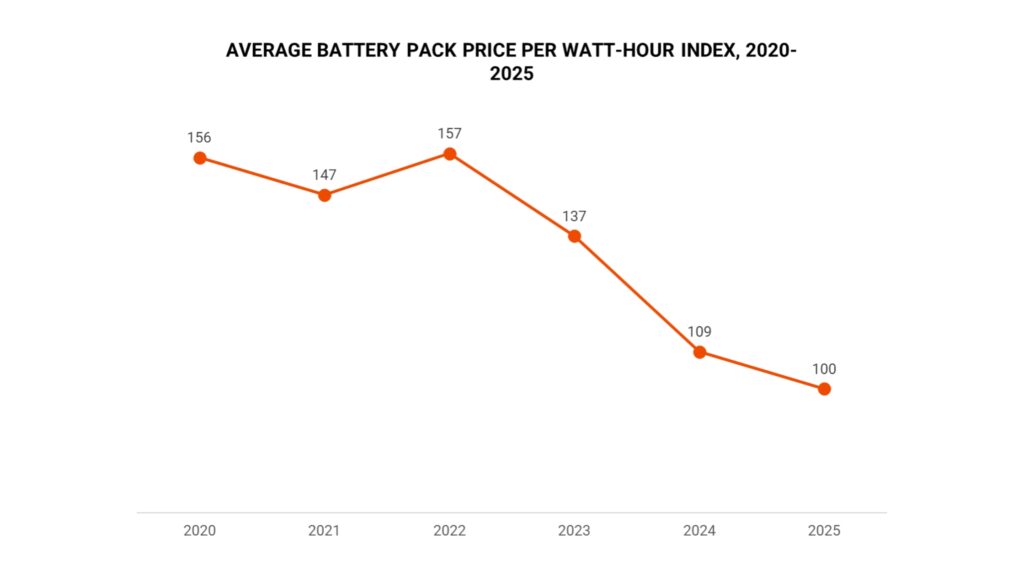
For years, the strongest case against energy storage was simply cost. That argument doesn’t hold up as well anymore. Battery prices have dropped sharply over the past decade thanks to manufacturing scale, a maturing supply chain, and better technology. Global demand for battery storage grew 43% in 2025, helped along by continued cost declines and expanding manufacturing capacity.
Meanwhile, the technology keeps getting better. Lithium iron phosphate (LFP) batteries now make up about 90% of global deployments because they’re affordable, durable, and well-suited to frequent cycling. Lazard’s research consistently shows lithium-ion remains among the cheapest storage technologies out there, and it keeps getting cheaper and more efficient. Projects that once struggled to pencil out are now delivering solid returns.
Storage Is No Longer Just About Lithium-Ion
Lithium-ion still dominates today’s deployments, but the field is widening. Other technologies gaining traction include:
- Sodium-ion batteries
- Flow batteries
- Liquid-air energy storage
- Compressed air energy storage
- Thermal storage systems
General Motors and Peak Energy, for instance, recently announced plans to manufacture sodium-ion batteries for utility and data-center use. Peak Energy says its systems could cut storage costs by roughly 20% versus lithium-ion, while also skipping certain cooling requirements. These alternatives are especially useful for long-duration storage, where lithium-ion sometimes runs into economic limits. As the market matures, expect more organizations to pick their battery chemistry based on duration, cycling needs, and operating conditions, rather than defaulting to whatever’s most familiar.