

For most of the automobile’s history, the interaction between driver and vehicle was mechanical, then electronic, and then beginning with first-generation voice assistants tentatively conversational. What those early systems could not do was truly understand.
They responded to commands, not conversations. They could tell you the nearest petrol station but could not engage with the question behind the question. The arrival of large language models has changed this fundamentally, and the automotive industry is now in the middle of a rapid and consequential deployment of cloud-hosted generative AI into the vehicle cockpit.
The technology is not speculative. It is already in series production vehicles reaching millions of customers, and it is reshaping how automakers think about the relationship between the car, the customer, and the cloud.
For automotive CXOs, digital transformation leaders, product strategists, and technology decision-makers, understanding how cloud-hosted generative AI is reshaping the in-vehicle experience has become increasingly important as software emerges as a key source of competitive differentiation.
This article examines how leading automakers are integrating cloud-based large language models (LLMs) into production vehicles, the cloud architectures enabling these deployments, and the strategic value they create for both customers and OEMs.
It also explores the opportunities and operational challenges associated with deploying conversational AI at scale, providing insights into how cloud-hosted LLMs are redefining the future of connected and software-defined vehicles.
Why In-Car AI Requires the Cloud to Work at Scale
The most important thing to understand about generative AI in the vehicle is where the computation actually happens. An LLM of the kind that powers meaningful conversational AI GPT-4, Gemini, and comparable models requires computing resources that no vehicle’s onboard hardware can realistically provide.
These models run on specialised GPU clusters in data centres. The vehicle itself is an endpoint: it captures the voice input, transmits it to the cloud via a secure API, receives the response, and renders it to the driver. The quality and naturalness of the conversation is a cloud capability, not a hardware capability.
This architecture has profound implications. It means that improvements to the AI model, better reasoning, more up-to-date knowledge, richer contextual understanding can be deployed to existing vehicles through a software update, without any change to the car’s hardware.
A vehicle sold today can have a substantially more capable AI assistant in two years simply because the cloud-side model has been improved. It also means that the economics of deployment are fundamentally different from those of traditional embedded software: the cost of running an LLM scales with usage, not with the number of vehicles, which creates both opportunities and challenges for OEM business models.
The dependence on connectivity is a real operational constraint, the system requires a reliable data connection to function. But as 5G network coverage expands in major markets and embedded connectivity becomes standard in new vehicles, this constraint is diminishing rather than growing.
Mercedes-Benz and Azure OpenAI – A Production-Grade Case Study
The most thoroughly documented deployment of generative AI in production vehicles belongs to Mercedes-Benz, and it deserves detailed examination because it establishes the architectural model that other OEMs are now referencing.
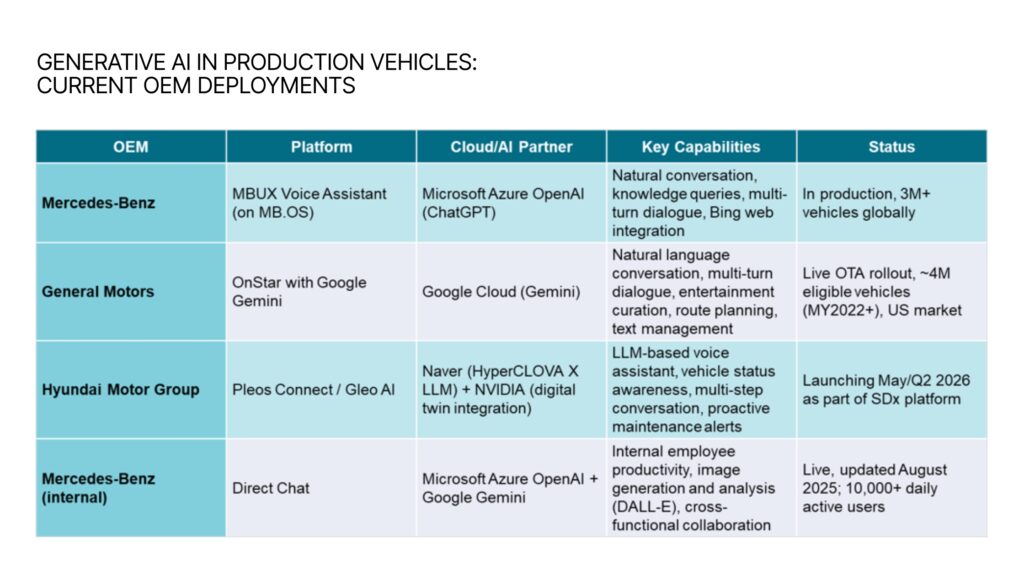
In June 2023, Mercedes-Benz launched a beta programme in the United States that made ChatGPT available through its MBUX Voice Assistant – the “Hey Mercedes” system – in over 900,000 vehicles equipped with its infotainment system. The programme worked as follows: a driver activates the assistant by voice, the input is processed through the vehicle’s existing MBUX system, transmitted to Microsoft Azure via a secured API, handled by the Azure OpenAI Service hosting OpenAI’s GPT models, and the response is returned and rendered in natural speech.
What made this deployment significant was not the novelty of the use case but the scale at which it was validated and then deployed to production. Mercedes subsequently extended the ChatGPT AI knowledge feature to over three million vehicles globally as a free over-the-air update to first, second, and third generation MBUX vehicles, making it one of the largest single deployments of a generative AI capability to consumer hardware in any industry.
The technical architecture, as described by Microsoft Azure, relies on Azure OpenAI Service as the core inference engine, Azure Kubernetes Service for managing the back-end logic connecting MB.OS to the Azure APIs, Azure API Management for controlling the communication pipeline, and Azure Virtual Network ensuring data transmission through a private rather than public internet pathway.
The governance choices are instructive. Mercedes retains full control over IT processes; voice command data is stored in the Mercedes-Benz Intelligent Cloud, anonymised, and analysed before any model usage.
The company implemented a risk assessment layer to evaluate system responses and reduce the possibility of harmful outputs, reflecting the reality that deploying a general-purpose LLM in a regulated, safety-adjacent product context requires careful content governance. As of August 2025,
Mercedes has also integrated Google Gemini alongside Azure OpenAI in its internal AI tooling, suggesting a multi-model strategy is emerging even within the generative AI domain.
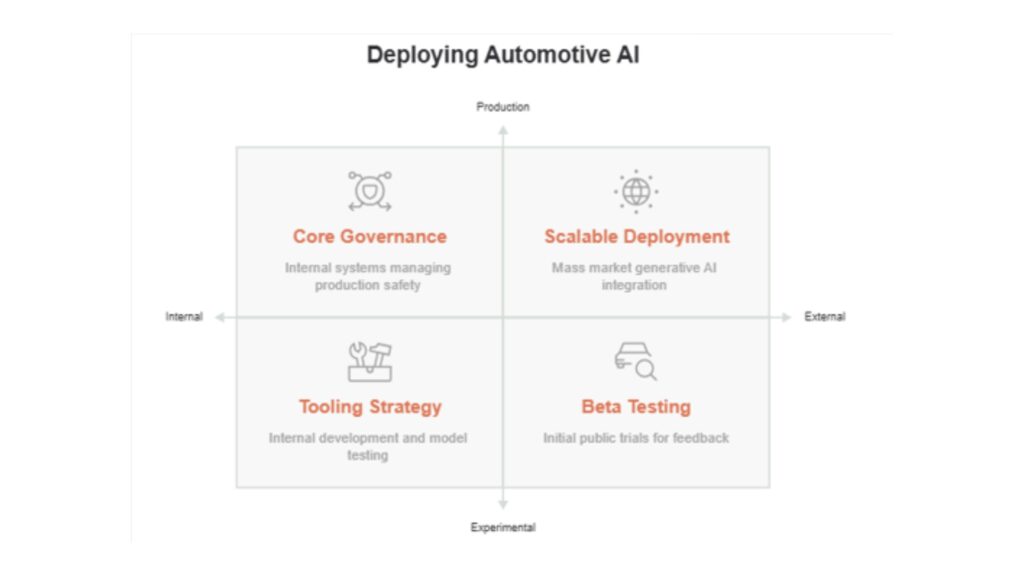
The Broader Wave: GM, Hyundai, and the Architecture of the AI Cockpit
Mercedes is not alone. General Motors is developing its GM Digital Assistant through Microsoft Azure OpenAI, designed to respond to driver queries about vehicle functions, schedule service appointments, and navigate complex interactions using natural language rather than command-and-response patterns.
This is qualitatively different from earlier GM voice technologies: it understands intent and context rather than matching utterances to a lookup table of commands. Hyundai is pursuing a similar path through Google Cloud Vertex AI for its Connected Customer Assistant, integrating generative AI with vehicle status and telematics data to create a voice assistant that is aware of the specific vehicle’s current condition, its charge level, maintenance status, upcoming service intervals when responding to customer queries.
Generative AI in Production Vehicles: Current OEM Deployments
What This Means for the In-Vehicle Experience
The practical consequence for drivers is a shift from transactional to conversational interaction with their vehicle. Where an earlier voice system required a driver to know the specific command syntax “Navigate to nearest charging station”, a generative AI assistant can handle “I’m running low and need to charge before my 3 PM meeting; what are my options?” and reason through the answer. The system can follow up, ask clarifying questions, and maintain context across a multi-turn exchange in the same way a knowledgeable human assistant would.
For OEMs, this creates a new dimension of differentiation. The quality of the AI interaction is now a product attribute in the same category as ride quality or interior refinement, a variable that influences purchase decisions and brand perception. It also opens revenue possibilities: AI-powered features can be offered as premium subscriptions, and the assistant can serve as a discovery and purchase interface for additional vehicle capabilities and third-party services.
The Risks Automakers Cannot Afford to Ignore
Three risk categories deserve serious attention from OEMs deploying cloud-based generative AI. The first is connectivity dependency: an AI assistant that becomes unavailable in areas with poor network coverage degrades the user experience in precisely the moments long journeys, unfamiliar routes, when it is most needed.
The second is data governance: voice interactions in a vehicle contain sensitive information about location, habits, and preferences, and the legal frameworks governing this data – GDPR in Europe, and analogous regulations in other markets impose strict requirements on how it is stored, used, and shared.
The third is output quality: LLMs can and do produce incorrect or misleading responses, and in a vehicle context where a driver may act on that information while operating a vehicle, the tolerance for error is lower than in a desktop application.
Future Outlook
The trajectory of generative AI in automotive points toward deeper integration rather than consolidation at the current level. As models improve, latency decreases, and 5G connectivity expands, the limitations of the current architecture will diminish.
The more consequential question for the medium term is how automakers monetise the AI layer whether through subscription models, data partnerships with third-party services, or as a differentiator embedded in the base vehicle price.
OEMs that are already operating at production scale with cloud-hosted LLMs in millions of vehicles are accumulating interaction data that will compound their advantage in training and refining vehicle-specific AI models over time.
Connecting to the Broader Cloud Architecture
The generative AI use case sits on top of the same cloud infrastructure that handles connected vehicle services, OTA updates, and telematics analytics. The choice of Azure versus Google Cloud versus AWS for in-vehicle AI is not made independently,
It reflects the broader CSP relationship each OEM has developed, and in many cases, the same cloud partnership that handles manufacturing or connected vehicle services is also the pathway through which AI capabilities are deployed.
This is why understanding OEM multi-cloud strategy is essential context for evaluating any individual AI deployment in this sector.
Conclusion
The cloud-hosted LLM in the vehicle cockpit is no longer a concept demonstration, it is a production reality at scale, already reaching millions of customers through Mercedes-Benz, and being built toward deployment by GM and Hyundai among others.
What the automotive industry is constructing, sometimes without framing it in these terms, is an AI-native vehicle platform where the car is continuously connected to intelligence hosted in the cloud and capable of improving over time.
For technology investors, cloud service providers, and automotive strategists, this is among the highest-value applications in the automotive cloud ecosystem because it sits at the intersection of the vehicle as a product and the vehicle as a data-generating, service-delivering platform.