
India’s Industrial IoT market is entering a scale-up phase, with adoption shifting from pilot projects to enterprise-wide deployments. Utilities, manufacturing, and metals are emerging as the leading adopters as connected technologies to deliver measurable improvements in productivity, asset reliability, energy efficiency, and safety.
Key Takeaways
- Utilities are scaling rapidly. Under RDSS, 20.33 crore smart meters had been sanctioned by July 2025, while 5.28 crore smart meters had been installed nationwide (across all schemes) as of 31 December 2025, reflecting accelerating deployment
- Manufacturing is leading in enterprise commitment. Indian manufacturers spent an estimated US$5.5–6.5 billion on Industry 4.0 in FY21, and more than two-thirds of the sector was expected to embrace Industry 4.0 by 2025.
- Metals and mining are proving the ROI case. JSW Steel says more than 13,500 sensors and an AI-led predictive maintenance platform helped avoid 25,000 hours of unplanned downtime; Tata Steel reports 588 AI models and 11.2 petabytes of curated data across operations.
- Logistics is improving, but adoption is concentrated. Delhivery operates 45 automated sortation centres with 8.2 million shipments per day of rated automated capacity, while the broader logistics market remains fragmented, with organized players only 5.5–6% of segments in FY22.
As of 15 January 2026, India had installed 5.44 crore smart meters, including 4.05 crore under the Revamped Distribution Sector Scheme (RDSS) including 4.05 crore under the Revamped Distribution Sector Scheme (RDSS). That is not just a utility statistic. It is the clearest sign that industrial IoT in India is no longer a pilot story.
It is moving into live infrastructure, live factories, and live logistics networks. The fastest adoption is happening where asset intensity is high, operating losses are measurable, and management can tie connected devices directly to uptime, billing accuracy, safety, or energy efficiency. On that test, three groups are out in front: power utilities by scale, manufacturing by spend and breadth, and metals/mining by operational depth. Organized logistics is advancing too, but more unevenly.
Industrial IoT adoption is scaling fastest where operational ROI is easiest to measure
|
Sector |
Why adoption is moving fast |
Most concrete evidence |
What still slows scale |
|
Power utilities |
Mass national rollout; clear billing and loss-reduction use case; policy-backed procurement |
20.33 crore smart meters sanctioned under RDSS (July 2025); 5.44 crore smart meters installed across all government schemes, including 4.05 crore under RDSS (15 Jan 2026). |
Execution quality, system integration, consumer engagement, DISCOM finances |
|
Discrete manufacturing and process manufacturing |
Direct link to throughput, quality, energy, and maintenance outcomes |
Estimated FY21 Industry 4.0 investment of US$5.5–6.5 billion; ~75% of investment concentrated in automotive, electrical equipment and electronics; chemicals and pharmaceuticals leading process manufacturing. |
MSME financing limits, leadership bandwidth, proof-of-concept to production gap |
|
Metals and mining |
High downtime cost, hazardous environments, large assets, and strong remote-operations logic |
JSW Steel deployed 13,500+ sensors and reported 25,000 hours of avoided unplanned downtime; Tata Steel operates 588 AI models and remote operation centres; Ministry of Coal showcased 13 mining 5G use cases. |
Legacy equipment integration, cyber resilience, site connectivity, skills |
|
Organized logistics |
Automation economics work at scale in hubs, gateways, and high-density networks |
Delhivery operates 45 automated sortation centres with 8.2 million shipments/day of rated automated capacity. |
Sector fragmentation, road dependence, regulatory complexity, uneven digital maturity |
The most material development is in utilities, not on factory floors
The fastest adoption by sheer device count is in power distribution. Under the Revamped Distribution Sector Scheme (RDSS), 20.33 crore smart meters had been sanctioned across 28 states and union territories by 24 July 2025. By 15 January 2026, India had installed 5.44 crore smart meters across government schemes, including 4.05 crore under RDSS.
For investors, this matters because utility IoT is one of the few Indian digital infrastructure segments where supportive national policy, large-scale procurement, and clearly measurable operational challenges align. Smart meters help reduce estimated billing, automate meter reading and data collection, improve billing efficiency, and support theft detection.
The same July 2025 Ministry of Power release reported that national Aggregate Technical and Commercial (AT&C) losses declined from 21.91% in FY21 to 16.12% in FY24, alongside broader power sector reforms. While this does not establish that smart meters alone drove the improvement, it illustrates why distribution utilities continue to invest in connected infrastructure at scale.
Metals and mining are where the operational depth is becoming unmistakable
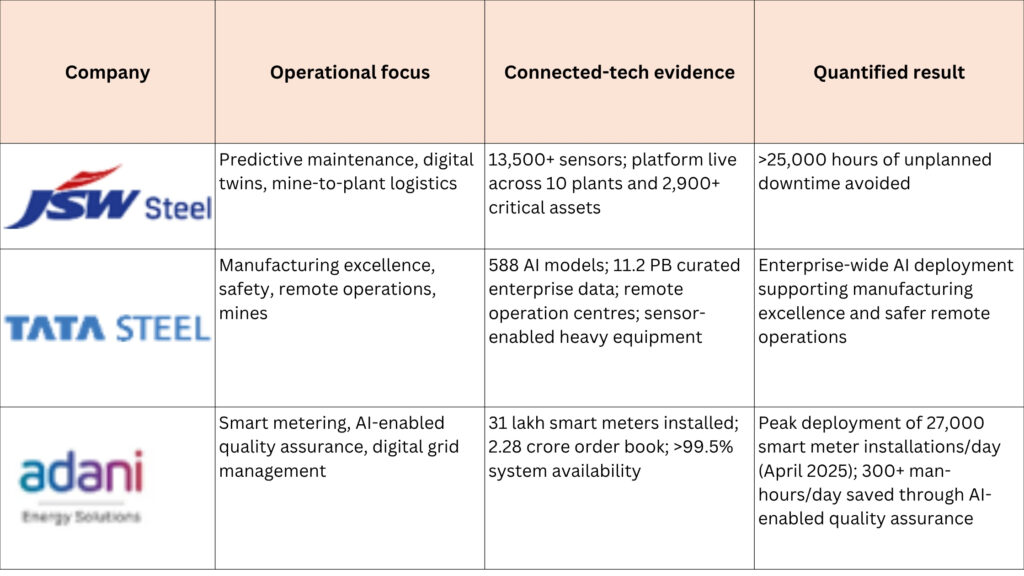
The strongest evidence of industrial IoT value in India may now be coming from the metals and mining sector rather than from broad manufacturing adoption surveys. JSW Steel reports that its predictive maintenance platform is deployed across 10 plants and more than 2,900 critical assets.
The company also reports more than 13,500 manufacturing sensors, over 25,000 hours of unplanned downtime avoided, and up to 12% downtime reduction through digital twin deployments. Tata Steel reports 11.2 petabytes of curated enterprise data, 588 AI models around 75% focused on manufacturing excellence and remote operation centres that reduce worker exposure in hazardous environments.
The company also highlights sensor-enabled heavy earth-moving machinery, smart bolts for continuous wear monitoring, and remote operation of raw-material stacker-cum-reclaimers. Mining is following a similar trajectory.
In October 2024, the Ministry of Coal showcased 13 digital mining use cases, including 5G-enabled IoT environmental and equipment sensors, automated drilling, and a digital twin of load-haul-dump operations, building on India’s first private 5G network in a coal mine. Collectively, these deployments extend well beyond proof-of-concept projects and are embedded in core operational processes such as asset uptime, worker safety, and production planning.
Logistics is improving fast inside large platforms, but not yet across the market
Logistics deserves attention, but with restraint. In organized networks, the economics of automation are already visible. Delhivery says it operated 45 fully and semi-automated sortation centres and 111 gateways as of 31 March 2025, with rated automated sort capacity of 8.2 million shipments per day.
Its systems include machine-vision-guided truck loading, real-time driver tracking, route optimization, static and dynamic profilers, and pilots involving autonomous mobile robots and drones.
Yet this is still a pocket of adoption, not a sector-wide verdict. IBEF notes that organized players represented only 5.5–6% of logistics market segments in FY22, while 66% of cargo movement in ton-kilometres still depended on road transport.
That combination matters. Fragmented ownership, uneven fleet quality, and regulatory complexity make it harder to deploy common IIoT standards across India’s full logistics stack. Large platforms can automate. The long tail still struggles to standardize.
India utility IoT is scaling first through smart metering
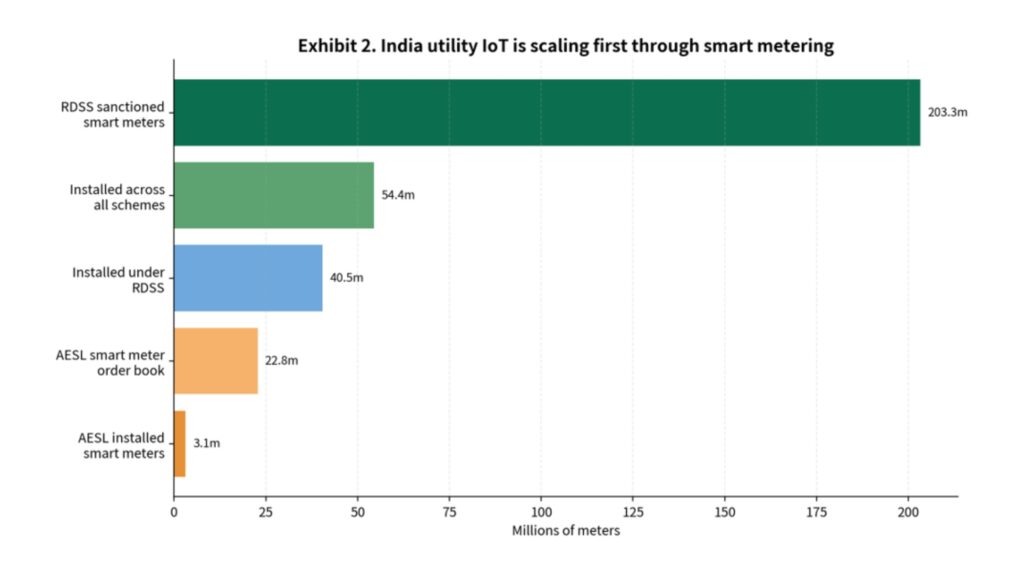
Figures shown in millions of meters. “Installed across all schemes” and “Installed under RDSS” are official as of 15 January 2026.
Company evidence that adoption is now tied to measurable operating outcomes
Strategic Implications for Investors and Industry Leaders
Industrial IoT in India is moving beyond pilot projects to enterprise-scale deployment, with adoption accelerating fastest in sectors where the business case is clear and measurable.
Utilities, metals and mining, and large manufacturers are leading adoption because connected technologies deliver tangible improvements in billing efficiency, asset uptime, predictive maintenance, energy management, and worker safety.
As deployments mature, competitive advantage will increasingly depend on integrating sensors, AI, and analytics into core operations rather than simply expanding the installed base of connected devices.
For investors, the opportunity extends beyond hardware manufacturers to the broader Industrial IoT ecosystem, including smart metering, industrial automation, AI platforms, connectivity, cybersecurity, and system integration.
Companies that can demonstrate measurable operational outcomes, build recurring digital revenue streams, and execute large-scale deployments are likely to be best positioned to benefit as India’s industrial digitalization accelerates.