
Part one of this series looked at why offshore wind keeps attracting serious investment despite costing roughly three times as much to build as onshore wind, per kilowatt.
The short answer was output and location value: offshore turbines run more hours in the year and tend to sit closer to high demand coastal markets.
This second part looks at what actually decides whether a wind project gets delivered on time and on budget in the first place, which comes down more to financing structure, risk management and plain execution than to the turbine technology itself.
Money costs more for offshore wind
Wind projects are mostly funded through a mix of equity and long term debt, with debt typically covering 60 to 80 per cent of total project cost depending on the market. Lenders price that debt against how predictable the future cash flow looks, and predictability is exactly where onshore and offshore wind part ways.
Onshore projects are usually smaller, faster to build, with construction periods that rarely run past three years, and faster to reach commercial operation, so debt gets repaid sooner and the project carries less exposure to interest rate movements along the way.
Offshore projects take longer to build and carry far higher capital costs, so every additional year before first power adds to the financing bill. A rise in the cost of capital therefore hurts an offshore project’s economics by a noticeably larger margin than it hurts an onshore one,
Which is a major reason governments across Europe and parts of Asia have leaned on revenue stabilising tools such as Contracts for Difference to keep offshore projects bankable in the first place.
Auctions have had to change as well. Early renewable auctions in most markets simply rewarded the lowest bid, which pushed some developers into prices that could not survive the inflation and supply chain shocks of 2021 to 2023.
The United Kingdom’s fifth offshore auction round in 2023 famously drew no bids at all, because the price cap on offer no longer matched real world costs, and several other offshore awards across Northern Europe and the United States needed renegotiation around the same period.
Auction design has since shifted toward rewarding actual delivery rather than the lowest headline price, with inflation linked pricing, local content requirements and grid readiness criteria now common features, even where that means paying somewhat more for capacity that genuinely gets built.
Transmission is the quiet constraint
Getting electricity off a wind farm and onto the grid is its own challenge, and a different one for each technology. Onshore wind often runs into trouble where the best wind sites sit far from demand centres and grid build out has not kept pace, a problem visible today in western China, the US Midwest, Australia, Brazil and parts of India, where curtailment is becoming routine in places.
Offshore wind has to build its own path to shore before a single unit reaches the mainland grid: export cables, an offshore substation and a converter station all have to be in place first, and this work alone makes up a meaningful share of total offshore project cost.
It is one reason the Netherlands, Denmark, Germany and the UK have moved toward centrally planned offshore grids instead of letting every wind farm build its own private connection, an approach likely to be copied elsewhere as gigawatt scale offshore projects multiply through the 2030s.
Risk, in plain terms
Onshore and offshore wind do not really share the same risk profile, even where they share an investment objective. Onshore projects are technically straightforward by now, after three decades of practice,
But they run into land acquisition disputes, community pushback, environmental permitting and grid bottlenecks that can stretch out an otherwise simple build well beyond plan. None of these risks are unfamiliar to an experienced developer, yet together they explain why even a routine onshore project can take years longer to reach financial close than its engineering would suggest.
Offshore projects face close to the opposite problem. The financing and policy environment around them has matured a great deal, but the engineering has not gotten any easier.
Heavy lift vessels remain in short supply, weather windows are unforgiving, and a delay in laying cable or installing a single foundation can push commercial operations back by months, with real cost consequences given how rate sensitive these projects already are.
Turbines are also getting larger, with commercial offshore units now well past 15 MW, which cuts down the number of foundations needed per gigawatt but adds its own transport and component replacement challenges.
Two projects worth knowing
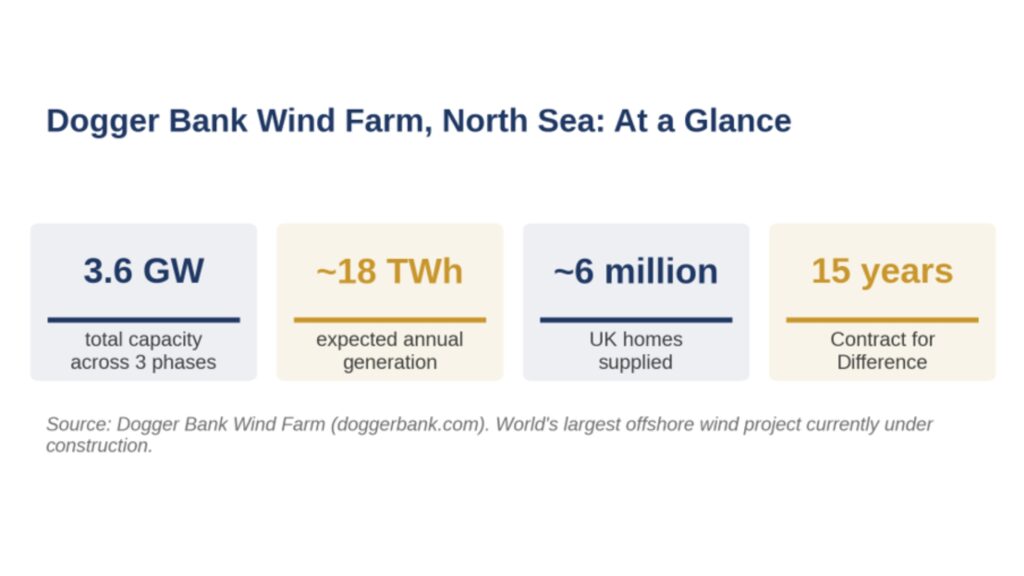
Dogger Bank, off the Yorkshire coast in the North Sea, is the clearest example of offshore wind built at real scale. Across its three phases it is set to deliver 3.6 GW of capacity and an estimated 18 TWh of generation a year, enough for around six million UK homes, making it the largest offshore wind project currently under construction anywhere in the world.
Its first phase is fully installed and the remaining phases are on track for full commercial operation later this year, backed by a 15 year Contract for Difference that locked in revenue certainty long before construction even began, which is exactly the kind of structure described above
China tells the onshore story just as clearly. The country has built such scale in turbine manufacturing and project delivery that it now accounts for roughly two thirds of the world’s new onshore wind capacity each year,
And its domestic supply chain has pulled equipment costs down for buyers of Chinese made turbines well beyond its own borders. It is a reminder that, on the onshore side at least, the biggest lever left to pull is not new technology but scale and execution.
Why this matters beyond electricity bills
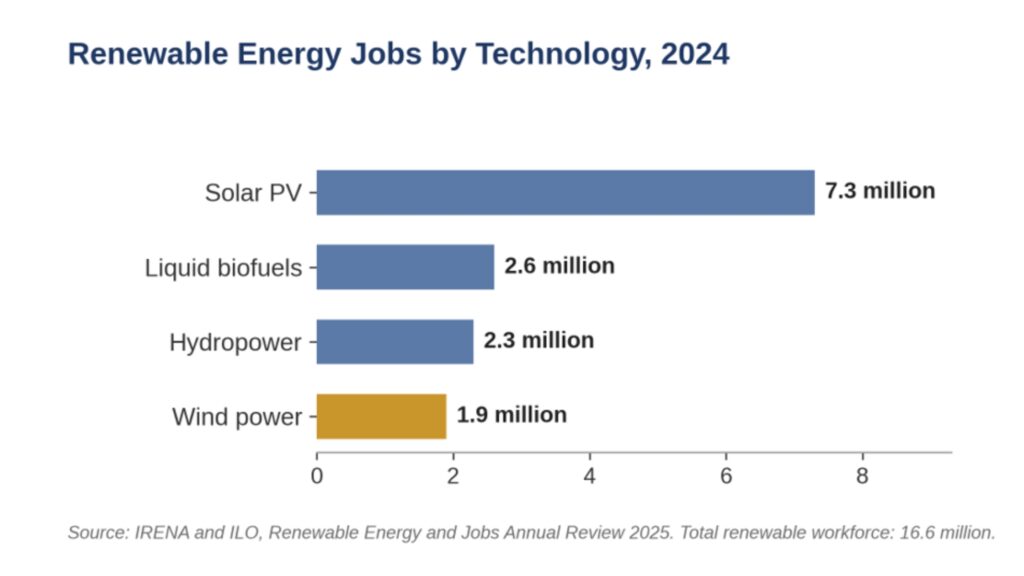
There is more to wind power than the electricity it generates. Renewable energy as a whole employed an estimated 16.6 million people worldwide in 2024, of which wind power alone accounted for close to 1.9 million jobs, according to the latest IRENA and ILO review of the sector, with India’s renewable workforce now at around 1.3 million.
Offshore wind in particular has built entire port, manufacturing and vessel ecosystems in the UK, Denmark, Germany, the Netherlands and China, while onshore wind continues to support landowner income, local tax revenue and rural employment in countries that have the open space to build it.
The practical takeaway
Offshore and onshore wind are not really competing for the same job, and treating them as rivals misses the point. Onshore wind will remain the cheaper, faster way to add bulk renewable capacity almost everywhere land allows it, India included. Offshore wind will keep commanding a premium in coastal markets where demand is concentrated, land is scarce and a steadier output is worth paying extra for. For developers, utilities and policymakers working through their own pipelines, the more useful question is no longer which technology wins. It is what mix of the two actually serves a given grid, a question that only gets more important as both technologies keep expanding through the next decade.
Sources: Global Wind Energy Council | IRENA / ILO | UK Dept for Energy Security & Net Zero | Dogger Bank Wind Farm