
Ninety-seven percent. That is the share of the general US population carrying detectable PFAS compounds in their bloodstream, according to the U.S. National Biomonitoring Program. Globally, a similar saturation picture applies to bisphenol A, chlorinated paraffins, and methylene chloride. Regulators have taken notice. In the eighteen months through June 2026, four major jurisdictions adopted legally binding phase-out measures that together affect well over 50 product categories and hundreds of supply chains. The window for preparing substitutes is narrowing fast.
This article maps the six chemical families that regulators are closest to eliminating, identifies the enforcement dates that should anchor corporate planning calendars, and translates the regulatory posture into operational and strategic priorities.
The acceleration of chemical regulation
Chemical governance has historically moved at the pace of scientific consensus formation. That pace has shifted. Three concurrent forces drive the current acceleration: faster molecular hazard profiling enabled by computational toxicology; a sharpened political appetite for the precautionary principle in the EU, China, and parts of the US federal apparatus; and the growing legal weight of international conventions, principally the Stockholm Convention on Persistent Organic Pollutants (POPs), whose Conference of the Parties (COP-12) in May 2025 added three new chemical groups to its elimination annexes in a single session.
The result is a calendar-driven compliance environment. Unlike previous regulatory cycles that allowed years of consultation before enforcement, several of the deadlines discussed below are already in effect or will trigger within 36 months. Companies still formulating products with these substances, sourcing intermediates that contain them, or exporting to regulated markets face market exclusion, not merely fines.
PFAS: the broadest restriction ever proposed under REACH
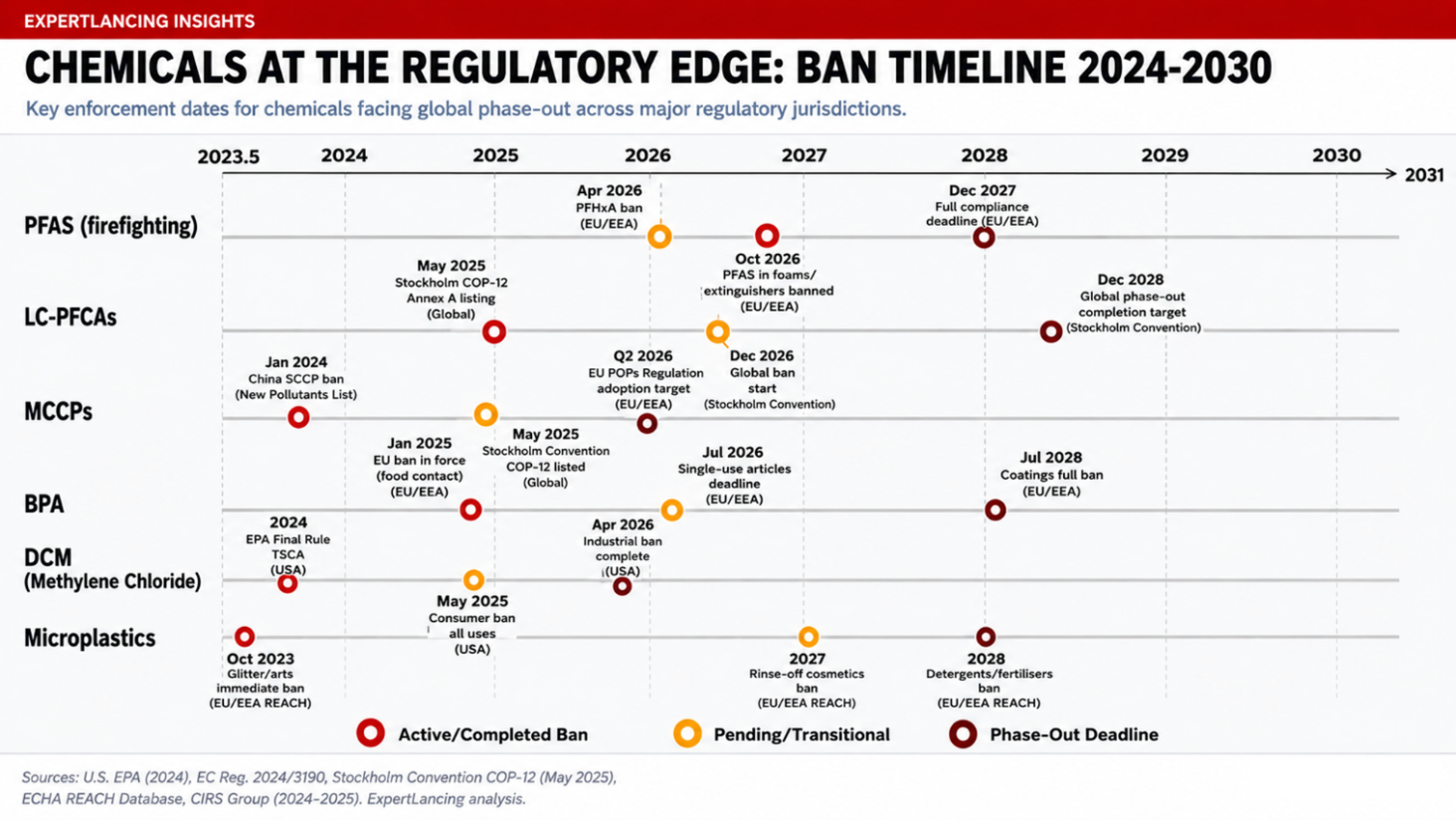
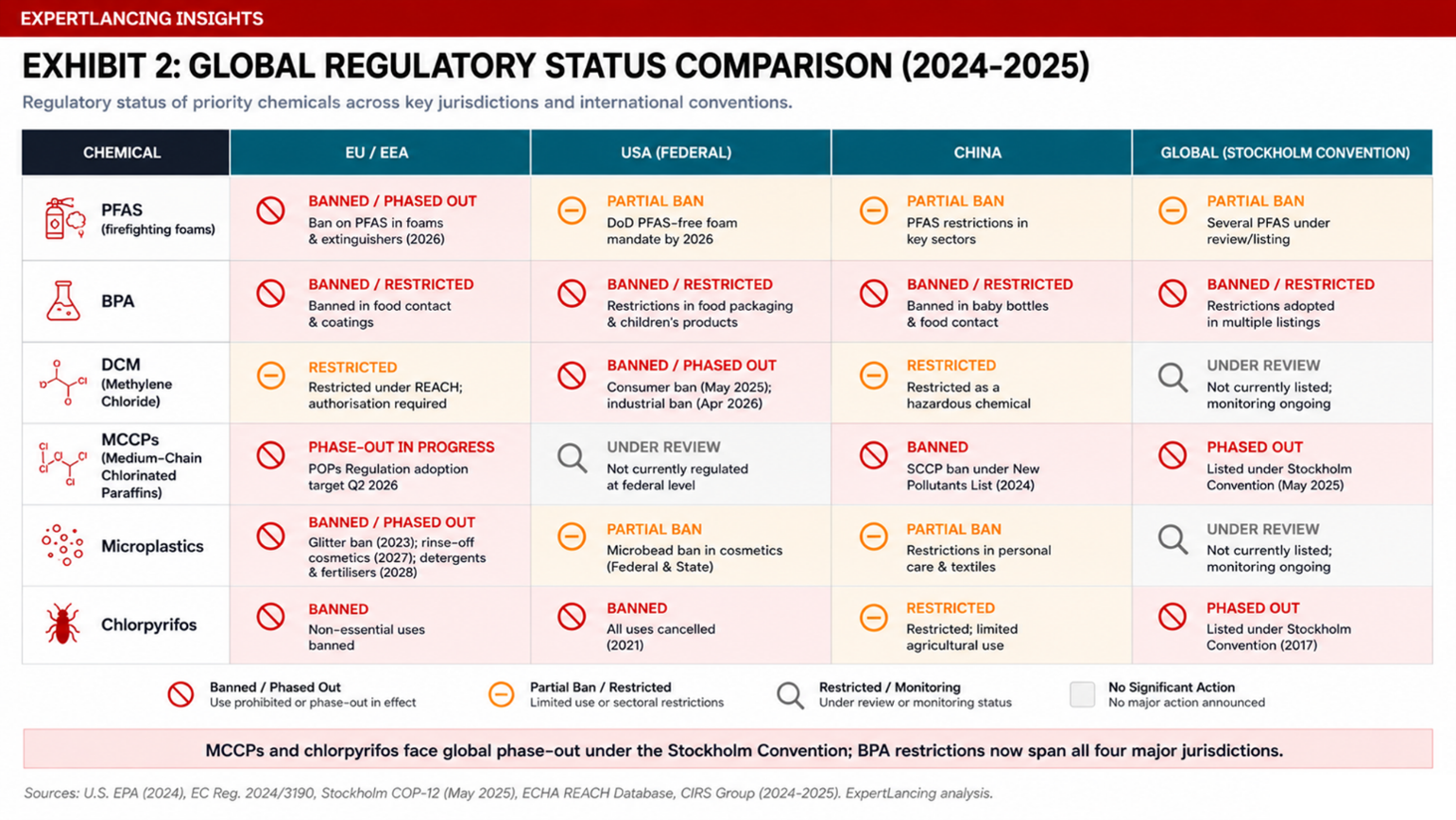
Per- and polyfluoroalkyl substances are collectively the largest chemical family under active global restriction. The European Chemicals Agency announced in August 2025 a revised, narrowed PFAS restriction proposal under REACH, targeting the most mobile and persistent subgroups, with ECHA’s scientific evaluation expected to conclude by end 2026. The enforcement timeline is already biting in segments: undecafluorohexanoic acid (PFHxA) faced EU/EEA restrictions from April 2026; PFAS in portable fire extinguishers are banned from October 2026 under a measure the European Commission adopted in October 2025; and long-chain perfluorocarboxylic acids (LC-PFCAs) were listed in the Stockholm Convention’s Annex A at COP-12 in May 2025, with global ban applicability from December 2026.
At the US federal level, the EPA in April 2024 designated PFOA and PFOS as Hazardous Substances under CERCLA, creating significant site-liability exposure. In May 2025, the agency confirmed PFOA/PFOS drinking-water Maximum Contaminant Levels while extending the utility compliance window to 2031. For manufacturers, the operative risk is not a single prohibition but a mosaic of use-specific, jurisdiction-specific deadlines that together leave diminishing space for PFAS-dependent formulations in consumer and semi-durable goods.
Bisphenol A: a food-contact ban already in force
Bisphenol A entered a new regulatory phase on 20 January 2025, when Commission Regulation (EU) 2024/3190 took effect, prohibiting BPA and its salts in food contact materials including plastics, coatings, inks, and adhesives. The European Food Safety Authority’s April 2023 opinion, which concluded that BPA poses health risks to consumers across all age groups through endocrine disruption, provided the scientific underpinning. Global BPA production is estimated at approximately 10 million metric tons per year, making this one of the highest-volume chemical restrictions in EU history.
Transition periods extend to July 2026 for single-use articles and July 2028 for coatings on packaging for fruit, vegetables, and processed fish. Companies that have not begun reformulation face the certainty of market exclusion, not a negotiable exemption window.
MCCPs and methylene chloride: industrial workhorses losing their licenses
Medium-chain chlorinated paraffins (MCCPs, carbon chain C14-C17), used widely as flame retardants and plasticisers in flooring, kitchenware, cables, and metalworking fluids, were listed in Annex A of the Stockholm Convention at COP-12 in May 2025. The listing followed a problematic regulatory pattern: short-chain chlorinated paraffins (SCCPs) were banned earlier, and MCCPs became their substitute, only to demonstrate the same persistence, bioaccumulative, and toxic (PBT) properties. The EU Commission initiated adoption procedures targeting Q2 2026 to incorporate MCCPs into the EU POPs Regulation. China banned SCCPs outright from 1 January 2024, the first substance eliminated under its New Pollutants Priority Management List.
Methylene chloride (dichloromethane, DCM) illustrates a parallel trajectory in the United States. The EPA’s May 2024 final rule under TSCA banned all consumer uses and the vast majority of industrial applications. Key milestones already passed: the consumer ban fully took effect May 2025; the industrial and commercial use prohibition deadline is April 28, 2026. Thirteen narrow exemptions remain, including production of the HFC-32 refrigerant and lithium-ion battery separator manufacturing. Industries relying on DCM as a paint stripper, degreaser, or pharmaceutical synthesis solvent must substitute or cease operations in regulated markets. The Federal Register compliance guide offers detailed workplace transition requirements for permitted uses.
Microplastics: a phased elimination across consumer sectors
The EU’s Regulation (EU) 2023/2055, which added Entry 78 to REACH Annex XVII, prohibits the placing on market of intentionally added synthetic polymer microparticles (SPM) in mixtures. The regulation is the largest single restriction ever adopted under REACH by affected product scope. An immediate ban on loose plastic glitter and non-essential dispersive uses took effect October 2023. Rinse-off cosmetics must comply by 2027; detergents and fertilisers by 2028; extended-release fertilisers by 2035. As of October 2025, mandatory product information obligations activated for industrial suppliers. Annual reporting to ECHA through REACH-IT and IUCLID commenced from May 2026 for manufacturers of pellets, flakes, and powders used in plastic production.
The regulation targets what it calls the “Zero Pollution Action Plan” objective of reducing microplastic emissions by 30 percent by 2030. For cosmetics, cleaning products, and agricultural chemical manufacturers exporting to Europe, formulation reformulation is not a future consideration but an active compliance obligation whose sector-specific deadlines are fixed by law.
Strategic implications: three actions before the deadlines close
The chemicals described above are not marginal specialty inputs. PFAS appear in food packaging, outdoor textiles, semiconductor manufacturing, and firefighting equipment. BPA is in can coatings and reusable plastics. MCCPs permeate conveyor systems, flooring, and cable sheathing. DCM underpins pharmaceutical and aerospace maintenance operations. Microplastics are embedded in personal care product formulations globally. The breadth of exposure means that chemical ban calendars are now material risks that warrant board-level attention in any company with a physical product or complex supply chain.
Three strategic priorities follow from the pattern above.
Action: Conduct an end-to-end substances inventory across direct materials and Tier 1 to 3 suppliers, mapped against the ban deadlines in Exhibit 1.
Rationale: Several of the deadlines above apply not just to manufacturers but to importers and distributors. Under EU REACH, placing a non-compliant product on the EU market triggers the same liability as manufacturing it. A 2024 ECHA enforcement survey found that 38 percent of sampled supply chain actors lacked accurate substance declarations for Annex XVII restricted entries.
Expected outcome: Companies that complete a full substances inventory before Q4 2026 gain 18 to 24 months of reformulation lead time ahead of the 2027 to 2028 cosmetics and detergent bans, avoiding last-minute supply disruption.
Risk/Caveat: Suppliers in non-REACH jurisdictions may not proactively disclose restricted-substance use; contract language mandating SVHC declarations should be updated before inventory exercises begin.
Owner/Timeline: Supply chain and procurement leadership, supported by regulatory affairs; target completion Q2 2027.
Action: Prioritise substitution investment in three chemical families in parallel: PFAS, BPA-derivative epoxies, and chlorinated paraffin-based plasticisers, rather than sequentially.
Rationale: Regulators in the EU, US, and China are moving on all three simultaneously. Sequential substitution programmes that address one family at a time will leave companies exposed to the next ban before the prior reformulation has been validated. PFAS alternatives in fluoropolymer coatings typically require 18 to 30 months of materials validation, and BPA-free can coating systems have required 24 to 36 months in prior substitution cycles.
Expected outcome: Parallel programmes reduce aggregate time-to-compliance by 12 to 18 months compared to sequential approaches, and shared infrastructure for alternative screening reduces total substitution R&D costs.
Risk/Caveat: Parallel programmes require higher upfront R&D budget allocation (estimated at 1.2 to 1.8 times sequential spend in year one) and demand cross-functional governance to prevent resource conflict between workstreams.
Owner/Timeline: Chief Technology Officer and Regulatory Affairs; parallel workstreams to be funded and resourced by Q3 2026.
Action: Establish a monitoring mechanism for the glyphosate CJEU proceedings and the ECHA PFAS universal restriction evaluation, with pre-defined contingency reformulation triggers.
Rationale: The European Court of Justice case challenging the Commission’s 2023 glyphosate re-approval to 2033 and the ECHA’s 2026 PFAS evaluation each represent binary outcomes that could dramatically accelerate or freeze ban timelines. Legal challenges to Stockholm Convention exemptions for MCCPs and chlorpyrifos introduce additional uncertainty. Passive monitoring does not provide adequate lead time for supply chain adjustment.
Expected outcome: Organisations with defined regulatory triggers (e.g., “if CJEU rules in favour of petitioners by Q1 2027, activate contingency sourcing plan”) can initiate substitution trials 6 to 9 months earlier than peers, translating to measurable first-mover advantage in reformulated product positioning.
Risk/Caveat: False-positive triggers (monitoring events that do not lead to bans) consume contingency planning resources. Trigger thresholds should be calibrated with in-house or external regulatory counsel to avoid alert fatigue.
Owner/Timeline: Regulatory Affairs, Legal, and Senior Leadership; monitoring dashboard to be operational by Q4 2026.
Forward call
The regulatory direction is not ambiguous. Stockholm Convention COP-12 in May 2025 added three new POPs groups in a single session, the fastest expansion in the Convention’s 24-year history. The EU REACH PFAS restriction is proceeding toward a 2026 scientific evaluation conclusion. The US EPA methylene chloride ban moves to its final industrial-use enforcement date in April 2026. Companies that have treated these deadlines as distant compliance exercises are running out of runway. The market access risk is not theoretical; it is calendared. The organisations that begin parallel substitution programmes now, rather than reacting to enforcement, will define the next generation of compliant formulations.
About the Authors
This analysis was produced by ExpertLancing’s Business Consultancy and Advisory Practice, which works with industrial manufacturers, specialty chemical producers, consumer goods companies, and private equity advisors on regulatory risk, supply chain transformation, and product compliance strategy across the EU, US, Asian, and emerging market regulatory environments.