
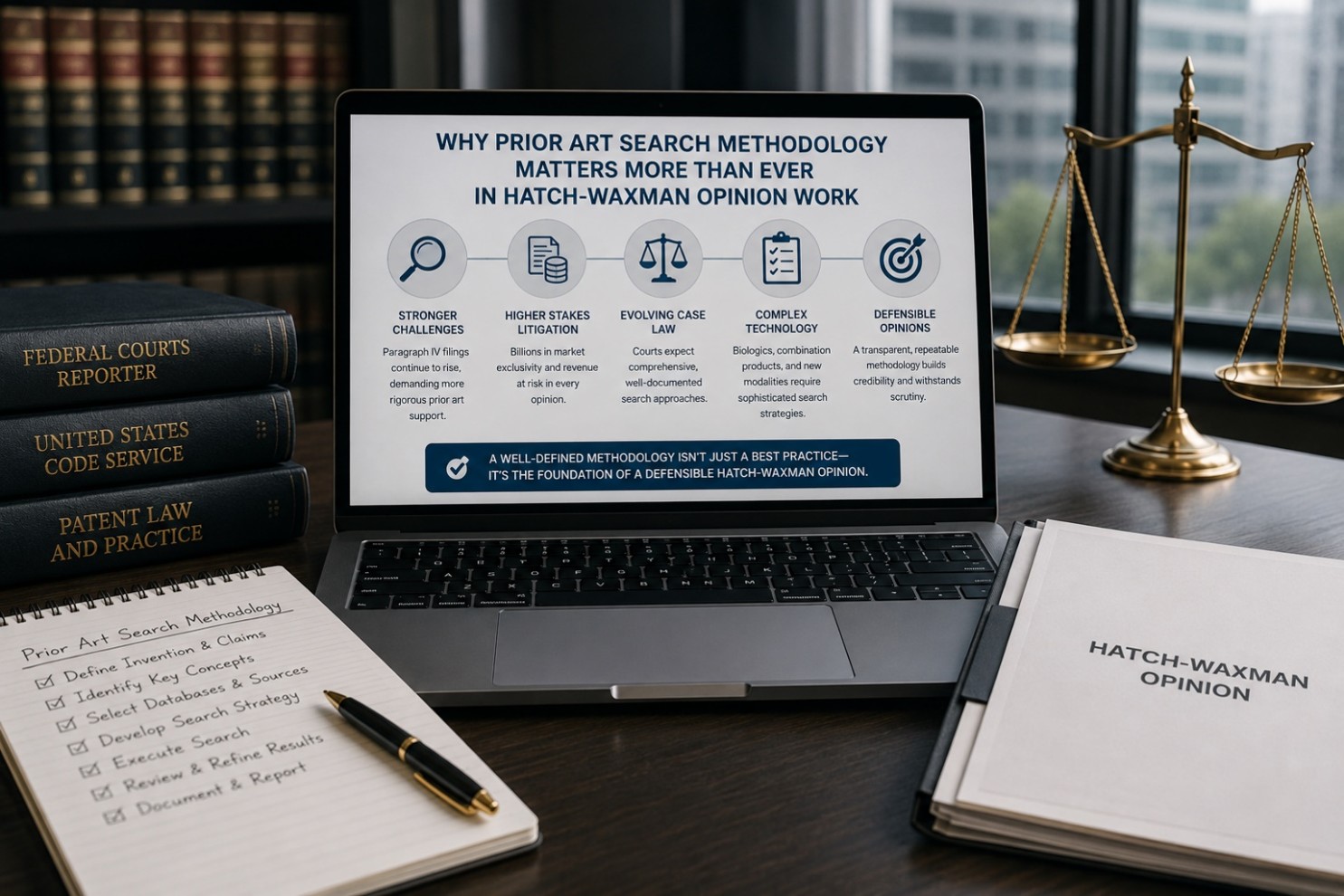
As early-stage patent risks rise, pharmaceutical companies must rethink how pre-suit search strategies shape commercial flexibility, litigation viability, and regulatory success.
Key Takeaways
- Prior art search methodology is a strategic asset. A weak search produces a weak opinion, and a weak opinion directly undermines regulatory and commercial outcomes.
- Legal theory must drive search architecture. Obviousness, anticipation, enablement, and label carve-out strategies each require distinct evidence types and source universes.
- Pharmaceutical prior art extends far beyond patent databases. Clinical trial registries, foreign filings, and conference abstracts are often the most decisive sources in validity disputes.
- Timing is often outcome-determinative. Searches completed before the Paragraph IV notice letter preserve strategic flexibility; searches conducted after may lock parties into positions that cannot easily be revised.
- Recent Federal Circuit decisions have raised the analytical bar. Polymorph validity, specification challenges, and Orange Book listing disputes are receiving heightened judicial scrutiny.
Introduction
In the high-stakes pharmaceutical industry, a patent validity opinion is only as defensible as the prior art search supporting it. Prior art searching is foundational to any patent practice. However, the unique procedural machinery of the Hatch-Waxman Act demands a level of precision, timing, and methodological rigor rarely seen in other sectors. Because the statutory framework effectively forces patent merits to be tested under intense commercial time pressure, the methodology behind a prior art search often dictates the quality of the resulting legal opinion and ultimately, a company’s business flexibility.
This article examines why a robust, theory-specific prior art search methodology is critical for in-house IP and life sciences professionals navigating Hatch-Waxman litigation. By examining the statutory pressures, the nuances of pharmaceutical search design, and recent Federal Circuit developments, the following pages outline a strategic approach to pre-suit patent analysis.
How the Hatch-Waxman Framework Makes Early-Stage Patent Analysis Decisive
The Drug Price Competition and Patent Term Restoration Act of 1984, commonly known as the Hatch-Waxman Act, established an expedited pathway for generic drug manufacturers to obtain FDA approval via Abbreviated New Drug Applications (ANDAs). This pathway allows generic applicants to rely on the safety and efficacy data developed by the brand-name manufacturer. To balance that benefit, however, the Act requires ANDA filers to address any patents listed by the brand manufacturer in the FDA’s Orange Book.
Where a generic applicant believes a listed patent is invalid or will not be infringed, a “Paragraph IV” certification must be submitted. Under 35 U.S.C. § 271(e)(2), the very act of filing an ANDA with a Paragraph IV certification constitutes an artificial act of patent infringement. This statutory trigger immediately front-loads the patent dispute. Upon receiving notice of the Paragraph IV certification, the patent owner has a 45-day window to file an infringement suit. If suit is filed, the FDA must suspend ANDA approval for up to 30 months, the “30-month stay”, preventing the generic product from entering the market while the court resolves the dispute.
Why Methodology Matters in Hatch-Waxman Opinion Work
In this compressed environment, a weak search methodology produces weak legal opinions, directly undermining business strategy. As industry analysts have noted, thorough prior-art searching before the Paragraph IV notice letter is filed remains the most effective way to preserve strategic flexibility.
The Paragraph IV notice letter must detail the legal and factual basis for the applicant’s position. Discovering critical prior art after the notice letter may require supplemental positions, strategic adjustments, or amended certifications that can complicate regulatory and litigation timelines. The search methodology, therefore, cannot be an afterthought. It must be demonstrably comprehensive and technically informed to ensure the resulting opinion does not lock any party into unsupported legal theories.
Different Theories Require Different Search Architectures
Prior art searching is not a monolithic exercise. The underlying legal theory determines the type of prior art required, the technical experts needed, and the expected trajectory of the litigation. A search designed to prove anticipation looks fundamentally different from one designed to attack enablement. The following table maps different legal theories to their corresponding search objectives, evidence sought, and common failure modes:
| Legal Theory | Search Objective | Evidence Sought | Common Failure Mode |
| Anticipation | Identify a single reference disclosing every claim element. | Identical chemical structures, exact dosage forms, and explicit prior use. | Searching too broadly or missing foreign patent equivalents with exact disclosures. |
| Obviousness | Identify the best starting point and a motivation to modify. | Closest structural analogs (lead compound) and structure-activity relationship (SAR) data. | Failing to establish a reasonable expectation of success in the combination. |
| Enablement / Written Description | Demonstrate that the specification does not enable or adequately describe the full claimed scope. | General state of the art showing high unpredictability in the field. | Focusing only on specific compounds rather than analyzing broad genus claims. |
| Non-Infringement (Label Carve-Out) | Support a Section VIII statement for unpatented indications. | Clinical literature defining discrete indications and usage patterns. | Ignoring induced infringement risks from residual label language. |
Where the strategy is to prove obviousness, the dominant theory in pharmaceutical litigation, the search must prioritize finding a “lead compound,” requiring analysis of structural similarities and biological activity. Proving anticipation, by contrast, calls for a narrower, more literal methodology. For method-of-treatment patents, a non-infringement defense paired with a label-carving strategy (a Section VIII statement) often provides a cleaner path to market than pure invalidity arguments. This approach shifts the analytical focus away from chemical prior art and toward clinical labeling and induced infringement precedents.³
Pharmaceutical Prior Art Requires a Specialized Search Methodology
Pharmaceutical obviousness makes search design especially complex. In many technology sectors, keyword searches of U.S. patents yield sufficient results. In the life sciences, however, obviousness often turns on finding exactly the right starting point. As experts have highlighted, finding the most structurally proximate prior art compound even if it appears in an obscure conference abstract or a foreign patent application is well worth the search investment.
A poorly chosen lead compound that does not closely resemble the claimed structure makes the motivation-to-alter analysis significantly harder to prove in court. Moreover, formulation patents covering specific preparations, extended-release systems, or stability enhancements require deep dives into process disclosures and pharmacokinetic literature. Because courts often view formulation improvements as routine pharmaceutical science, the prior art search must carefully evaluate whether the art would have provided a skilled artisan with a reasonable expectation of success.
Recent Developments Sharpen the Need for Precision
Decisions from 2024 and early 2025 demonstrate that courts are closely examining the exact scope of claims, the predictability of pharmaceutical science, and the validity of Orange Book listings, leaving little margin for methodological shortcuts. These recent Hatch-Waxman decisions underscore how granular patent analysis has become. Specification-based challenges, obviousness arguments grounded in predictability, and disputes over whether patents legitimately belong in the Orange Book are all receiving heightened judicial attention. Prior art search strategies that once appeared sufficient may no longer withstand this level of scrutiny.
Prior Art Search Lessons from the Courtroom
In Salix Pharmaceuticals v. Norwich Pharmaceuticals, the Federal Circuit invalidated dosage regimen and polymorph patents because Norwich’s search uncovered critical non-patent literature: a 2005 ClinicalTrials.gov protocol, a 2006 journal article showing higher rifaximin doses could be effective, and detailed process disclosures for producing rifaximin form β. This demonstrates that pharmaceutical prior art searches must extend far beyond patent databases to include clinical trial registries, journal articles, and conference proceedings, and for polymorph patents, must focus on whether prior art processes would predictably produce the claimed crystal form rather than just searching for the form itself.
In Amarin Pharma v. Hikma Pharmaceuticals, the decision turned heavily on the combination of residual label language and public promotional statements rather than the carve-out alone. This case teaches that for method-of-treatment patents, prior art searches must systematically survey clinical literature defining indication boundaries, off-label use patterns, and prescribing conventions alongside label analysis; a carve-out supported only by label text without this clinical search foundation may not withstand an induced infringement challenge. The following table highlights cross‑cutting search lessons from case law, showing how different patent types require extensions beyond U.S. patents:
| Patent Type | Critical Search Extension (Beyond U.S. Patents) |
| Dosage Regimen | Clinical trial registries like ClinicalTrials.gov, phase II/III protocols, dose-ranging studies in the journal literature, off-label prescribing data, and SIBO-related indication research all belong in scope. |
| Polymorph and Crystal Form | Process disclosures in synthesis patents, solvent system literature, pharmacopoeial references, foreign patent applications, and conference abstracts describing preparation protocols are the sources most likely to surface what courts actually care about. |
| Formulation and Extended Release | Pharmacokinetic literature, excipient compatibility studies, process patents covering analogous delivery systems, and prior FDA submissions in related drug classes each help establish whether a skilled formulator would have expected the claimed result. |
| Method of Treatment (with a Label Carve-Out strategy) | Clinical literature defining indication boundaries, prescribing convention studies, epidemiological research linking indications, and post-marketing surveillance publications all help map where the patented use ends and unprotected territory begins. |
A Practical Framework for In-House IP and Life Sciences Teams
Given the commercial stakes dictated by the Hatch-Waxman Act, in-house IP and life sciences professionals must view prior art searching as a core component of risk management. A defensible prior art opinion builds the record necessary for Paragraph IV certification, notice-letter drafting, expert selection, and settlement negotiations. The following framework provides a structured six-point approach to conducting high-quality Hatch-Waxman opinion work before litigation.
| # | Priority Action | Rationale |
| 01 | Conduct Searches Pre-Notice | Comprehensive prior art searches must be completed before a Paragraph IV notice letter is issued. Waiting until afterward risks locking the filing into weak legal theories or inadvertently resetting regulatory timelines. |
| 02 | Align Methodology with Legal Theory | Search architects and technical experts must be briefed on the specific invalidity theory being pursued. Use lead compound analysis for obviousness and exact-disclosure searches for anticipation. |
| 03 | Expand the Search Universe | The search perimeter must extend to obscure conference abstracts, non-patent scientific literature, and foreign patent filings. These sources frequently contain the most structurally proximate prior art. |
| 04 | Scrutinize Process Disclosures | For formulation and polymorph patents, prior art must be rigorously evaluated for process descriptions that could establish a reasonable expectation of success. |
| 05 | Verify Orange Book Eligibility | An independent analysis of whether listed patents legitimately claim the approved drug substance or product is essential for accurately assessing the true risk of a 30-month stay. |
| 06 | Integrate Scientific Experts Early | Search strategy should be developed jointly with medicinal chemists, formulation scientists, clinicians, and litigation counsel. |
Wrapping Up
Hatch-Waxman compresses the timeline between patent analysis and high-stakes litigation. In a landscape where recent Federal Circuit case law rewards nuance in obviousness and specification-based challenges, and where pharmaceutical prior art is far too specialized for generic keyword searches, the methodology behind a prior art search matters as much as the references it uncovers. Pharmaceutical organizations that invest in tailored, theory-specific search architectures give their patent opinions something most opinions lack a foundation solid enough to hold up when regulatory and commercial pressure is at its highest. Every subsequent legal argument, settlement discussion, regulatory decision, and commercial strategy ultimately depends on the quality of the work performed at that early stage.
Recommendations for stakeholders
- Generic Manufacturers: Complete prior art searches before any Paragraph IV notice letter is filed to preserve legal theory flexibility and avoid strategic exposure.
- Brand Pharmaceutical Companies: Conduct independent Orange Book listing audits to assess whether patent listings withstand the elevated judicial scrutiny courts now apply to listing eligibility.
- In-House IP Counsel: Establish cross-functional search teams that integrate medicinal chemists, formulation scientists, and clinicians at the earliest stage of patent risk assessment.
- Litigation Counsel: Align invalidity theory selection with the evidence landscape uncovered during pre-suit searches, rather than fitting the evidence retrospectively to a predetermined legal argument.
- Life Sciences Investors and Business Development Teams: Treat the rigor of prior art search methodology as a material factor in evaluating freedom-to-operate risk and the durability of exclusivity positions before transaction commitments are made.