

Why governments, industries, and consumers are confronting one of the most persistent environmental challenges of the modern era.
Per- and polyfluoroalkyl substances (PFAS) have rapidly emerged as one of the most debated chemical groups worldwide. Once celebrated for their durability and performance, these substances are now at the centre of environmental, regulatory, and public health discussions. From consumer goods to advanced industrial applications, PFAS are everywhere, and so are the concerns surrounding them.
What is PFAS?
Per- and polyfluoroalkyl substances (PFAS) are a large family of synthetic organofluorine compounds in which hydrogen atoms on an alkyl chain are partially or fully replaced by fluorine. Because of the extremely strong carbon-fluorine (C-F) bond, PFAS resist heat, water, oil, and stains, which is why they are widely used in consumer and industrial products. They are commonly dubbed “forever chemicals” because they break down very slowly in the environment and can accumulate in water, soil, wildlife, and humans. The OECD estimates that the family encompasses more than 4,700 distinct compounds, although the precise count depends on the structural definition applied.
Categories of PFAS
PFAS are classified along three independent dimensions, not a single hierarchy. Understanding this distinction matters, because a single molecule sits in one category on each axis simultaneously.
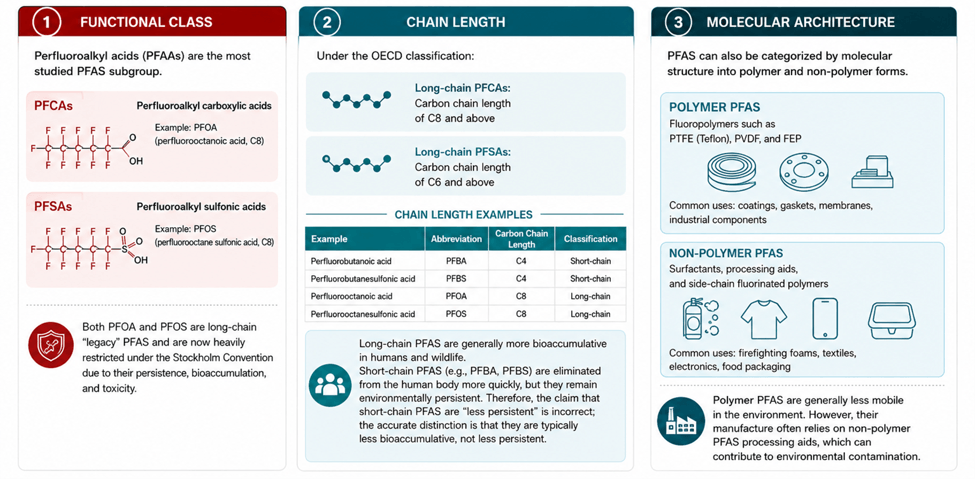
Functional class: Perfluoroalkyl acids (PFAAs) are the most studied sub-family and include perfluoroalkyl carboxylic acids (PFCAs) such as PFOA (perfluorooctanoic acid, C8), and perfluoroalkyl sulfonic acids (PFSAs) such as PFOS (perfluorooctane sulfonic acid, C8). Both PFOA and PFOS are long-chain legacy compounds, now heavily restricted under the Stockholm Convention.
Chain length: Per the OECD definition, long-chain PFCAs are those with carbon chain length of C8 and above, and long-chain PFSAs are those with C6 and above. Long-chain PFAS are more bioaccumulative. Short-chain PFAS (for example, PFBA at C4, PFBS at C4) clear from the human body faster, but they remain environmentally persistent. The frequent assertion that short-chain PFAS are “less persistent” is incorrect; the correct distinction is that they are less bioaccumulative.
Molecular architecture: Polymer PFAS such as fluoropolymers (PTFE / Teflon, PVDF, FEP) are used in coatings, gaskets, and industrial parts. Non-polymer PFAS, which include processing aids, surfactants, and side-chain fluorinated polymers, are used in firefighting foams, textiles, electronics, and food packaging. Polymer PFAS are typically less mobile in the environment but their manufacture often involves non-polymer PFAS as processing aids.
Uses of PFAS
PFAS are valued for water resistance, oil and grease resistance, and thermal and chemical stability. They are embedded in both everyday life and high-tech industry.
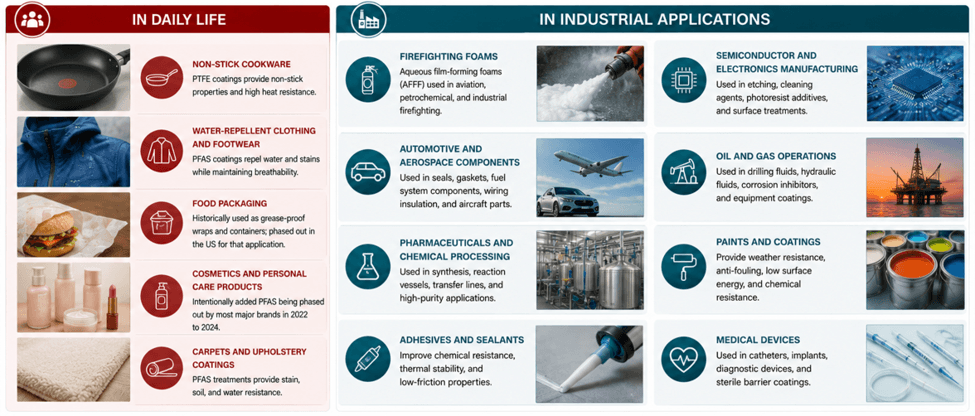
In daily life: non-stick cookware (PTFE coatings), water-repellent clothing and footwear, food packaging (historically used as grease-proof wraps, now phased out in the US for that application), cosmetics and personal care products (intentionally added PFAS being phased out by most major brands in 2022 to 2024), carpets and upholstery coatings.
In industrial applications: firefighting foams (aqueous film-forming foams in aviation and petrochemical sectors), semiconductor and electronics manufacturing, automotive and aerospace components, oil and gas operations, pharmaceuticals and chemical processing, paints and coatings, adhesives, and medical devices.
Why PFAS is a hot topic now
Three factors have pushed PFAS to the centre of global policy.
Persistence and widespread contamination: Studies have detected PFAS in drinking water supplies, groundwater, rivers, rainwater, and remote polar regions, earning them the “forever chemicals” label. The US Geological Survey reported in 2023 that at least 45 percent of US tap water samples tested contained one or more PFAS compounds.
Health risks: Epidemiological and toxicological research links long-term PFAS exposure to liver damage, thyroid dysfunction, elevated cholesterol, kidney and testicular cancer, immune-system suppression including reduced vaccine efficacy in children, and adverse developmental effects. The US National Academies of Sciences, Engineering, and Medicine issued a 2022 consensus report recommending PFAS blood testing for exposed populations.
Regulatory and legal pressure: Governments, NGOs, and affected communities are pursuing chemical manufacturers and water utilities. In June 2023, 3M agreed to a settlement of up to USD 12.5 billion with US public water suppliers; DuPont, Chemours, and Corteva announced a USD 1.185 billion settlement in the same period. Class actions across Europe, Australia, and several US states continue.
Key concerns regarding PFAS
Environmental persistence: PFAS can persist in water and soil for decades. US Geological Survey hydrogeological work suggests that PFAS from historical discharges could remain in some aquifer systems for 40 years or more, because the chemicals slowly leach from low-permeability clay layers into groundwater flow paths even after surface emissions stop.
Bioaccumulation and toxicity: Certain PFAS compounds, particularly the long-chain PFAAs, accumulate in human blood and organs. They are associated with endocrine disruption, immunotoxicity, hepatotoxicity, and developmental effects. Human elimination half-lives for PFOA and PFOS are measured in years, not days.
Regrettable substitution: As specific long-chain PFAS are phased out, industry has often replaced them with structurally similar short-chain analogues (for example, GenX, PFBS) whose long-term safety profiles are uncertain. ECHA and the OECD have explicitly flagged this pattern, which is why regulators are increasingly treating PFAS collectively as a “class of concern” rather than managing each compound individually.
Global regulations on PFAS
Different regions are moving at different speeds, but the trend is unambiguously toward stricter controls.
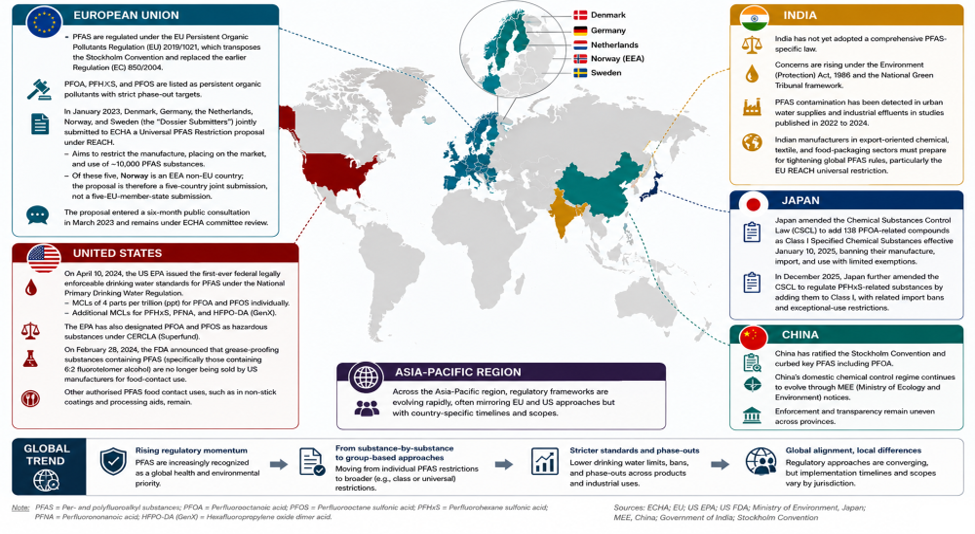
European Union: PFAS are regulated under the EU Persistent Organic Pollutants Regulation (EU) 2019/1021, which transposes the Stockholm Convention and replaced the earlier Regulation (EC) 850/2004. PFOA, PFHxS, and PFOS are listed as persistent organic pollutants with strict phase-out targets. In January 2023, authorities from Denmark, Germany, the Netherlands, Norway, and Sweden (the “Dossier Submitters”) jointly submitted to ECHA a Universal PFAS Restriction proposal under REACH, aiming to restrict the manufacture, placing on the market, and use of approximately 10,000 PFAS substances. Of these five, Norway is an EEA non-EU country; the proposal is therefore a five-country joint submission, not a five-EU-member-state submission. The proposal entered a six-month public consultation in March 2023 and remains under ECHA committee review.
United States: The US EPA issued the first-ever federal legally enforceable drinking water standards for PFAS on April 10, 2024, under the National Primary Drinking Water Regulation. The rule sets Maximum Contaminant Levels (MCLs) of 4 parts per trillion for PFOA and PFOS individually, and additional MCLs for PFHxS, PFNA, and HFPO-DA (GenX). The EPA has also designated PFOA and PFOS as hazardous substances under CERCLA (Superfund). The FDA announced on February 28, 2024 that grease-proofing substances containing PFAS (specifically those containing 6:2 fluorotelomer alcohol) are no longer being sold by US manufacturers for food-contact use. Other authorised PFAS food contact uses, such as in non-stick coatings and processing aids, remain.
India: India has not yet adopted a comprehensive PFAS-specific law, but concerns are rising under the Environment (Protection) Act, 1986 and the National Green Tribunal framework, particularly as PFAS contamination has been detected in urban water supplies and industrial effluents in studies published in 2022 to 2024. Indian manufacturers in export-oriented chemical, textile, and food-packaging sectors must prepare for tightening global PFAS rules, particularly the EU REACH universal restriction.
Japan: Japan amended the Chemical Substances Control Law (CSCL) to add 138 PFOA-related compounds as Class I Specified Chemical Substances effective January 10, 2025, banning their manufacture, import, and use with limited exemptions. In December 2025, Japan further amended the CSCL to regulate PFHxS-related substances by adding them to Class I, with related import bans and exceptional-use restrictions.
China: China has ratified the Stockholm Convention and curbed key PFAS including PFOA. China’s domestic chemical control regime continues to evolve through MEE (Ministry of Ecology and Environment) notices, although enforcement and transparency remain uneven across provinces.
Across the Asia-Pacific region, regulatory frameworks are evolving rapidly, often mirroring EU and US approaches but with country-specific timelines and scopes.
How long until PFAS environmental concentrations decline?
Complete environmental clearance of PFAS is not realistically expected for many decades, even if new emissions drop to near zero. The correct framing is environmental decline through remediation and natural attenuation, not “eradication.”
US Geological Survey groundwater modelling suggests that PFAS from historical discharges could persist in aquifers for 40 years or more, because the chemicals slowly leach from low-permeability clay layers into groundwater flow paths even after surface emissions stop. Regulatory roadmaps in the US and EU focus on eliminating new PFAS emissions and phasing out non-essential uses by the 2030s, but legacy PFAS in landfills, industrial sites, and contaminated soils will continue to leach into water and ecosystems well into the mid- to late 21st century.
Active remediation technologies are advancing but remain expensive at scale. The current frontier includes granular activated carbon (GAC) and ion exchange resins for drinking water treatment, foam fractionation for concentrated industrial waste streams, supercritical water oxidation and electrochemical oxidation for destruction of concentrated PFAS, and plasma-based destruction technologies under demonstration in 2024 to 2026. Most experts and exposure-modelling studies indicate that human exposure and environmental concentrations will decline gradually over several decades, but globally meaningful reductions are unlikely within the next 50 to 100 years without coordinated remediation investment at a scale not yet committed by any jurisdiction.
Conclusion
PFAS have shifted from being a niche industrial chemistry issue to one of the defining environmental and regulatory challenges of the 21st century. Their unmatched performance characteristics made them indispensable across consumer products, electronics, aerospace, energy, and advanced manufacturing, but the same chemical stability that enabled these applications has also created a long-term environmental legacy.
The global response is now accelerating. Regulators in the EU, US, Japan, and other major economies are moving beyond compound-by-compound management toward broader class-based restrictions, while litigation costs and remediation liabilities continue to rise into the billions of dollars. For manufacturers, the challenge is no longer simply regulatory compliance; it is strategic adaptation across product design, supply chains, materials innovation, and sustainability commitments.
At the same time, the PFAS transition will not be immediate. Many applications, particularly in semiconductors, medical devices, aerospace, and critical infrastructure, still depend heavily on fluorinated chemistries with limited near-term substitutes. This creates a complex balancing act between environmental protection, industrial competitiveness, and technological resilience.
Over the coming decades, the focus will increasingly shift toward three priorities: phasing out non-essential PFAS uses, scaling remediation technologies, and developing safer next-generation materials. While global PFAS concentrations may gradually decline, the persistence of legacy contamination means the issue will remain a major environmental, legal, and industrial concern well into the mid-21st century. Ultimately, PFAS represent not only a chemical challenge, but also a broader test of how industries and governments manage innovation, risk, and sustainability in an increasingly regulation-driven world.