
At a Glance
This case study shows how ExpertLancing mapped the India fabless semiconductor design market for investor decision-making, identifying the scale of the semiconductor investment opportunity India and the most attractive company segments for capital deployment.
A global private equity firm with active interests in deep-tech and electronics manufacturing approached ExpertLancing to build a clear, investment-grade view of India’s fabless semiconductor design market. The client needed to size the opportunity, study the competitive field of domestic startups and global captive design centres, and decide where to place capital over the next five to seven years.
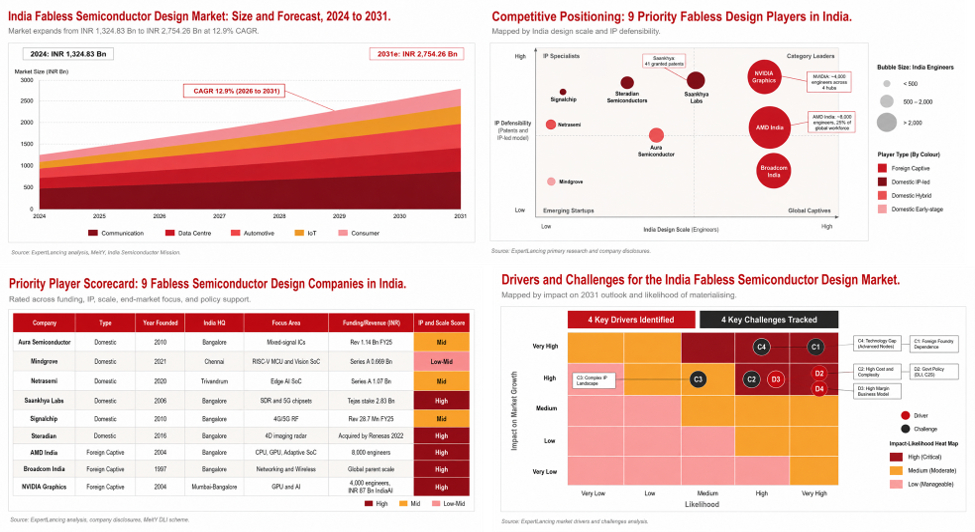
ExpertLancing studied the market across drivers, challenges, government schemes, and nine priority companies, sizing the market at INR 1,324.83 Bn in 2024 with a forecast of INR 2,754.26 Bn by 2031 at a 12.9% CAGR. The work shaped a focused investment thesis built around RISC-V startups India, edge AI chip design India, and 5G chip design plays.
The Challenge
Investor Challenge
India is fast becoming a serious node in the global semiconductor value chain, but the fabless design layer remains the least understood by investors. Most of the global chip design talent already sits in India, with players like AMD, NVIDIA, Broadcom, and Qualcomm running large captive design centres, while a fresh wave of domestic startups like Mindgrove, Netrasemi, Saankhya Labs, and Signalchip is building India-origin IP across RISC-V, edge AI, 5G, and automotive radar. The Government of India has added serious weight through the Design Linked Incentive (DLI) Scheme, the Chips-to-Startup (C2S) Programme, and the broader India Semiconductor Mission, pushing the sector into a new phase.
Market Complexity
The client, a global private equity firm, was sitting on a thesis but lacked the granular evidence to act. Internal teams could not credibly size the design-only segment (distinct from fabrication or ATMP), nor could they separate the value created by foreign captives from that created by Indian-origin IP houses.
Inaction carried real cost as competing PE and VC funds were already writing cheques into the same names. The client needed a sharper view of fabless semiconductor companies in India, the broader semiconductor design market India, and the policy incentives shaping investability.
Key Questions to Answer
The client asked ExpertLancing to answer five key questions:
- How large is the fabless semiconductor design market in India today, and how will it grow to 2031?
- Which drivers and challenges will shape the next five years of growth?
- Which government schemes meaningfully change the unit economics of a fabless startup in India?
- Who are the most credible domestic and foreign players, and how do their business models compare?
- Where should the client place capital, and what entry routes (direct equity, co-investment, secondary) make the most sense?
Our Market Mapping and Investment Research Approach
The engagement was delivered in a five-stage phased model over a ten-week timeline.
Stage 1: Scoping and Hypothesis Design. ExpertLancing ran a structured kick-off with the client’s investment committee, locking the market definition around fabless design activities only, excluding wafer fabrication, ATMP, and EDA tools. The team built an initial hypothesis tree covering market sizing, competitive intensity, policy support, and investability.
Stage 2: Secondary Research and Data Triangulation. The team studied over 60 sources, including MeitY notifications, India Semiconductor Mission updates, DLI scheme disclosures, company filings, patent databases, and global benchmarks from SIA and IESA. Data points were triangulated across three independent sources before being accepted.
Stage 3: Primary Research. ExpertLancing held more than 20 interviews with founders, CTOs, design centre heads of multinational captives, DLI scheme administrators, OSAT partners, and venture investors. These calls validated revenue assumptions, talent costs, tape-out conversion rates, and unit economics for both startups and global captives.
Stage 4: Market Sizing, Forecasting and Competitive Mapping. The team built a bottom-up sizing model splitting the market by end-application (communication, data centre, automotive, IoT, consumer) and by player type (Indian-origin IP houses vs. foreign captive design centres). Nine priority companies were profiled in depth, covering Aura Semiconductor, Mindgrove, Netrasemi, Saankhya Labs, Signalchip, Steradian, AMD India, Broadcom India, and NVIDIA Graphics.
Stage 5: Investment Thesis and Synthesis. Findings were converted into a prioritised investment shortlist, with a Porter’s Five Forces view, a risk register, and a where-to-invest heat map covering five end-use verticals and four player archetypes.
Key Findings
The study surfaced four insights that reshaped the client’s view:
- Market Size: The India fabless semiconductor design market is concentrated in value but fragmented in players. Foreign captives like AMD India, with around 8,000 engineers and 25% of AMD’s global headcount, and NVIDIA, with around 4,000 engineers, capture the bulk of design output. Domestic firms control a far smaller revenue base but a faster growth curve.
- Captive Design Centres: Global captive design centres remain central to the semiconductor design market India, but Indian-origin IP houses are becoming increasingly relevant as investors look for product-led growth rather than only services-led capability.
- DLI Scheme: The DLI scheme is the single biggest lever for startup viability, with companies like Mindgrove securing INR 0.15 Bn and Netrasemi raising INR 1.07 Bn in Series A on the back of DLI recognition.
- RISC-V and Edge AI Opportunity: RISC-V startups India, edge AI chip design India, and 5G/D2M chipsets are the three pockets where Indian-origin IP is most defensible, given lower licensing dependence on Arm and clear use-case pull from defence, telecom, and IoT.
The dependence on foreign foundries, including TSMC and Samsung, at advanced nodes remains the largest structural risk, capping margin expansion until India’s own fab capacity comes online.
The Impact
Market Sized at INR 2,754.26 Bn for 2031 with a 12.9% Growth Trajectory. The bottom-up sizing model gave the client a defensible base year value of INR 1,324.83 Bn for 2024 and a clear forecast curve, replacing earlier internal estimates that varied by more than 30%.
Competitive Field of 9 Priority Players Mapped Across Domestic and Foreign Archetypes. Detailed profiles covering products, funding, IP portfolios, key people, and recent deals gave the client a ready-reference deck for direct outreach and diligence.
Investment Shortlist of 3 High-Conviction Targets Identified Across RISC-V, Edge AI and 5G. The shortlist narrowed a long list of more than 25 names into three priority targets backed by clear theses on IP defensibility, customer traction, and exit pathways.
Strategic Takeaway
India’s fabless design market is moving from a back-office story to a product story. Over the next five to seven years, the firms that own India-origin IP in RISC-V, edge AI, and wireless will define a new layer of value above the global captive base. Investors who build conviction now, while valuations are still reasonable and the policy tailwind is fresh, will be the ones writing the headline cheques of 2031.
If your firm is studying the India semiconductor opportunity, whether as an investor, OEM, or technology partner, ExpertLancing can build a similar evidence-led view tailored to your thesis.
ExpertLancing supports semiconductor research, market mapping, and investment due diligence for companies evaluating the India fabless semiconductor design market. Our team helps investors identify high-growth segments, compare fabless semiconductor companies in India, assess policy-linked opportunities, and build an investor-ready view of where value will sit next.