
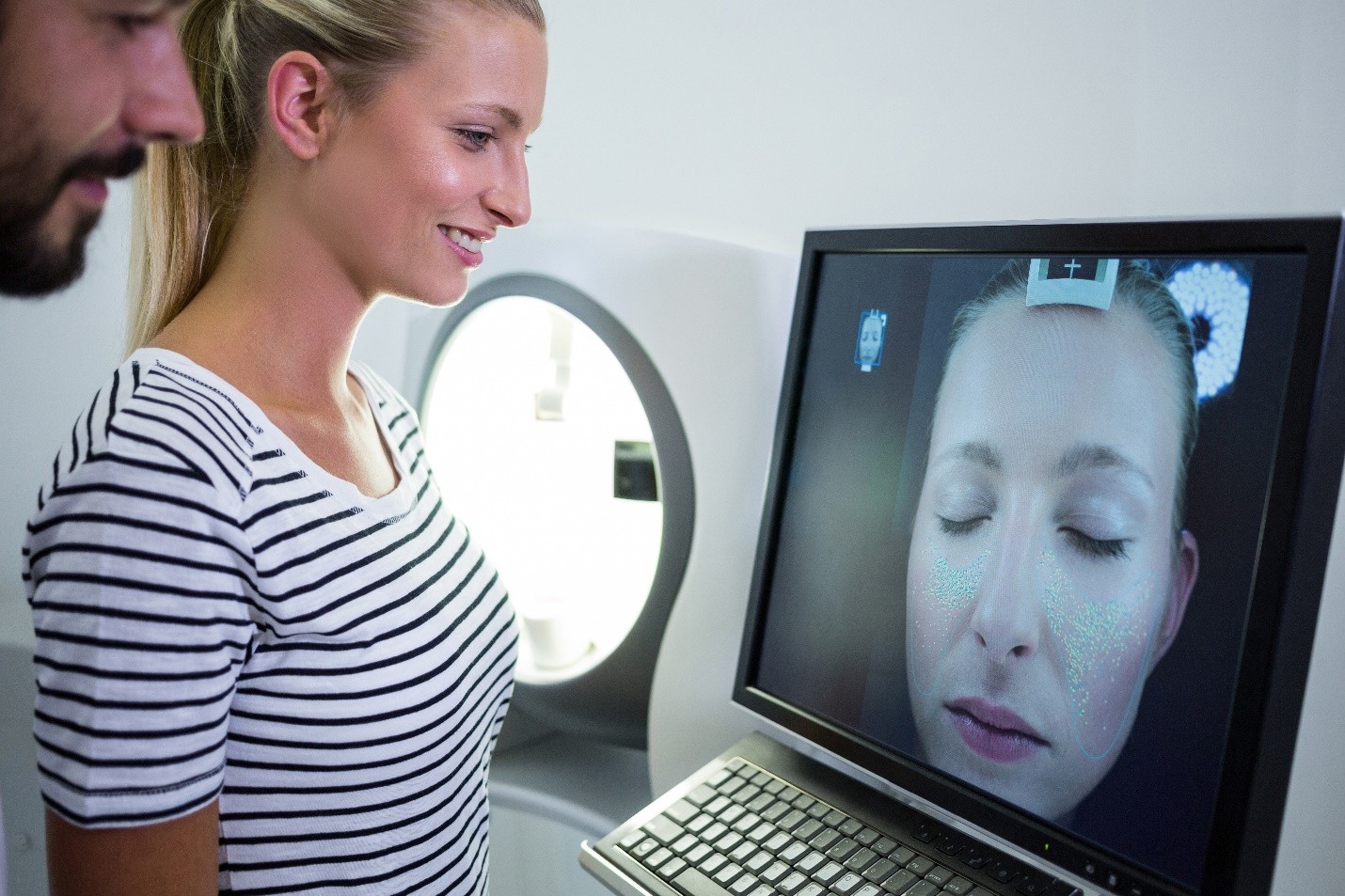
Personalized skincare is no longer a differentiator, it’s the baseline. The real race now is over who controls the biology: proprietary skin data, novel ingredients, and diagnostics that predict problems before customers even notice them.
Key takeaways
- The global AI in beauty and cosmetics market is on course to grow from USD 4.9 billion in 2025 to USD 33.75 billion by 2035 at a 22.3% CAGR, representing deep structural adoption rather than a technology trend.
- AI formulation platforms deliver up to 45% higher ingredient compatibility accuracy versus traditional bench methods and are expected to reduce formulation timelines by 42% by 2028.
- AI-guided molecular discovery has produced structurally novel actives that did not exist before, disrupting the legacy reliance on commodity ingredients like retinol and hyaluronic acid that incumbents have shared for decades.
- Brands building AI-diagnostic consumer touchpoints are accumulating a proprietary data moat with compounding returns: every interaction refines the underlying model and widens the gap from competitors.
- Over USD 3.2 billion in cumulative capital has flowed into AI-beauty platforms since 2022, concentrating across three strategic layers: ingredient IP, formulation infrastructure, and consumer personalization engines.
- The skin microbiome market is forecast to grow at 7.9% CAGR to USD 28.63 billion by 2036, with AI personalization cited as a primary growth catalyst. Companies investing in this frontier now are positioning for advantages that will not be visible to competitors until they are decisive.
AI-Native Skincare: Reshaping the Beauty Value Chain
For years, the skincare industry has been operating on a structural paradox: products marketed as personalized were, in practice, built for demographic averages. Taxonomy of skin types fails to account for the full complexity of actual skin biology. Beneath each surface category lies a unique matrix of lipid balance, immune signaling, microbial composition, and environmental exposure. AI is the first technology that can deal with that complexity at a consumer scale, and its arrival is not incremental. It’s a complete re-wiring of the value chain from discovery to purchase.
The opportunity’s scope is considerable. AI is set to generate a revenue of USD 33.75 billion by 2035 compared to USD 4.9 billion in 2025 in the beauty and cosmetic products industry. This forecast demonstrates the existence of solid and stable acceptance of the technology, not hyped-up buzz around it. For example, AI-based formulations of beauty and cosmetic products will grow at a CAGR of 22.4% from USD 455 million in 2025 to USD 2.29 billion by 2033. The driving force behind such growth includes the convergence of demand for customizability, generation ability, and digitization.
What differentiates this moment from mere development is the occurrence of three disruptions simultaneously. First, consumer-facing AI diagnostics are producing structured, high-quality skin data on a scale never seen before. This data actually affects formulation rather than simply serving as feedback for future campaign planning. Second, Generative AI formulations, are also transforming the process of product development. These provide an increase in compatibility accuracy by 45% and reduce reformulations by 40%. Third, new AI-driven molecule discovery, which used to be limited to pharmaceutical research and development, is now making its way into skincare. This creates unique ingredient intellectual property that legacy brands cannot replicate, as they continue to rely on the same retinols, hyaluronic acids, and peptides they have used for many years. (Exhibit 1)
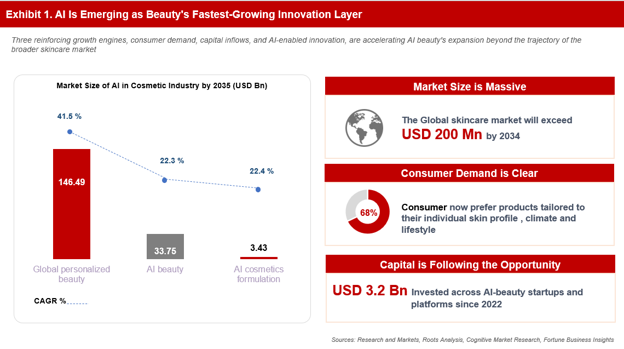
68% of consumers now prefer products designed for their unique skin type, climate, and lifestyle. Thus, the global personalized beauty product market will be valued at USD 4.55 billion in 2025 but reach a whopping value of USD 146.49 billion in 2035, reflecting a compound annual growth rate of 41.5% within the given period. Additionally, the global skin care market is projected to be worth over USD 200 billion in 2034. Such demand and market size fueled by AI represent one of the most significant opportunities for executives to capitalize on. Otherwise, they will lose out to AI-first players.
AI as the New Consumer Interface: From Skin Analysis to Skin Intelligence
The old skincare purchasing experience was largely passive, where the consumer looked at the packaging label, determined what kind of skin they had, and hoped that it would deliver a reasonably satisfactory outcome. AI transforms this paradigm. The purchase of ModiFace by L’Oréal created the blueprint, with computer vision and machine learning analyzing skin texture, hydration gradient, and melanin levels from one smartphone snapshot, with every data point feeding structured data back into the company’s research & development system. This is not an enhanced user experience but a data advantage that builds upon itself.
L’Oréal built on its success further through Perso, which is the world’s first AI-enabled at-home formulation station adjusting to daily fluctuations in weather conditions, pollution level, and skin health analysis. Paula’s Choice Taiwan saw tangible ROI benefits from adopting the AI skin analyzer Revieve, in the form of increased consumer engagement rates and higher conversion ratios, proving beyond any doubt that diagnostics make money rather than mere perception of brands. Every scan improves the underlying algorithm and creates deeper layers of data advantage that are impossible to catch up with. (Exhibit 2).
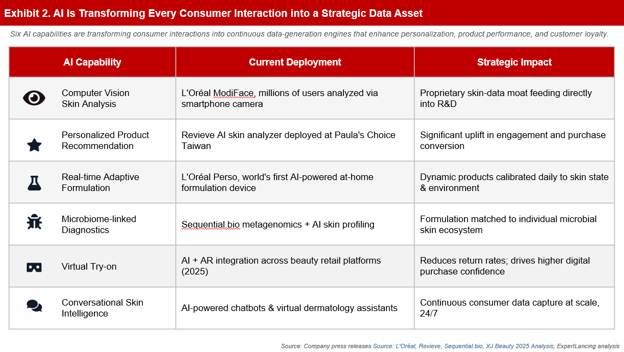
Revieve’s broader platform enables beauty brands to deliver hyper-personalized recommendations by synthesizing consumer skin data with formulation databases in real time, collapsing the distance between a diagnostic interaction and a product recommendation. AI-driven tools are enabling brands to provide genuinely hyper-personalized beauty experiences, with AR virtual try-on and AI-powered skin analysis converging to create seamless digital engagement loops that simultaneously generate consumer data and drive purchase.
Product Innovation: AI Transforming Formulation
Not only is traditional cosmetic research and development inefficient because of its slowness, high cost, and lack of combinatorial potential, which enables a talented formulating team to test a couple hundred ingredients at most annually, but AI systems can test millions while also analyzing their interaction, suitability for consumers’ skin types, environmental stability, and regulation compliance.
The productivity increase can be precisely calculated: 45% increased accuracy of ingredient compatibility, 42% reduced time-to-market by 2028, and predicted to achieve a 38% improvement in first-time batch accuracy by 2029 (Congruence Market Insights). However, the real disruption lies in ingredient discovery, for instance, Oddity’s USD 76 million acquisition of Revela, followed by the company’s USD 25 million lab construction in Boston, has yielded such innovations as ProCelinyl and Fibroquin thanks to AI-assisted molecular screening. (Exhibit 3).
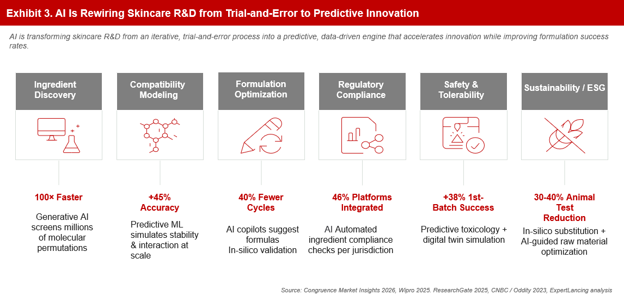
The IBM- L’Oréal collaboration (January 2025) extends AI into sustainability, building a custom foundation model to identify sustainable raw material substitutes while maintaining performance targets, a multi-constraint optimization no human team could pursue at equivalent speed. As far as regulation goes, more than 46% of AI-based formulation technologies include automated ingredient safety screening, which shifts compliance from being a challenge to becoming a competitive advantage, allowing for quick launches in multiple jurisdictions at once. Safety and tolerability prediction by means of predictive modeling is increasingly becoming accepted within the realm of regulation, especially when AI algorithms are validated and auditable.
Investment Landscape: Mapping the Emerging AI-Beauty Ecosystem
Capital movement within the domain of AI-beauty demonstrates the areas of value creation according to insider opinion. From 2022-2025, the accumulated investment on various AI-beauty platforms was over USD 3.2 billion. The allocation of capital into three distinct avenues, AI-natural ingredients intellectual property, AI formulation technology, and personalization technology, reflects a hierarchical ecosystem that is developing at an exponential pace.
At the ingredient IP (Intellectual Property) layer, Oddity’s USD 101 million combined investment (USD 76M acquisition + USD 25M lab build) signals the highest-conviction bet in the ecosystem: that proprietary AI-generated molecules will become the new brand moat in beauty, displacing the legacy reliance on commodity actives like retinol and hyaluronic acid. In parallel, Debut Biotech’s USD 20 million raise specifically to accelerate AI ingredient discovery in skin longevity, with a dual strategy of proprietary brand development and white-label formulation supply to other brands, illustrates a second archetype: the AI-native ingredients-as-a-service model.
At the formulation infrastructure layer, the strategic partnerships between incumbents and technology giants are defining the competitive landscape. L’Oréal’s collaboration with NVIDIA highlights the growing role of predictive AI in ingredient innovation, shifting product development from a largely experimental process toward a data-driven, simulation-led approach that can significantly accelerate discovery timelines .Meanwhile, Grant Industries illustrates how AI-enabled ingredient intelligence can enhance formulation productivity by guiding ingredient selection, uncovering novel combinations, and accelerating product development cycles without requiring extensive trial-and-error experimentation (Exhibit 4).
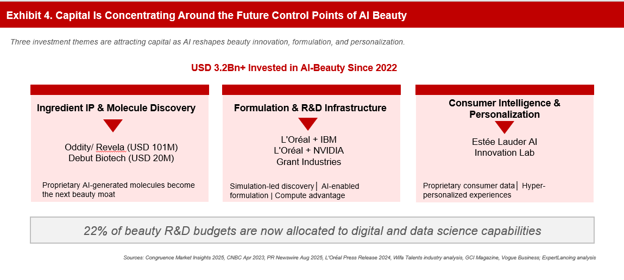
The Estée Lauder Companies’ AI Innovation Lab created in partnership with Microsoft, the lab will work on in-house uses of generative artificial intelligence that enable teams to respond more quickly and accurately to trends: a dedicated internal structure to translate AI capability into product portfolio advantage, consumer sentiment intelligence, and formulation personalization across a multi-brand portfolio. The strategic logic is clear, own the AI capability internally rather than license it at a margin, and apply it systematically across brands where network effects in data accumulation compound over time. 22% of beauty R&D budgets are now allocated to digital and data science departments, suggesting the adoption curve has passed an inflection point where non-adopters face structural disadvantage.
Future Outlook: Digital Skin Twins and Autonomous Beauty
Digital Skin Twins: The technology of digital skin twins is proving to be an upcoming research and development capability within the beauty and personal care sector. The use of digital skin twins which leverage artificial intelligence, advanced skin modeling and imaging, as well as environment data, can help with predicting the effects of ingredients on the skin, as well as help with in silico formulations of skincare products prior to their physical verification. Digital twins could provide substantial boosts in formula effectiveness, personalization, and predictions in skincare development. By 2029, predictive skin models driven by machine learning could boost first formula success rates by 38%.
Autonomous Formulation Engines
The trajectory of AI formulation points toward products generated by autonomous systems operating on consumer skin profiles, optimized simultaneously against efficacy, safety, sustainability, cost, and multi-market regulatory compliance. ML systems drawing on multi-omic skin science training datasets are closing the loop between biological measurement and product creation, a feedback cycle that, once fully operational, will make the current R&D function in skincare look categorically different.
Exposome & Genomics Integration
Next-generation skin intelligence will integrate genomic predispositions, real-time exposome data (pollution, UV, diet, stress), microbiome state, and transient skin metrics into a single diagnostic layer. Integration of genomics, exposome data, and real-time consumer feedback will define the next stage of AI-powered formulation growth. Sequential.bio’s multi-omic skin testing platform is already combining host genomic analysis with microbiome profiling, a preview of what a fully integrated skin intelligence platform will deliver at consumer scale within this decade.
Microbiome-Adaptive Products
Microbiome beauty products are close to breaking out big, given the doubling in search interest over the past five years, while searches specifically focused on the skin microbiome increased by 177% YoY, indicating rising awareness of microbiome-driven skincare solutions. The skin microbiome market size is expected to reach USD 28.63 billion by 2036, growing at a compound annual growth rate (CAGR) of 7.9% with the application of artificial intelligence to drive personalization being identified as the key driver for growth.