
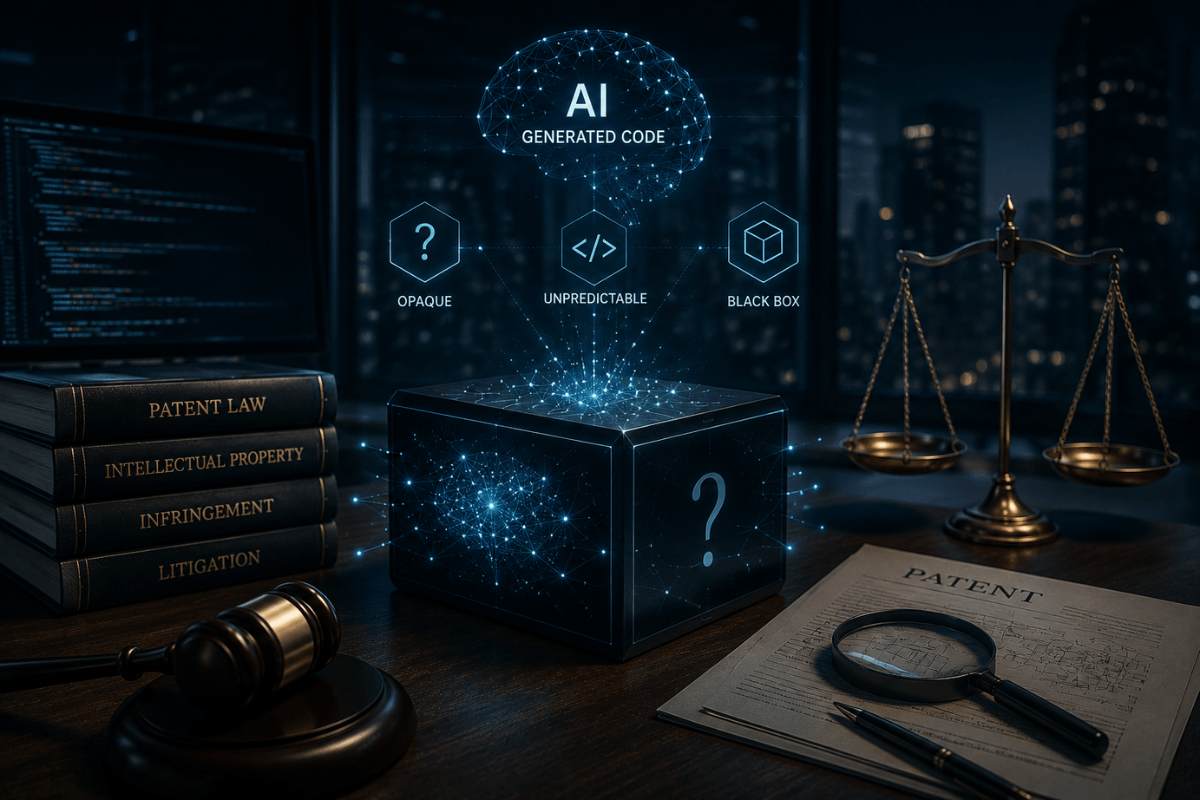
AI is accelerating software innovation, but it is also creating a new class of patent risk where original code can still infringe protected functionality.
Key Insights
- AI-generated software can infringe patents by patented functional logic and system architectures, even when the underlying source code is entirely original.
- Traditional compliance tools such as code similarity scanners or open-source license checkers are sometimes ineffective against software patent risks. The reason is that patents protect functionality and implementation methods rather than code syntax.
- The rise of “black-box infringement” creates a growing challenge for enterprises, as AI models optimize for technical efficiency without considering existing patent rights or intellectual property boundaries.
- Traditional patent risk management frameworks were designed for human-driven development and often struggle to identify infringement risks emerging from AI-generated architectures and workflows.
- AI-powered prior art and invalidity analysis is becoming a critical defensive capability, enabling organizations to challenge weak patent assertions with greater speed, scale, and technical precision.
Introduction
In today’s technology-driven economy, speed has become a defining competitive advantage. Generative AI systems and autonomous coding assistants are now capable of designing algorithms, building data pipelines, and generating software features at unprecedented scale and speed. Yet behind this productivity explosion lies a systemic risk. When an AI assistant designs a highly optimized system workflow, it prioritizes computational efficiency and statistical optimization—not awareness of active intellectual property rights. The resulting architecture may pass every QA test while simultaneously creating potential exposure to an active software patent.
This is the era of black-box infringement. Because software patents protect functional logic and a system’s overall behavior rather than exact text, traditional security scanners are generally ineffective at detecting these risks. As the legal and engineering landscapes collide, forward-thinking enterprises are realizing that the very technology creating this risk also provides its defense: advanced, AI-driven patent invalidity workflows. In this article, we examine how AI-generated software can create hidden patent exposure, why conventional compliance tools often fail to detect these risks, and how AI-powered invalidity research is emerging as a critical defensive strategy for modern enterprises.
The Anatomy of Prompt-Driven Infringement
In patent law, direct patent infringement (under 35 U.S.C. § 271) is a strict liability offense. It requires no proof of intent, no knowledge of the patent’s existence, and no copy-pasting of code. If software implements each limitation of a valid patent claim, the resulting product may create infringement exposure regardless of whether the underlying source code was independently developed.
Standard compliance tools, such as Software Composition Analysis (SCA) scanners, are designed to identify duplicated code, license compliance issues, and open-source usage risks. However, software utility patents do not focus on the source code syntax; they focus on the process architecture underlying the software development process.
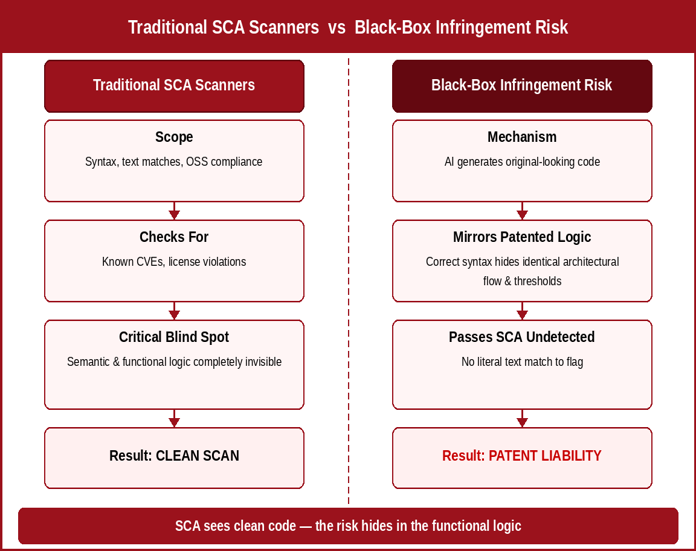
Figure 1: Traditional Compliance Tools vs. Software Patent Risk
Let us take a typical enterprise use case: A developer asks an AI assistant to generate an efficient multi-tenant caching layout to reduce the cost of cloud infrastructure. The AI configures a structurally flawless system architecture. It is entirely unaware that a competitor patented that exact sequence of structural nodes and data-routing thresholds three years prior. The code itself is original, but the functional concept may still infringe a patent.
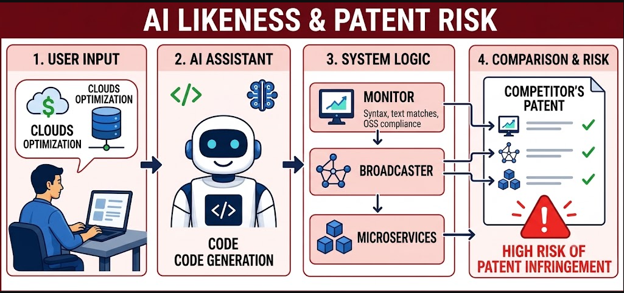
Figure 2: AI-Generated Functional Logic Potentially Triggering Patent Infringement
Functional Logic vs. Patent Claims
To understand how AI-generated systems trigger liability, we must look at how a system’s logic interacts with the legal definitions found in a patent’s independent claims. The scenario below illustrates a standard, optimized backend data-cleansing sequence generated by an enterprise AI assistant, mapped directly against a patent claim chart.
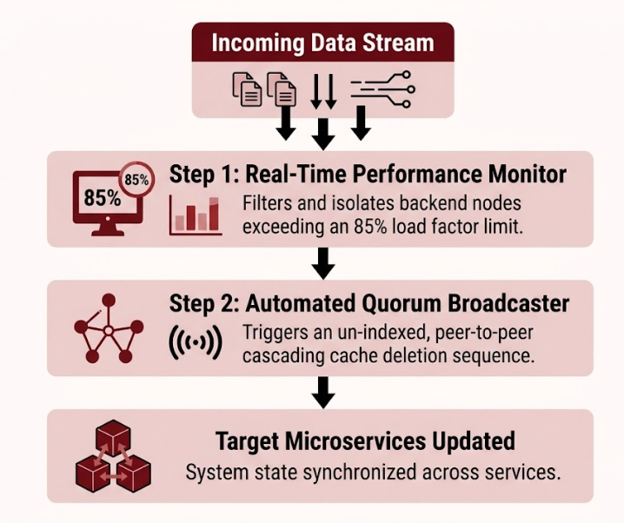
Figure 3: AI-Generated System Architecture Flow
Case Study: IPA Technologies v. Microsoft Corporation (2024)
A jury delivered a $242M verdict in favor of plaintiff IPA Technologies in a federal patent infringement lawsuit against Microsoft, finding that Microsoft’s Cortana virtual assistant infringed a patented invention conceived in the late 1990s by researchers at SRI International, a nonprofit spinoff of Stanford University.
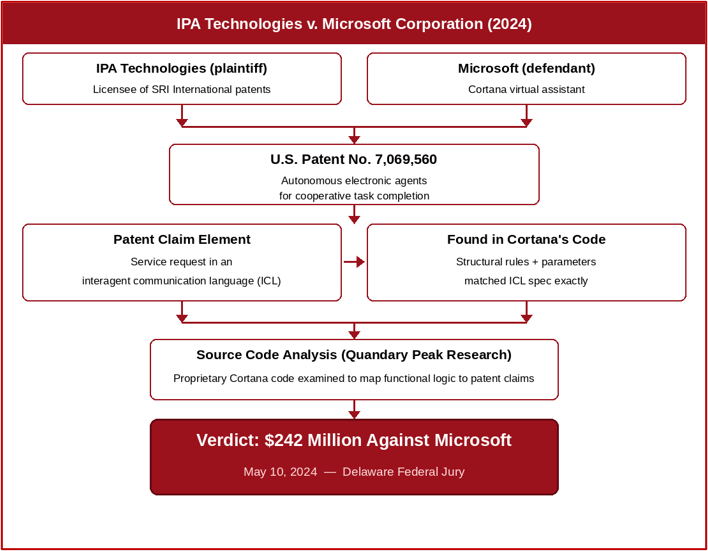
Figure 4: IPA Technologies v. Microsoft – Cortana Functional Architecture Under Patent Scrutiny
- What made this case significant for software IP: The patent claims involved methods for using “autonomous electronic agents” for “cooperative task completion,” and various elements of the patented methods related to the system’s internal design — meaning a look under the hood at Cortana’s proprietary source code was necessary to determine whether Cortana included those design elements. In other words, Microsoft’s code didn’t copy text from the patent — it independently implemented the same functional architecture, which is precisely what utility software patents protect.
- Why this connects to AI-generated code risk: This case illustrates an important legal principle: if your code replicates the functional steps and architectural logic of a patented invention—even with completely original syntax—it infringes. An AI coding assistant generating a “cooperative task completion” architecture from a developer prompt could reproduce exactly this kind of infringement without any literal copying, and no SCA scanner would catch it.
Table 1: Hypothetical Example: AI-Generated Implementation Mapped to Patent Claims
| Competitor Patent Claim Language (Hypothetical Patent “ABC”) | Your AI-Generated System Implementation
|
Infringement Status
|
| Element A: “A computer-implemented method for dynamically isolating data nodes based upon a real-time performance threshold scalar…” | Verified: The AI created a monitoring hook that filters database nodes when their load factor exceeds 0.85 | Match (Literal) |
| Element B: “…and executing a peer-to-peer, un-indexed cascading invalidation sequence on said isolated nodes.” | Verified: The system clears data by broadcasting an un-indexed deletion request that hops sequentially across the isolated cluster. | Match (Literal) |
Consider a scenario increasingly faced by modern software organizations: an AI-generated architecture independently reproduces every functional element of a competitor’s patented claim. The code looks nothing alike on the surface—different syntax, different structure—but under the hood, it does the same thing the same way. That’s enough to trigger an infringement suit. Clean code doesn’t mean safe code.
AI-Powered Invalidity Searches
If generative models are accelerating accidental patent exposure, AI-powered invalidity workflows are helping level the playing field. When an enterprise faces an infringement assertion, one of its most effective defensive strategies is to challenge the validity of the asserted patent. Under patent law, a claim is invalid if the technology already existed in the public domain before the patent’s filing date. This body of prior evidence is known as prior art.
Historically, searching for prior art was a grueling manual process requiring human specialists to guess archaic Boolean keywords and parse international filing classifications. Today, specialized engineering and legal platforms connect advanced language models natively to live global IP registries and deep academic databases. These agentic systems analyze a competitor’s patent on a claim-by-claim basis, then run deep semantic searches across billions of historical data points. They do this in a few key ways:
- Deconstructing Abstract Legal Prose: Patents are intentionally written in sweeping legal language. AI agents turn complex phrases like “a state-based distributed data-truncation mechanism” into simpler technical ideas, like “a time-to-live driven database eviction pattern.”
- Locating Non-Patent Literature: The search doesn’t stop at patent offices. These systems dig into obscure academic papers from decades ago, old technical forums, even commit histories in legacy open-source repos — anywhere the underlying logic might have been publicly demonstrated first. Establishing public availability before the patent’s priority date is often critical to an invalidity analysis.
- Automated Invalidity Mapping: Once relevant prior art surfaces, the system lines it up directly against the patent’s claims and generates the documentation needed to challenge its validity at the regulatory level. In many cases, that’s enough to significantly weaken or eliminate the basis for enforcement.
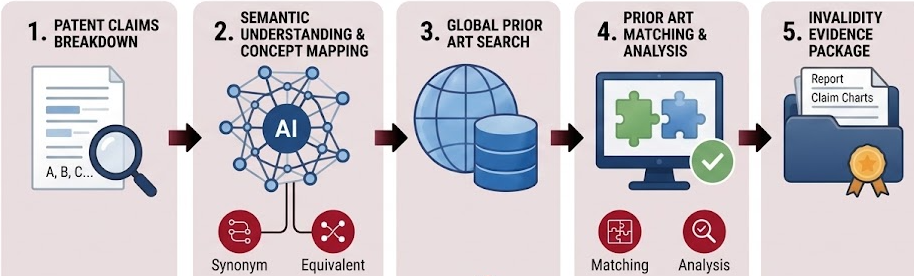
Figure 5: AI-powered patent invalidity workflow
Operational Constraints for Corporate Executives
Moving fast with AI is the goal—but doing so without considering legal exposure can create serious problems down the road. Engineering leaders and CTOs need to draw clear lines around how these tools get used.
- Separate Out the Risky Logic Layer: Avoid giving AI assistants tasks like building custom algorithms for transferring or synchronizing data or low-level optimizations; these areas have the densest clusters of patents. Instead, require teams to use existing, industry-standard open-source tools for infrastructure, leaving AI assistants to work on proprietary higher-level logic.
- Maintain Immutable Prompt Trails: Maintaining development records may help demonstrate good-faith conduct and may be relevant when courts evaluate allegations of willful infringement.
- Finding and Fixing Patent Overlaps Early: You do not need to wait until a formal disagreement to assess your position on intellectual property. Build semantic system sweep capabilities into large releases of software systems. Putting system architectures through dedicated intellectual property assessment tools will allow management to recognize overlap among patent landscapes in advance of deployment.
The Path Forward
The integration of artificial intelligence into product development is reshaping traditional approaches to corporate liability and patent risk management. Given the volume of software being generated, occasional overlaps with the vast landscape of global software patents are no longer a statistical anomaly—they are an emerging operational risk of AI-enabled software development. However, enterprises are far from defenseless. By coupling proactive architectural guardrails with advanced, AI-driven invalidity research tools, corporate leaders can confidently capture the full velocity of the AI revolution while maintaining a robust defense against intellectual property risk.