
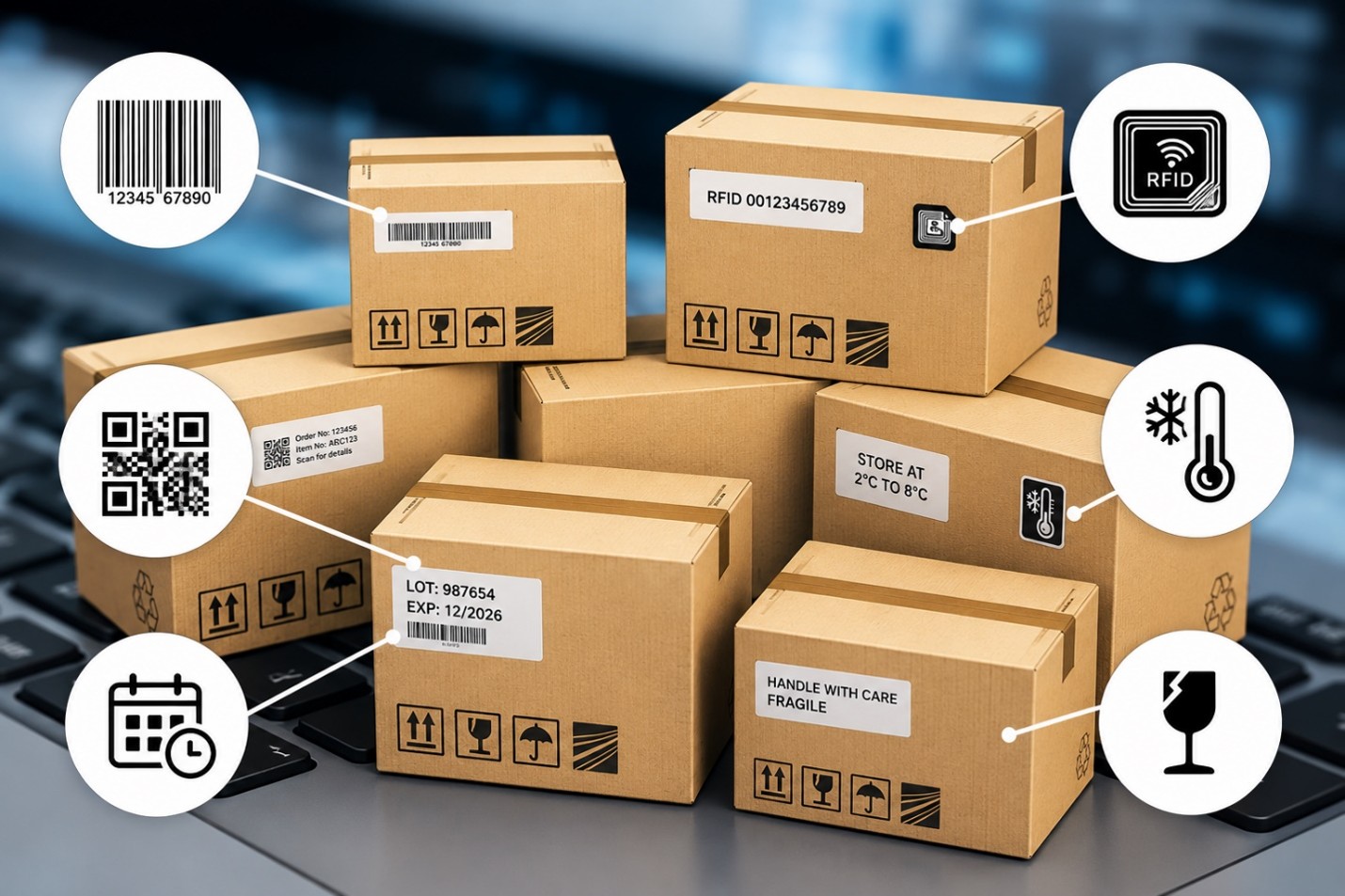
Smart packaging is transforming from a compliance requirement into a source of measurable business value. Leading Food & Beverage (F&B) companies are leveraging it to unlock consumer insights, reduce waste, and strengthen supply chain resilience.
Key Takeaways
- The worldwide market size of smart food packaging is forecasted to increase from $26.4B in 2024 to $35.7B by 2029 (CAGR of 6.2%), driven by food-safety, traceability and sustainability demand, and reinforced by initiatives such as GS1 Sunrise 2027.
- Consumer participation in digital packaging applications increased by 43% in 2024-2025 period with more than nine million SmartLabel QR code readings, indicating that the demand signal is no longer a niche trend.
- Smart packaging delivers value beyond sustainability through four key business value pools: logistics efficiency, waste reduction, branding, and counterfeit protection.
- Leading brands such as Diageo, Walmart, and Tetra Pak are already leveraging connected packaging to build competitive advantages through technologies such as NFC, AI-driven freshness prediction, and cloud-based serialization.
- The next inflection point is not QR codes, it is biosensor-integrated, AI-scored packaging that dynamically communicates shelf-life in real time, with early pilots already demonstrating 25%+ food waste reduction.
Smart Packaging Market: A $35.7B Opportunity Reshaping F&B
The packaging of food is moving far beyond simply being a protective barrier around the product. Rather, packaging is developing into an enabling platform that integrates consumers, brands, retailers, and supply chains in real-time through the power of technology. With the rapid progress of projects like GS1 Sunrise 2027, the move towards connected packaging is happening faster than ever before. And, for F&B organizations, the adoption of smart packaging is now a business necessity, not merely a matter of compliance. Smart packaging allows for better traceability, reduces food wastage, and helps create proprietary data assets.
The trend towards intelligent packaging technology is growing stronger in the F&B sector, owing to an increased focus on food safety, tracing, freshness management, and minimizing food waste. The global market value of smart packaging was recorded to be around $28.5B in 2023 and is expected to expand and attain $43.3B by 2030 at a CAGR of 6.2%. F&B make up the biggest segment of this market, accounting for 45.5% of overall market revenues through the use of RFID, freshness indicators, QR codes, and active packaging. Market size of smart food packaging is forecasted to increase from $26.4B in 2024 to $35.7B by 2029 (CAGR of 6.2%).
India is estimated to develop into one of the fastest growing countries with the smart food packaging market expected to register a CAGR of 8.9% during the forecast period (2025 – 2034). This development has been attributed to sustainability goals, the rising food safety standards, and measures adopted by the sector players like Tetra Pak in launching recyclable content cartons. More broadly, Asia Pacific will experience the highest growth rate among all regions as far as the adoption of smart packaging goes (Exhibit 1).
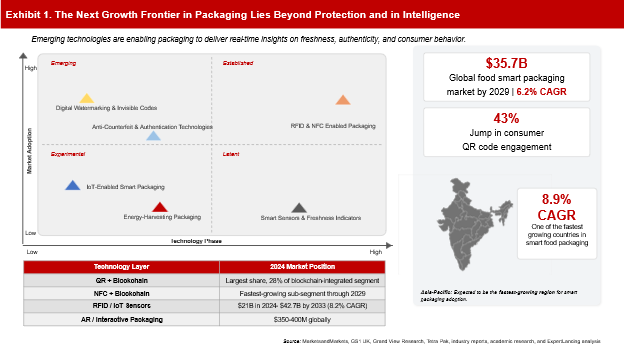
Adoption of smart packaging technology has moved from being merely traceable to becoming intelligent and interactive in nature. Although solutions such as QR code blockchains still make up most of the deployed applications, NFC-based systems and RFID / IoT sensors are fast gaining popularity due to increasing needs for visibility, authenticity, and cold chain monitoring. At the same time, innovations in AR-enabled packaging technologies are giving rise to newer uses of packaging other than that of protection.
Beyond market growth, smart packaging is increasingly becoming a boardroom priority. Rising food waste costs, stricter traceability requirements, growing consumer demand for transparency, and the need for first-party consumer data are compelling F&B companies to view packaging as a strategic business asset rather than a compliance or marketing tool.
Three Structural Forces Converging to Make Smart Packaging Adoption Inevitable
For most of the past decade, smart packaging was a pilot-program category, strategically interesting but commercially peripheral. That window is closing fast. Three structural forces are converging to make adoption both urgent and irreversible:
- Growing Regulation Fuels the Shift to Digitally Enabled Packaging: GS1 Sunrise 2027 is facilitating the transition from old 1D barcodes to highly informative 2D barcodes, which hold much more valuable information like expiry date, batch number, serial numbers, and digital content. Tesco has already moved past the dual-code phase, becoming the first UK retailer to begin retiring traditional barcodes entirely.
- Lower Cost of Technology Facilitates Connected Packaging: The cost of implementing technologies like NFC, IoT sensors, and cloud storage has dropped considerably, thus making connected packaging feasible for more businesses than just the major multinational players.
- Greater Supply Chain Visibility is Needed: Food chains becoming increasingly international and intricate have made it imperative for companies to gain greater visibility into their supply chain operations.
Connected packaging is gaining popularity at a fast pace. Approximately 82% of brand owners plan to move from using 1D barcodes to 2D barcodes in five years’ time. This change comes due to the GS1’s 2027 Sunrise initiative that aims at the universal adoption of 2D barcodes that will be scanned at retail checkout stations. The change is expected to be accelerated with the transformation within the consumer goods and F&B value chains. In line with general digitalization efforts, almost all brands (96%) plan to invest more in connected packaging.
Consumer demand is increasingly centered on transparency, freshness assurance, and easy access to product information
There have been notable improvements in the consumer demand signal. The interaction of consumers with SmartLabel QR Codes rose by 43% from 2024 to 2025, with a total of over nine million scans in the year previous, showing that the act of scanning has become an everyday grocery activity. Research from GS1 revealed that 77% of consumers want more information to be available immediately on their products through packaging.
But the transparency mandate requires more than ingredient labels. Food freshness continues to be an essential concern for perishables, such as meat and dairy products, produce. Here, traditional “best-before dates” are simplistic and ultimately cause wastage while diminishing consumer confidence. With biosensors in their new packaging, companies can convey actual product freshness rather than relying on statistical dates that lead to more wastage. The business case is clear: brands who act fast will transform a regulatory requirement into a selling point.
The critical user experience consideration for corporate decision-makers is that consumers see the QR code scan as an obstruction rather than a bonus, one that sometimes serves as a vehicle for withholding information from consumers (a poor scan experience can hide rather than reveal information). The idea here is that connected packaging needs to provide information instantly without any barriers, so technology is just the beginning of earning consumer trust.
Four Commercial Value Pools Beyond Sustainability
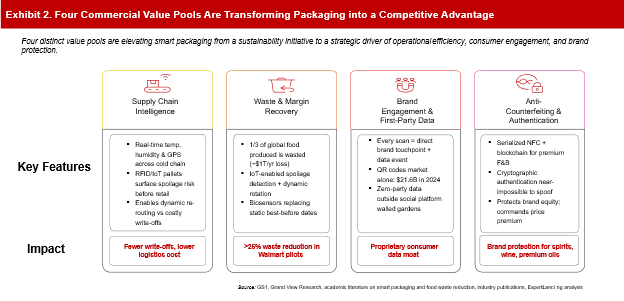
While sustainability is still a key benefit, the leading F&B companies are now focusing on smart packaging due to its direct business benefits. There are four value pools that appear to have the greatest impact on creating business value.
1. Supply Chain Intelligence
Real-time temperature, humidity, and location tracking across cold chains. RFID and IoT-enabled pallets surface spoilage risk before it reaches retail, enabling dynamic re-routing and preventive discounting rather than write-offs. Industry 4.0 research confirms that smart labels and RFID are materially reducing food loss and waste across the production-to-retail chain.
2. Waste and Margin Recovery
Globally, one-third of all food produced is wasted, an economic loss approaching $1 trillion annually. Intelligent packaging with IoT integration enables proactive spoilage detection and dynamic inventory rotation that cuts these losses at retail and distribution level.
3. Brand Engagement and First-Party Data
Every scan of a connected package is a direct brand interaction and a data event. The QR codes segment alone was valued at $21.6B in 2024, enabling brands to deliver promotions, personalized recipes, and sustainability data, while capturing zero-party consumer data outside the walled gardens of social platforms.
4. Anti-Counterfeiting and Authentication
For premium F&B categories, spirits, wine, premium olive oil, serialized NFC and blockchain-backed packaging provides cryptographic authentication that is near-impossible to spoof. This protects brand equity and enables premium pricing among consumers who view authentication as a proxy for quality (Exhibit 2).
Leading Brands Are Redefining Packaging as a Competitive Advantage Lever
Diageo, Johnnie Walker Blue Label: NFC + Generative AI Personalization
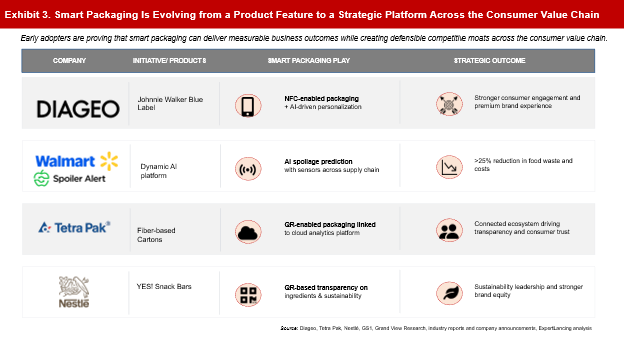
NFC technology has been utilized by Diageo to incorporate it into the Johnnie Walker Blue Label bottles, providing consumers with the ability to authenticate the product, access personalized information, and enjoy unique digital experiences when using their smartphones for interaction. The brand launched a personalization campaign using a generative AI system in March 2025 to customize its labels.
Walmart × Spoiler Alert: AI + IoT Sensor Integration
The Spoiler Alert AI-driven inventory optimization software was used to allow retailers to determine excess food, forecast the selling ability, and manage markdowns as well as redistributions automatically. As stated by a 2025 peer-reviewed industry analysis, Walmart pilot stores reduced waste by more than 25%, driven by inventory tracking, demand forecasting, and dynamic pricing adjustments. Although the industry analysis provides impressive results of food waste reduction efforts, there are no public primary sources mentioning packaging-embedded sensors in the Spoiler Alert system.
Tetra Pak: QR + Cloud Analytics
In the third quarter of 2024, Tetra Pak introduced a connected packaging platform featuring a combination of QR codes and cloud-based analytics to provide consumers with real-time information about their products. In February 2025, Tetra Pak added a sustainable innovation to its portfolio by introducing carton packaging that incorporates 5% certified recycled polymers in India.
Nestle: The Sustainability and Transparency Play
QR-enabled packaging was adopted by Nestle for its YES! snack bar products, giving consumers direct information on sourcing ingredients, environmental footprint, and more. This enhances the credibility of their sustainable products while increasing visibility at the same time (Exhibit 3).
In a similar manner, Others company such as, Unilever adopts QR-enabled packaging on several products with information related to recycling process and information related to ingredients and use of the product. This eliminates the need for printing material and increases consumer engagement. Both Nestle and Unilever have used such technology in line with sustainability goals and customer experience. Then PepsiCo’s ‘Press Play on Summer’ campaign with Bad Bunny deployed QR codes on limited-edition Pepsi bottles that unlocked Apple Music
The Next Generation of Smart Packaging: From QR Codes to Intelligent, AI-Scored Products
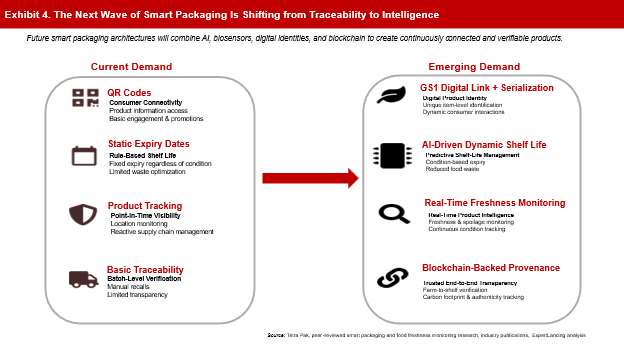
QR Codes are today’s mainstream reality. They’re not the end-game either. There’s a new architecture for connected packaging coming from four intersecting technology layers that will redefine the entire category from 2026 to 2030.
Biosensor Integration
Electrochemical sensors printed on paper that monitor for microbial activity, changes in pH, and the composition of gases within the pack, feeding information about freshness levels to cloud-based dashboards and apps. Not just a laboratory idea: it is now being rolled out commercially in meat and fish products.
AI-Driven Dynamic Expiry
ML models trained on condition and spoilage data can replace static “best-before dates” with dynamically computed shelf-life estimates, improving safety while cutting food waste. Milk cartons that alert before spoilage is no longer hypothetical; they are a practical solution entering commercial deployment.
GS1 Digital Link + Serialization
GS1 Digital Link-enabled 2D codes give each product a unique digital identity. Brands can update promotions, recall notices, and location-based content after shipment without changing the package, providing greater flexibility and responsiveness.
Blockchain-Backed Provenance
Trusted traceability from farm to shelf enables consumers to access verified information about a product’s origin, cultivation practices, and carbon footprint. This is especially valuable for premium products, where authenticity and source information strongly influence purchasing decisions and the risk of fraud is higher (Exhibit 4).
The executive agenda for the next 18 months is straightforward: audit your current labelling and packaging architecture against GS1 Sunrise 2027 requirements, identify the highest-value commercial use case across the four value pools, not the easiest to implement, and initiate a pilot that generates proprietary consumer or supply chain data. The companies that treat the barcode transition as a compliance exercise will meet the minimum. The ones that treat it as a platform moment will define the next decade of F&B brand differentiation.
Future Outlook: AI, Sensors, and Digital Identity Redefine the Role of Packaging
At this stage, smart packaging is at its strategic inflection point where the emphasis will not be on deploying the technologies but on creating value. This means that competitive advantage will not be generated by the adoption of QR codes, sensors, and other identification mechanisms on the package, but rather in the ability of firms to transform the information gathered through packaging into meaningful business insights. Over the next decade, packaging is set to become a platform of enterprise-wide intelligence, connecting consumers, products, and supply chains for better decision-making, more engaging consumer relationships, more efficient stock control, and environmental sustainability. Those firms which successfully manage to incorporate packaging intelligence into their overall digital strategy will be able to leverage their data advantage and grow their business.