
Why the future of invalidity work belongs not to the teams that merely find compelling references, but to the teams that can prove, defend, and transport their search record across forums.
Key Takeaways
- A prior art search record is the first line of a legal argument, not a passive research file.
- Methodology is evidence; if the process cannot be defended, the reference may be discounted.
- Dependent claims are frequently where validity disputes are won or lost.
- Resilient invalidity strategy depends on redundancy, combination theories, and documented fallback positions.
- Technical relevance without evidentiary reliability is not litigation value.
Introduction
The most dangerous document in patent litigation is not a weak reference. It is a strong reference attached to an indefensible search record. In practice, invalidity positions fail as often from documentation weakness as from technical insufficiency. The issue is not always what was found. It is whether the record can withstand scrutiny when methodology, scope, evidentiary support, and claim logic are placed under pressure.
In this article, we examine what litigation counsel expects from a prior art search record, why methodology increasingly functions as evidence, and how claim analysis, evidentiary reliability, strategic redundancy, and forum-aware documentation determine whether prior art becomes a usable litigation asset or remains merely a research artifact.
The Accountability Crisis in Prior Art Practice
There is a quiet accountability crisis running through prior art practice. Search teams often produce technically impressive references, yet those references fail to mature into litigation assets because the record around them is too thin to survive adversarial review. The documentation is vague. The search path is opaque. The rationale for inclusion and exclusion is missing or incomplete. The evidentiary footing is assumed instead of established.
That mismatch creates a predictable problem for counsel. A reference may appear powerful on first review, only to become fragile once the questions start: Why were these databases chosen? Which classes and keywords were used? What was omitted? How were dependent claim limitations handled? What proof exists that the source was publicly accessible before the relevant date? If the record cannot answer those questions cleanly, opposing counsel gains an attack path that is independent of the technical merits.
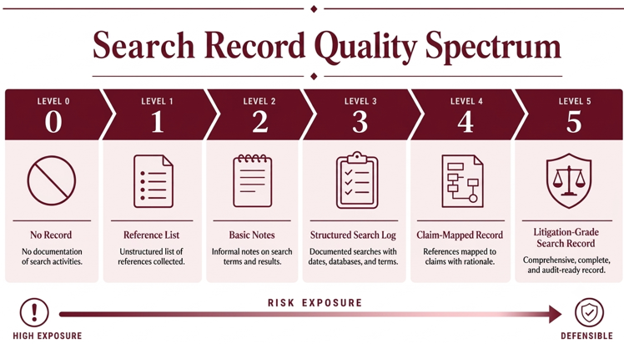
Figure 1: Search record quality spectrum. The practical shift is from a research artifact to a litigation asset: documented scope, claim-linked reasoning, and evidentiary support become progressively more important as a search approaches real dispute use.
Finding Is Not Proving
Finding prior art and proving invalidity are related exercises, but they are not the same one. Research identifies potentially relevant material. Litigation requires a structured chain of reasoning that connects claim language, search logic, reference selection, legal theory, and evidentiary proof. A ranked reference list with technical annotations may be useful internally, but it is not yet a litigation-grade deliverable.
This distinction matters because litigation counsel does not inherit only the references; counsel inherits the record. If that record does not explain how the search was designed, how the claim language was interpreted, how candidate references were filtered, and how publication proof was validated, the search product arrives with embedded risk. The result may still be intelligent, but it is not yet defensible.
The practical implication is straightforward: search teams should stop measuring quality solely by whether they found a seemingly decisive document. The better question is whether the search file can be read as the opening architecture of a legal argument.
Methodology Becomes Evidence
In litigation, methodology is not background detail. It becomes evidence. Opposing counsel will examine search breadth, database sequencing, classification logic, query construction, and iteration history for signs that the process was incomplete, biased, or strategically narrow. A search record that cannot narrate its own method invites distrust even when the underlying art is strong.
The answer is not volume. It is architecture. Litigation-grade search records are built so that a third party can follow the reasoning from start to finish. Search strings are preserved. Jurisdictional coverage is explained. Inclusion and exclusion decisions are documented. Changes in direction are captured with purpose rather than hidden as informal trial and error. What looks like administrative discipline is, in fact, defensive infrastructure.
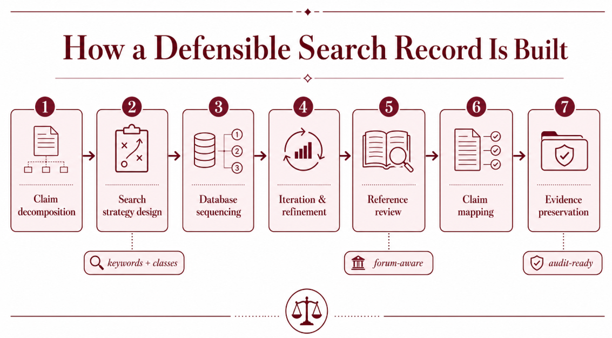
Figure 2: A defensible search record is cumulative. It begins with claim decomposition, moves through intentional search design and iteration, and ends with claim mapping plus evidence preservation. The process must be legible enough to survive retrospective attack.
Claims Are Not the Starting Point; They Are the Entire Point
The most reliable predictor of whether a search will produce usable litigation value is the quality of its claim analysis. Strong searches do not merely orient around the technology. They work claim by claim, element by element, limitation by limitation. They treat dependent claims with the same seriousness as independent claims because litigation often turns on the narrower features that distinguish commercial reality from broad conceptual framing.
This is where many search efforts underperform. Teams locate references that are technologically similar but legally misaligned. They collect material that looks persuasive until someone asks whether the specific structural element, process step, timing relationship, range, or functional requirement is actually disclosed. Without disciplined claim interpretation, technical similarity can become a trap rather than a strength.
Claim-centric work also forces precision earlier in the process. It sharpens query design, improves classification choices, and exposes where a search is overinclusive in some areas and dangerously shallow in others. That precision is not pedantry. It is what allows counsel to build confidence that the art supports the actual dispute, not merely the general technology space.
The Myth of the Decisive Reference
There is a persistent tendency in invalidity work to overvalue the single decisive reference. Such references do exist, but they are exceptional. In most serious disputes, invalidity is built from a portfolio of theories: stronger and weaker references, anticipation arguments, obviousness combinations, and fallback positions that absorb the failure of any one theory without collapsing the entire case.
That is why mature search records are designed for resilience rather than romance. They do not merely ask, “What is the best reference?” They ask, “What combination of references, rationales, and evidence gives counsel the widest credible strategic range?” A well-built record acknowledges that one lead theory may weaken under claim construction, evidentiary challenge, or forum-specific constraints. Redundancy is not inefficiency; it is litigation insurance.
Thoughtful use of combination theories matters especially in light of modern obviousness practice. If the law permits broader, better-supported combinations, then search records must do more than list references in isolation. They must document why the references work together, what motivation exists, where the support gaps are, and how those gaps are addressed before the theory reaches expert or tribunal review.
The Evidentiary Threshold Cannot Be Deferred
A technically perfect reference is worthless if it cannot be proved. Yet evidentiary work is still too often postponed until it becomes urgent. Publication dates are assumed. Public accessibility is inferred. Authentication is left for later. That sequence turns evidentiary proof from a manageable design question into an emergency response.
Litigation counsel increasingly treats evidentiary reliability as a threshold requirement, not a cleanup task. A reference that cannot be dated reliably, authenticated credibly, or shown to have been publicly accessible before the relevant priority date is not just weakened; it may become unusable. The search record must therefore preserve proof in parallel with relevance analysis.
That means validating dates early, identifying source provenance, preserving archival records, and preferring materials whose accessibility can be shown with confidence. It also means documenting the status of that proof within the record itself rather than allowing evidentiary assumptions to remain invisible. The stronger the reference, the more dangerous it is to leave evidentiary questions unanswered.
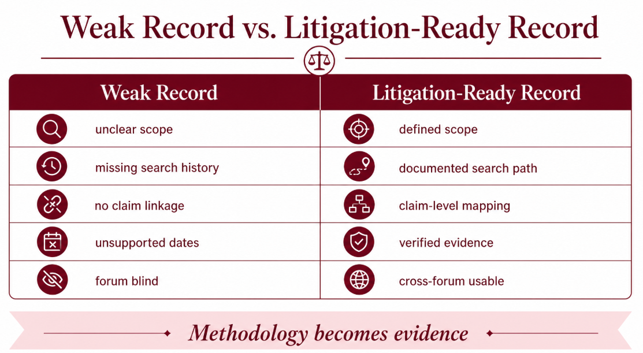
Figure 3: Side-by-side comparison of fragile and defensible search records. The difference is not rhetorical polish; it is whether scope, search path, claim linkage, evidentiary support, and forum usability were designed into the record from the start.
Forum Portability and Strategic Intelligence
A search record that cannot travel across forums has already surrendered strategic value. District court, IPR, opposition, and cross-border advisory work do not impose identical expectations. The legal theories, evidentiary burdens, timing constraints, and practical uses of a search record vary. Yet search teams often produce a single generic package that is not optimized for any of them.
Forum-aware search design does not require writing different realities for different venues. It requires building a record that is explicit about priority assumptions, claim interpretation choices, search scope, and evidentiary support so that counsel can adapt the work without reconstructing it. Portability is a product of transparency. A record that discloses its reasoning can be repurposed. A record that hides its logic must be rebuilt.
Strategic intelligence also reaches beyond the references themselves. Priority-chain weakness, prosecution history signals, family variations, foreign counterpart activity, and market-wide technical saturation may all shape which prior art story matters most. These elements do not replace claim mapping. They enrich it by helping counsel understand where the most durable arguments are likely to sit.
Practical Implication: Build the Record Like It Will Be Challenged
The highest standard in prior art work is not exhaustive searching for its own sake. It is disciplined searching that leaves behind a coherent, auditable, claim-linked, evidence-backed record capable of surviving attack. A shorter record can outperform a longer one if its logic is visible, its evidentiary support is real, and its strategic design is clear.
For search teams, that means shifting the mindset from “How many references did we find?” to “Can counsel defend the way we found them?” For litigation counsel, it means evaluating search work not only by technical relevance, but by transportability, evidentiary integrity, and readiness for adversarial use. For clients, it means understanding that process quality is not administrative overhead. It is part of substantive legal value.
The future of prior art practice belongs to teams that treat the search record as a legal asset from day one. That is where invalidity work stops being merely informative and starts becoming strategically decisive.
The Litigation-Ready Audit
A search record is only as valuable as its ability to withstand scrutiny. The following audit checklist identifies the foundational elements of a litigation-ready prior art search record:
- Document claim interpretation element by element, including dependent limitations that may control the real dispute.
- Preserve search strings, classifications, databases, sequencing choices, and iteration history.
- Explain why references were included, why others were rejected, and where any scope limitations remain.
- Verify publication dates and public accessibility using reliable, documented evidence.
- Build multiple theories where warranted, including combination rationales and fallback positions.
- Draft the record so it can be understood by counsel, experts, and hostile reviewers who were not present during the search.
Wrapping Up
A prior art search that locates compelling art but fails to document a defensible record has completed only part of the task. The remaining challenge is ensuring that the art can withstand scrutiny when it is ultimately relied upon. Litigation counsel does not necessarily need more references. They need greater confidence that the references already identified can withstand evidentiary, procedural, and strategic challenge. A well-constructed search record provides that confidence by linking claim analysis, search methodology, evidentiary support, and legal theory into a coherent and defensible whole. As patent disputes become increasingly complex, the ability to build a search record that survives scrutiny is becoming just as important as the ability to find relevant prior art in the first place. That is the standard sophisticated clients increasingly expect, and the standard effective prior art practice requires.