

Client Situation
A global medical device company wanted to identify where to focus its airway management portfolio over the next 5-7 years. The company had exposure across airway products but needed a sharper strategy across product segments, hospital channels, emergency care use cases, and high-growth regions.
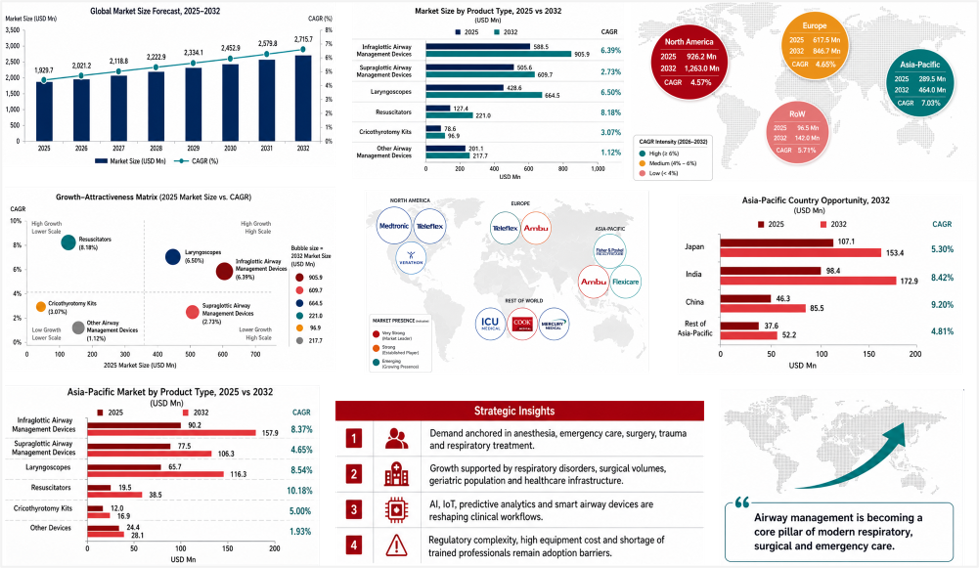
The airway management market includes devices and tools used to keep a patient’s airway open during anesthesia, emergency care, surgery, trauma care, and respiratory treatment. The market is projected to grow from USD 1.93 billion in 2025 to USD 2.72 billion by 2032, at a 5.05% CAGR. Growth is being driven by respiratory disorders, higher surgical and critical-care admissions, aging populations, healthcare infrastructure expansion, and adoption of smart, non-invasive, AI/IoT-enabled airway technologies.
Client Challenge
The client’s core question was not simply, “Is the market growing?” The real question was: Where should we compete, with which products, in which regions, and through which end-user channels?
The challenge was that the market appeared attractive at the headline level, but growth was uneven across segments. North America and Europe offered scale, while Asia-Pacific offered faster growth. Hospitals dominated demand, but ambulatory care was growing faster. Infraglottic devices represented the largest segment, while resuscitators and laryngoscopes showed stronger growth momentum.
Our Approach
We converted the market report into a decision-ready growth case by analyzing the market through five lenses:
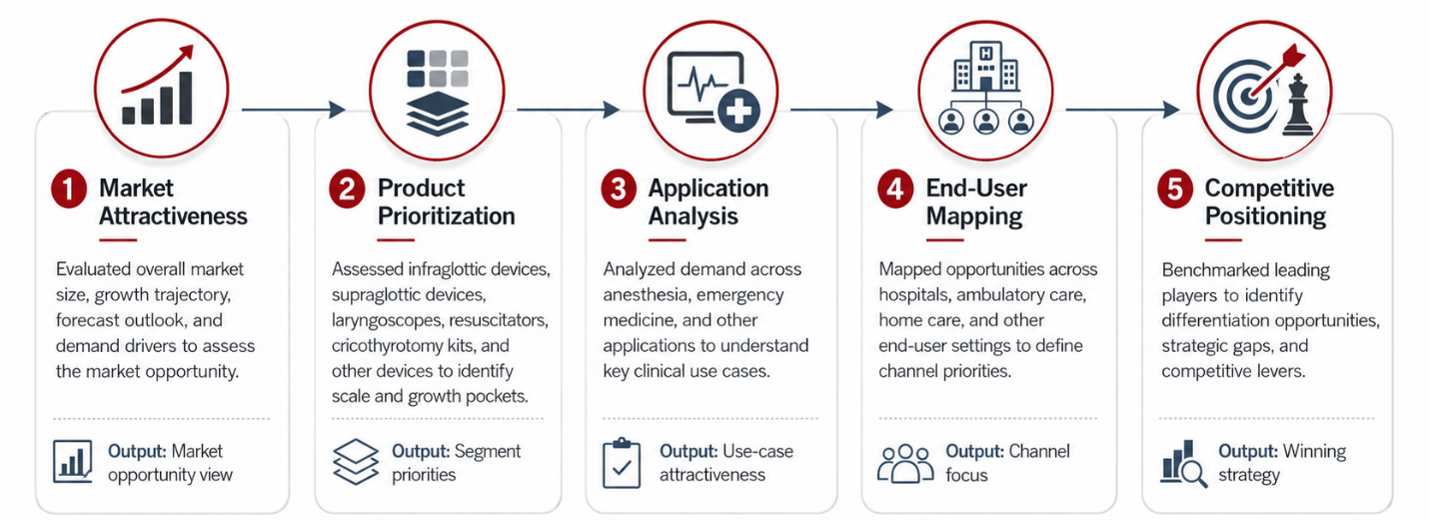
1. Market Attractiveness – Overall Market Size, Growth and Forecast Trajectory
We evaluated the overall market potential by analyzing market size, growth trends, forecast trajectory, and key demand drivers. This helped identify the long-term commercial attractiveness of the airway management market and prioritize investment opportunities.
2. Product Prioritization – Infraglottic Devices, Supraglottic Devices, Laryngoscopes, Resuscitators, Cricothyrotomy Kits, and Other Devices
We benchmarked each product segment based on market size, growth rate, clinical importance, and future demand. This enabled the client to identify which product categories should be defended for scale and which offered the strongest growth opportunities for future investment.
3. Application Analysis – Anesthesia, Emergency Medicine, and Other Applications
We assessed demand across major clinical applications to understand where airway management devices are most frequently used and how demand is evolving. The analysis highlighted differences in product requirements, purchasing behavior, and growth potential across surgical, emergency, and respiratory care settings.
4. End-User Mapping – Hospitals, Ambulatory Care Settings, Home Care Settings, and Other Users
We analyzed demand across different healthcare settings to identify the most attractive customer segments and procurement channels. This helped define channel-specific strategies based on purchasing priorities, adoption patterns, and future growth potential.
5. Competitive Positioning – Benchmarking Leading Companies
We benchmarked leading global players, including Medtronic, Teleflex, Fisher & Paykel Healthcare, Stryker, Ambu, Verathon, ICU Medical, Cook Medical, Flexicare, and Mercury Medical, across product portfolios, innovation, geographic presence, and competitive strengths. This identified market gaps, differentiation opportunities, and strategic positioning for the client.
Key Findings
Hospitals remain the core commercial battleground: Hospitals are the largest end-user segment, increasing from USD 1.73 billion in 2025 to USD 2.44 billion by 2032, supported by surgical, emergency, ICU, and trauma-care demand. Hospitals also prioritize reliability, regulatory compliance, infection control, and integration with monitoring systems, making them the most important target channel for premium airway management devices.
Infraglottic devices are the largest product opportunity, but resuscitators and laryngoscopes how stronger growth: Infraglottic airway management devices are projected to grow from USD 588.5 million in 2025 to USD 905.9 million by 2032, while laryngoscopes grow at 6.50% CAGR and resuscitators at 8.18% CAGR. This suggests a dual strategy: defend the large infraglottic core while building faster-growth positions in visualization and emergency-response devices.
Anesthesia is the dominant application, but emergency medicine requires a different product strategy: Anesthesia represents the largest application segment, growing from USD 1.29 billion in 2025 to USD 1.91 billion by 2032. Demand is linked to surgical volumes, older and high-risk patients, and operating-room safety. Emergency medicine is smaller but strategically important, requiring quick-deployment, portable, ergonomic, and easy-to-use devices for trauma, cardiac arrest, respiratory distress, and prehospital care.
Asia-Pacific is the growth engine, while North America remains the scale market: North America remains the largest regional market, rising from USD 926.2 million in 2025 to USD 1.26 billion by 2032. However, Asia-Pacific is expected to grow the fastest, from USD 289.5 million to USD 464.0 million, at 7.03% CAGR, driven by healthcare infrastructure expansion, demographic shifts, rising healthcare spending, and improved access to surgical and emergency care.
Strategic Recommendations
- Prioritize a hospital-first growth strategy: Hospitals should remain the anchor channel because they account for the majority of demand and influence purchasing standards across operating rooms, ICUs, emergency departments, and trauma centers.
- Build a two-speed product portfolio: The client should maintain leadership in infraglottic airway devices while investing selectively in higher-growth laryngoscopes and resuscitators. Video laryngoscopy, single-use devices, antimicrobial-coated tubes, AI-assisted intubation tools, and portable emergency devices should be treated as priority innovation areas.
- Treat Asia-Pacific as the expansion market, not just a distribution market: The region requires localized pricing, distributor partnerships, clinical training, and value-engineered product variants. Premium products can target tertiary hospitals, while cost-effective and portable devices can address secondary hospitals, emergency care, and public procurement.
- Compete on training and adoption, not product alone: Skill variability and lack of trained professionals are major barriers. The client should bundle devices with clinical education, simulation programs, and protocol-based training for anesthesiologists, emergency physicians, nurses, and first responders.
- Use infection control as a commercial differentiator: Single-use airway devices, disposable circuits, and products designed to reduce cross-contamination should be positioned strongly, especially in hospitals, ICUs, emergency rooms, and ambulatory surgery centers.
What the Client Got
The client received a clear, decision-ready growth roadmap that converted a broad airway management market opportunity into prioritized actions. They gained clarity on:
- Where to compete: hospitals as the anchor channel, with ambulatory and emergency care as growth adjacencies.
- Which products to prioritize: defend infraglottic devices while investing in faster-growing laryngoscopes and resuscitators.
- Which regions to focus on: North America for scale and Asia-Pacific for high-growth expansion.
- How to win: combine product innovation, infection-control positioning, clinical training, distributor partnerships, and regulatory readiness.
- What to do next: build a two-speed portfolio strategy with solutions for advanced hospitals and value-engineered devices for emerging markets.
Partner with ExpertLancing to turn complex market data into clear growth strategy. We help MedTech and healthcare companies identify where to compete, which segments to prioritize, and how to build execution-ready market entry and expansion roadmaps.