

At a Glance
South Africa looked attractive on paper. Smoking prevalence was rising. Vaping was growing fast. For a global tobacco and next-generation products player, it looked like a market worth serious capital. But the real story was sitting underneath. Illicit product had captured most of the demand. One incumbent controlled the legal cigarette channel. The same player also had a grip on the domestic leaf supply chain. We helped the client separate the real opportunity from the surface-level growth story, then redirect capital away from the value trap and toward the segments where defensible value still existed.
The Situation
South Africa looked like a strong entry market. Smoking prevalence had moved from roughly 20% in 2017 to nearly 26% by 2021. Vaping was growing quickly. And as the largest and most developed tobacco market in Sub-Saharan Africa, the country looked like a natural gateway into the wider continent.
For our client, a global tobacco and next-generation products manufacturer, this was not a light-touch market scan. They were considering real capital. A stronger NGP push.
South Africa was one of the most distorted tobacco markets in the world. The five-month tobacco sales ban during the 2020 lockdown had pushed consumers into illicit product at scale. That shift did not reverse when the ban ended. Legal, duty-paid cigarette volumes fell from 21. 3 billion sticks in 2019 to 13. 5 billion in 2022. Demand had not disappeared. It had moved into untaxed product.
One multinational controlled around three-quarters of the legal cigarette channel. The same player bought more than 90% of domestic tobacco leaf through the country’s only green-leaf processor. So, this was not just a growth market with execution risk. It was a market where most demand sat outside the legal channel, the legal channel was heavily concentrated, and the domestic leaf supply chain was effectively controlled by one incumbent.
Then regulation added another layer. A major tobacco control bill was moving through the system. A new e-liquid excise was already changing the economics of vaping. Cigarettes, vaping, heated tobacco, oral nicotine, every segment was facing pressure at the same time. The client’s question was simple. Does South Africa reward entry, or punish it?
Our Approach
We began by decomposing the full value chain and surfaced the defining structural fact: the domestic leaf-to-cigarette chain was a near-monopsony, with one processor selling 80-95% of its output to one dominant buyer, while the vaping chain had no link to domestic agriculture and was almost entirely import-dependent, with roughly 96% of devices sourced from China. These were not one market but two, demanding entirely different strategies.
Because the size of the illicit market was actively disputed, with industry-funded research claiming 70% and independent academic work estimating 54-58%, we refused to anchor on a single number. We triangulated multiple independent sources and presented a defensible range with the biases named, noting the legal industry’s commercial incentive to inflate illicit estimates.
We then assessed competitive concentration, read the pending regulatory bill clause by clause for commercial impact, and modelled the new flat e-liquid excise, which penalized the large-format bottles favoured by experienced vapers while barely touching the cheap disposables favoured by younger users. Finally, we scored five candidate entry routes through a Porter’s Five Forces lens to rank them by risk-adjusted attractiveness.
What We Found
The conventional opportunity was a value trap. With the illicit market at 54–63% of total volume, the majority of demand growth was, by definition, inaccessible to a compliant player. Entering combustible cigarettes meant fighting an incumbent holding 75% of the legal market and an untaxed grey market simultaneously, for a shrinking, low-margin slice, while carrying direct exposure to the illicit-trade contagion and the reputational and tax-integrity risk that came with it.
The genuine opportunity lay elsewhere. Vaping was the real growth vector, with sales rising from R1.25bn in 2019 to R1.7bn in 2021, but it was now regulation-exposed, with a new excise compressing margins. The excise design itself was pushing demand toward affordable disposables, the fastest-growing and youngest-skewing segment, a commercial signal paired with a reputational warning. And the import-dependent supply chains, the heated-tobacco niche, oral nicotine, and emerging CBD adjacencies offered routes that sidestepped the illicit-cigarette battleground entirely, and crucially, were insulated from the leaf monopsony and the illicit dynamic.
The Results
We reframed the client’s entire thesis. The most valuable outcome was steering them away from a conventional cigarette push, where the growth was structurally unreachable and the risks acute, and toward the next-generation and supply-adjacent opportunities where defensible value existed. That insight alone protected the client from deploying capital into a value trap.
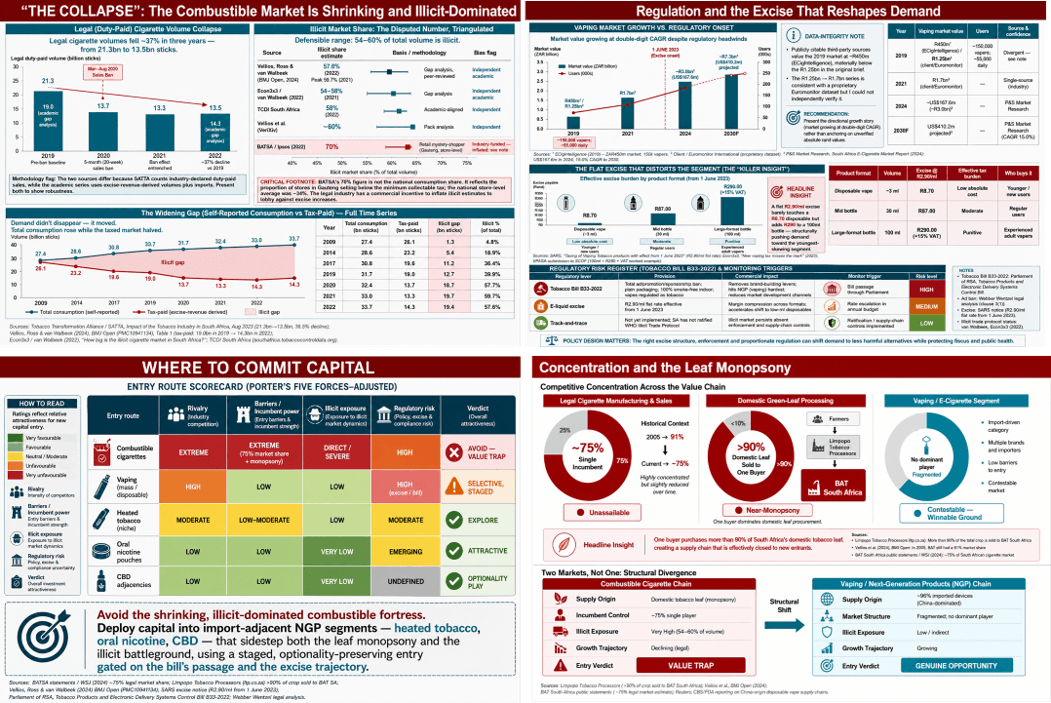
The illicit-trade and regulatory analysis gave them a quantified view of systemic risk and a set of policy triggers to monitor, the bill’s passage, the excise trajectory, and track-and-trace progress, enabling a staged, optionality-preserving entry rather than an irreversible bet. The concentration analysis showed precisely where the incumbent was unassailable, the legal channel and the domestic leaf chain, and where the market was genuinely contestable, the fragmented vaping segment, focusing resources on winnable ground. And the excise-design finding equipped them to anticipate the demand shift toward disposables ahead of the regulatory scrutiny that has since followed vaping worldwide.
A market that looked attractive on the surface, but was structurally hostile to compliant entry, was decoded into a precise map of where, and where not, to commit capital, with every risk named, sequenced, and made monitorable.
Client Value Delivered
- Protected capital by identifying the legal cigarette market as a structural value trap before entry.
- Redirected investment toward fragmented, high-growth next-generation product opportunities with stronger competitive potential.
- Mapped where incumbents were effectively unassailable versus where the market remained genuinely contestable.
- Equipped the client with a regulatory monitoring framework to support phased, lower-risk market entry decisions.
- Improved strategic confidence through evidence-based assessment of illicit trade, competition, and policy risk.
Conclusion
South Africa presented growth on the surface but significant structural barriers beneath. By distinguishing attractive opportunities from hidden risks, ExpertLancing enabled the client to avoid capital misallocation, focus on genuinely contestable next-generation product segments, and enter the market with a strategy grounded in evidence rather than assumptions. The result was a clearer investment roadmap, stronger risk visibility, and greater confidence in where and where not to compete.