

Client Situation
A global water technology and treatment equipment company wanted to identify where to focus its portfolio and commercial investments over the next five years. The company had exposure across filtration, disinfection, sludge treatment, desalination, and integrated treatment systems, but needed a sharper view of where growth would come from across applications, product categories, treatment stages, regions, and competitive segments.
Client Challenge
The client’s key question was where should they compete, which technology segments should they prioritize, which regions should receive investment, and how should we position against established global and regional competitors?
The challenge was that the market was large but moderately growing. Growth was not evenly distributed. Municipal applications were growing faster than industrial applications, primary treatment and filtration were the strongest segmental growth pools, and APAC was both the largest and fastest-growing region. At the same time, high buyer power, high rivalry, high capex requirements, and evolving regulations created pressure on pricing, margins, and execution.
Our Approach
We converted the report into a decision-ready growth case by analyzing the market through five strategic lenses.
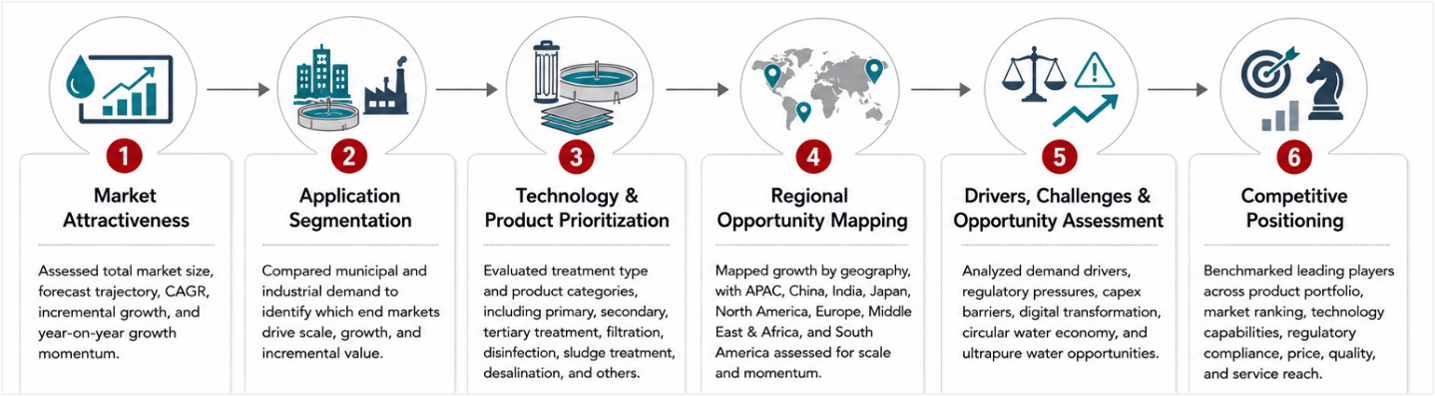
- Market Attractiveness: We assessed the overall market size, forecast trajectory, incremental growth, and year-on-year growth pattern. This established that the market offers a large, stable opportunity, but one where companies must win share through disciplined segment prioritization and differentiated offerings rather than relying only on market expansion.
- Application Prioritization: We analyzed municipal and industrial applications to identify which end markets were driving growth. Municipal was the larger and faster-growing segment, expanding from USD 45.46 billion in 2025 to USD 61.22 billion in 2030, contributing 69.4% of incremental market growth.
- Treatment Type and Product Prioritization: We evaluated treatment-stage segments and product categories to identify where technology investment should be focused. Primary treatment was the largest and fastest-growing treatment-stage segment, while filtration was the leading product-type segment.
- Regional Expansion Mapping: We assessed regional growth and country-level opportunities. APAC was the largest region in 2025 and is expected to remain the largest in 2030, contributing 42.7% of total incremental growth. China and India were identified as critical APAC markets.
- Competitive Positioning: We benchmarked the competitive landscape across global leaders, specialized technology providers, and regional engineering players. The report identifies a fragmented and intensely competitive market, with major players including Veolia, Xylem, SUEZ, Ecolab, DuPont, Pentair, Grundfos, Kurita, Organo, Thermax, Trojan Technologies, Sulzer, and others. The most important differentiators in 2025 were price, quality, and regulatory compliance.
Key Findings
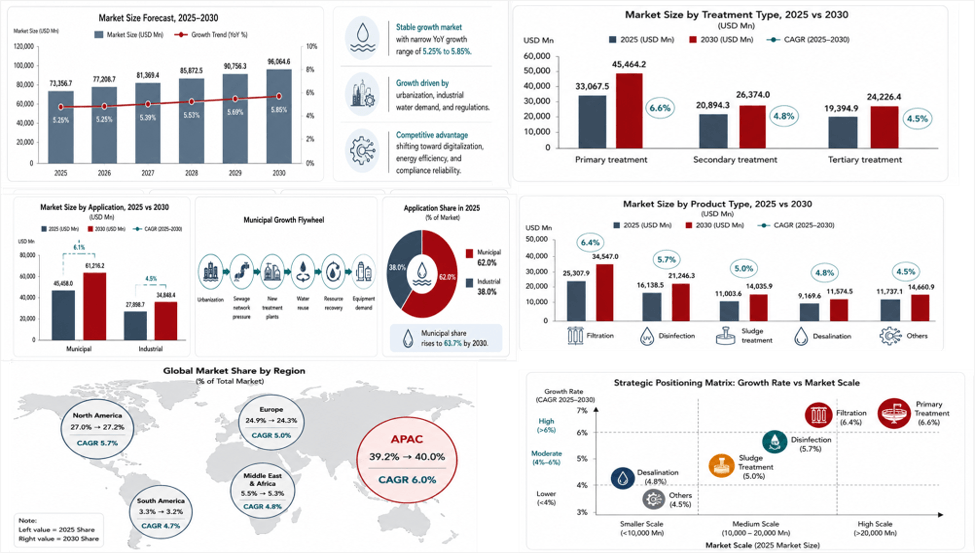
- Market growth is meaningful, but not automatic: The market is forecast to add USD 22.71 billion between 2025 and 2030, but the report characterizes this as a low-growth environment where companies must be both aggressive and defensive. Gaining share from competitors becomes an important lever for growth.
- Municipal is the anchor application segment: Municipal applications accounted for 62.0% of the market in 2025 and are expected to rise to 63.7% by 2030. Growth is driven by urbanization, pressure on sewage networks, public health requirements, filtration, disinfection, sludge management, water reuse, and resource recovery.
- Primary treatment is the strongest treatment-stage opportunity: Primary treatment is projected to grow from USD 33.07 billion in 2025 to USD 45.46 billion in 2030, at 6.6% CAGR, contributing 54.6% of incremental growth by treatment type. It remains critical because it protects downstream systems, reduces pollutant load, and lowers energy and chemical demand in later treatment stages.
- Filtration is the product category to defend and scale: Filtration is both the largest and fastest-growing product-type segment, increasing from USD 25.31 billion in 2025 to USD 34.55 billion in 2030, at 6.4% CAGR. Growth is supported by membrane adoption, stricter water quality requirements, industrial process-water needs, decentralized treatment, and innovation in low-energy membrane and ceramic filtration technologies.
- APAC is the core growth geography: APAC is the largest and fastest-growing region, supported by urbanization, population growth, industrial compliance, large-scale water infrastructure, desalination, membrane adoption, decentralized rural systems, high-end metropolitan treatment systems, and industrial water recycling.
- Ultrapure water is a high-value adjacency: The report identifies rising demand for ultrapure water systems in high-tech manufacturing and semiconductors as a key opportunity. Semiconductor and microelectronics manufacturing require reverse osmosis, ultrafiltration, advanced oxidation, filtration membranes, and ion exchange systems to remove microscopic impurities and enable water recycling.
- Competitive advantage is shifting toward digital, energy efficiency, and compliance reliability: Digital transformation is reshaping the market through IoT, AI, big data analytics, real-time monitoring, predictive maintenance, chemical dosing optimization, high-efficiency motors, variable frequency drives, smart aeration, modular systems, and advanced membranes.
Strategic Recommendations
- Prioritize municipal growth while maintaining industrial specialization: Municipal should remain the anchor growth segment because it contributes the majority of incremental market growth.
- Treat APAC as the strategic growth platform: APAC should be treated as a priority expansion region, with China and India requiring localized strategies. China offers scale and modernization; India offers infrastructure-led growth, smart city needs, river rejuvenation projects, industrial compliance, and decentralized treatment opportunities.
- Compete on lifecycle value, not equipment price alone: Given high buyer power and intense rivalry, the client should avoid competing only on upfront equipment cost. The stronger positioning is total lifecycle value: energy efficiency, reliability, maintenance savings, compliance assurance, digital monitoring, modular deployment, and reduced downtime.
- Build an integrated solution and partnership model: The market increasingly rewards end-to-end capabilities. The client should strengthen partnerships with EPCs, municipalities, industrial operators, digital monitoring providers, membrane specialists, and service networks to offer turnkey solutions backed by long-term service and maintenance.
What the Client Got
The work translated a broad market report into a practical growth roadmap. The client gained clarity on:
- Where to compete: municipal infrastructure, APAC, filtration, primary treatment, and high-tech industrial water.
- Which products to prioritize: filtration, primary treatment, disinfection, sludge treatment, desalination, and ultrapure water systems.
- Which regions to focus on: APAC as the growth engine, with China and India as priority markets.
- How to differentiate: digital water platforms, energy-efficient equipment, compliance reliability, modular systems, and lifecycle service models.
- What to do next: sequence investments by segment scale, growth rate, regulatory intensity, customer type, and competitive advantage.
Partner with ExpertLancing to turn complex market reports into execution-ready growth strategy. We help water technology, industrial equipment, and infrastructure companies identify priority markets, attractive segments, competitive gaps, and practical go-to-market roadmaps.