Global patent filings are at an all-time high, but the infrastructure used to manage patent ownership, licensing, and royalty payments has changed far more slowly. Nearly 3.7 million patent applications were filed worldwide in 2024 alone. Yet the systems that track who owns those patents, who has licensed them, and who owes royalties on them still run largely on spreadsheets, PDFs, and processes built for a paper era. That gap has renewed interest in blockchain in intellectual property, not as a replacement for patent offices, but as infrastructure for the part of the IP lifecycle that sits between filing and monetization, establishing evidence of creation, disclosure, and ownership history, automating license terms, splitting royalties, and building an evidence trail that holds up in court.
Some of this is already happening. IBM and the patent marketplace IPwe announced a platform capable of representing approximately 25 million patent records as NFTs on a hybrid blockchain infrastructure. Chinese courts have accepted blockchain-anchored evidence in well over a thousand IP disputes. Academic teams have built working smart-contract prototypes that walk a patent through filing, examination, and grant. And some of it has already failed. WIPO built its own timestamping tool and shut it down within two years of launch. This article looks at both halves of that story. First, the patent filing numbers themselves, where the growth is coming from, who is filing, and what is driving it. Second, a stage-by-stage look at where blockchain genuinely adds value across the IP lifecycle, and where the case is still thin.
Patent Filings by the Numbers, 2020–2024
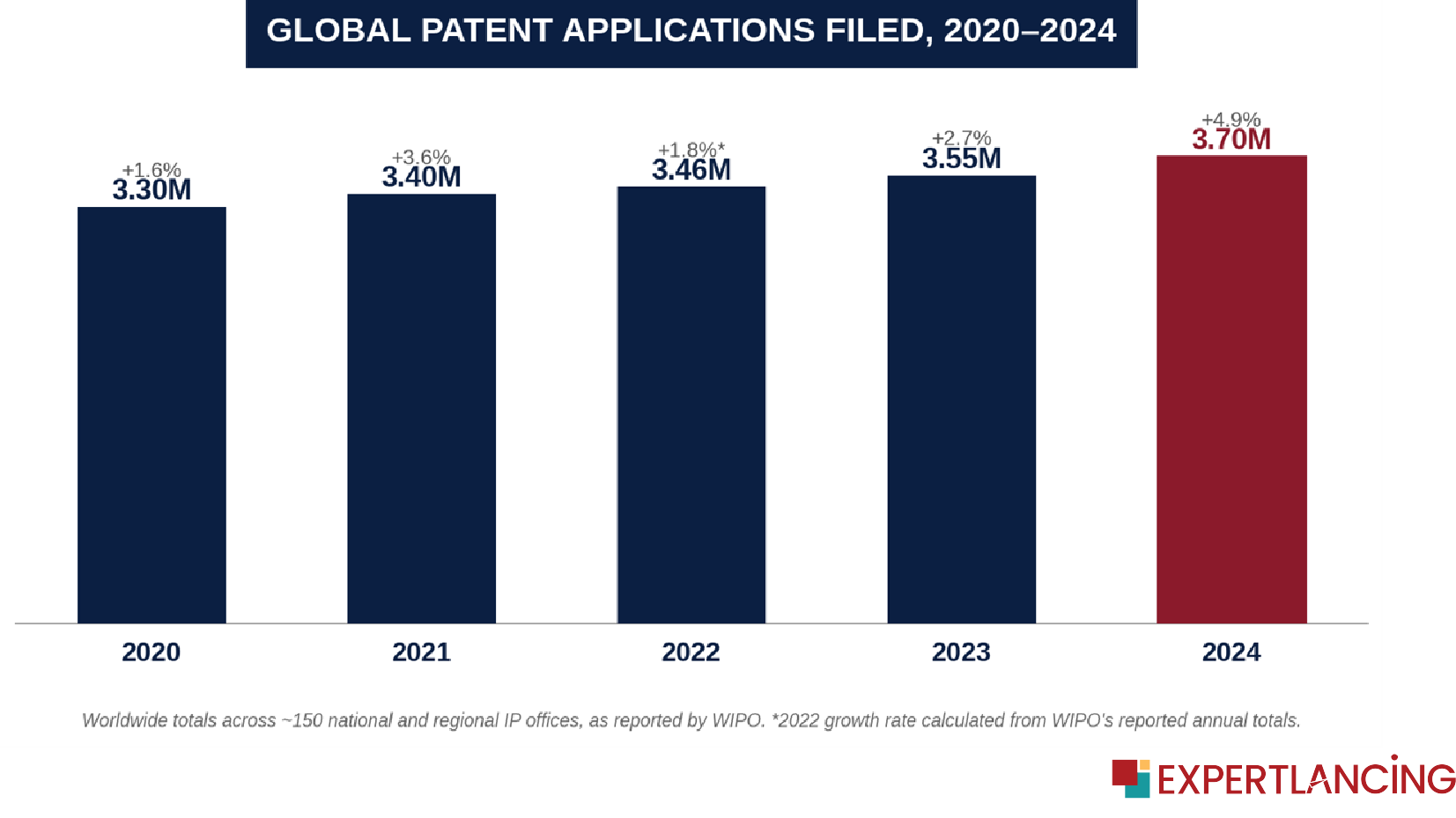
Global patent activity has continued to expand despite economic uncertainty, reflecting sustained investment in innovation across industries and geographies. The table below draws only on WIPO’s published statistics, the World Intellectual Property Indicators (WIPI) series, and the annual PCT Yearly Review.
| Year | Patent Applications Filed Worldwide | YoY Change |
| 2020 | ≈ 3.30 million | +1.6% |
| 2021 | ≈ 3.40 million | +3.6% |
| 2022 | ≈ 3.46 million | +1.8% |
| 2023 | ≈ 3.55 million | +2.7% |
| 2024 | ≈ 3.70 million | +4.9% |
Table 1: Global Patent Applications Filed Worldwide, 2020–2024 (Source: WIPO Statistics Database)
WIPO’s comprehensive annual count, which covers roughly 150 national and regional offices and produces the headline “X million patents filed” figure, is compiled with a lag of about ten months. The edition covering 2024 filings was published in late 2025. The edition covering 2025 filings is expected to be published around November 2026. The one 2025 figure WIPO has published so far covers only its own Patent Cooperation Treaty (PCT) system, which handles international filings and represents roughly one in fourteen patent applications worldwide. This figure is useful as an early signal but is not a substitute for the full total. For 2026, no IP office anywhere has closed its books yet, so no verified figure exists from any source, including WIPO, the USPTO, and the EPO.
Trends Driving the Growth in Patent Filings
Patent filings dipped in 2019, the final year before the COVID-19 pandemic, then did something unexpected. They kept growing straight through COVID-19 and the years since. That run is now five years long, the longest stretch of growth since 2018.
Which Countries Are Driving Patent Filing Growth?
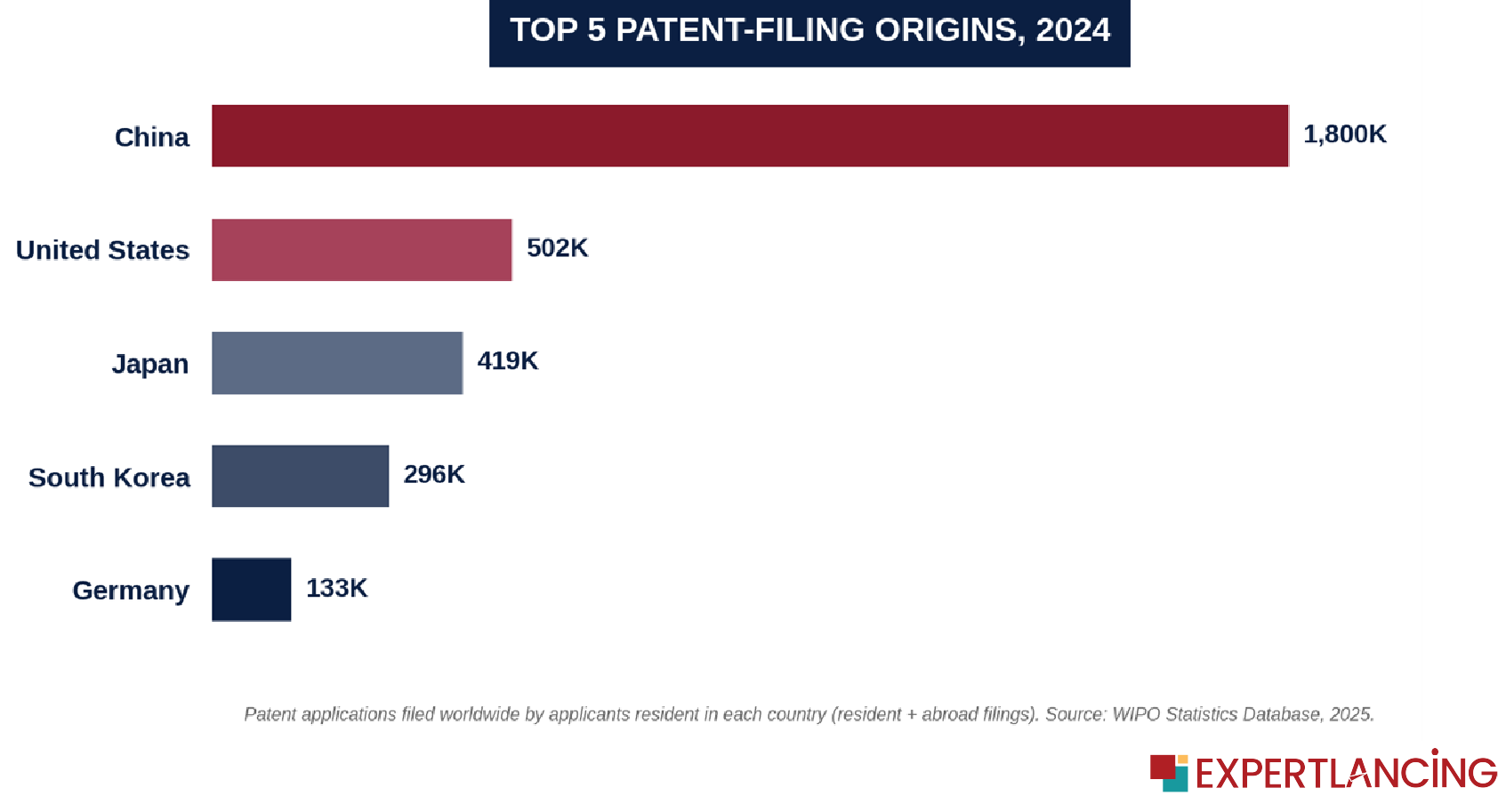
China’s patent office received 1.8 million patent applications in 2024, up 9% on the previous year and accounting for nearly half of the global total. That share has climbed steadily, from 34.6% of global filings in 2014 to 49.1% in 2024, entirely due to China’s own growth rather than any decline elsewhere. India is the other standout. Patent filings by India-based applicants grew 19.2% in 2024, the sixth straight year of double-digit growth, a run no other country in the top ten has matched. The Republic of Korea and Japan also added filings in 2024, while several mature markets, including Germany, grew more slowly.
Which Industries and Companies Are Leading Patent Activity?
At the company level, the rankings barely move year to year. Huawei has been the single largest filer under WIPO’s international PCT system every year since 2017, filing 7,523 international patent applications under the PCT system in 2025. Samsung Electronics (4,698), Qualcomm (3,227), LG Electronics (2,400), and China’s battery maker CATL rounded out the top five. Sixteen of the top twenty applicants worldwide sit inside the information and communications technology sector, a useful reminder that patent volume increasingly tracks the electronics and telecoms industry more than any other.
Which Technologies Are Driving Patent Growth?
In technology fields, the pattern is consistent across both WIPO’s full-office data and its narrower PCT figures. Digital communication and computer technology remain among the leading technology fields, with AI-related inventions contributing significantly to recent growth. Semiconductors emerged as the fastest-growing technology field in 2025, up 6.1% year over year. WIPO’s own economist has pointed to the ongoing wave of AI investment as the force pulling those numbers up, even as overall PCT growth for the year sat at a modest 0.7%.
Put together, three forces explain most of the movement in these numbers. First, national innovation policy: China’s R&D spending topped 3.6 trillion yuan (about $495 billion) in 2024, up 8.3% on the year, and that spending shows up directly in filing volume. Second, a genuine technology cycle: AI, semiconductors, and digital communication are attracting real investment, not just patent-office paperwork. Third, macroeconomic drag in the West. The US, Japan, and Germany have all seen slower or negative growth in some recent years, a pattern several WIPO reports link to tighter budgets and economic uncertainty rather than any drop-in inventive activity.
Where Blockchain Adds Value Across the Intellectual Property Lifecycle
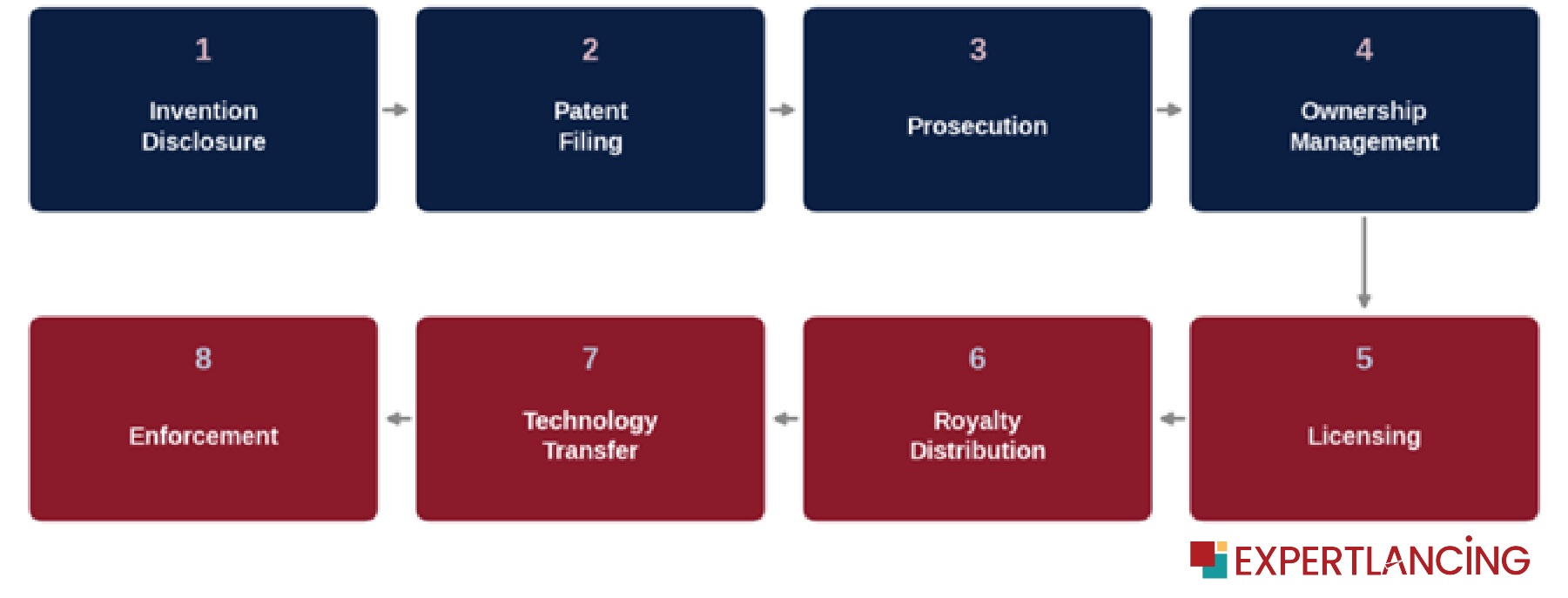
A patent’s life doesn’t end at grant. It moves through disclosure, filing, examination, ownership changes, licensing deals, royalty payments, cross-border transfer, and sometimes, a courtroom. The value of blockchain in intellectual property varies sharply by stage. Blockchain’s usefulness varies sharply by stage. It is strongest wherever the core problem is proving a fact (who created something, when, and who owns it now) and weakest wherever the core problem is human judgment (whether an invention is actually novel, or whether a court should rule in someone’s favor). The eight stages of IP lifecycle are as follows:
Stage 1: Invention Disclosure
Before any application is filed, an inventor needs proof that an idea existed at a given moment, useful for establishing priority, defending against a later infringement claim, or simply protecting a trade secret that will never be patented. Blockchain-based timestamping mechanisms are well suited to this purpose. Once a hash of a document is written to a ledger, the record is very hard to alter quietly, and the time it was written is baked in.
WIPO attempted to address this use case through WIPO PROOF. Its WIPO PROOF service, launched in 2020, issued a cryptographically signed, dated token for any digital file, though notably, it ran on conventional public-key infrastructure rather than blockchain itself. It never found an audience, with fewer than a few thousand tokens against an initial target closer to 100,000, and WIPO discontinued the token-generation service in January 2022, citing weak demand and overlap with private-sector alternatives. Existing tokens remain valid, but no new ones can be created.
Private platforms OriginStamp, Bernstein, and Verisart, among them, continue to offer similar timestamping, some built directly on public blockchains.
Stage 2: Patent Filing
Filing itself is still overwhelmingly a matter of national law. An application goes to a patent office, which examines it against that jurisdiction’s rules. Blockchain doesn’t change that process, but researchers have explored using it as a parallel record layer. One academic prototype, developed at BITS Pilani, sketched out a Solidity smart contract on Ethereum that would log each patent application’s core details, including applicant, inventors, classification, and title, as an on-chain hash, while storing the full filing off-chain to keep costs manageable. The design mirrors a broader pattern in this space. Put a compact, tamper-evident fingerprint on the chain, and keep the bulky, sensitive material in a conventional database. The appeal for filers, especially smaller ones working across several countries, is a single, consistent audit trail. It follows an application regardless of which office is handling it. This is useful given how much paperwork a multi-jurisdiction filing already generates.
Stage 3: Prosecution
Patent prosecution is the back-and-forth between an applicant and an examiner before a patent is granted or refused. It is the stage where blockchain has the least to offer directly, since it depends on expert judgment about novelty and inventive step that no ledger can automate. Where it can help is at the edges. Smart contracts can automatically release fee payments once the office logs an office action. A shared, timestamped record of amendments and responses can also reduce later disputes about what applicants submitted and when. The BITS Pilani prototype’s grantPatent and checkGrantStatus functions are a simple illustration. An administrator (standing in for the patent office) updates status on-chain, and any applicant can verify that status without contacting the office directly.
Stage 4: Ownership Management
This is where blockchain in intellectual property has one of its strongest use cases, because the underlying problem is a messy, incomplete public record of who currently owns a given patent. It is exactly the kind of problem a shared ledger is built to solve. Patents change hands constantly through assignment, merger, and acquisition, and many changes never get properly recorded with the relevant patent office, leaving buyers, licensees, and courts working from an incomplete picture.
The clearest large-scale example so far comes from IPwe and IBM, which announced a platform capable of representing approximately 25 million patent records as non-fungible tokens on a hybrid network combining the Casper public blockchain with a permissioned Hyperledger Fabric layer. Alongside the token registry, IPwe runs a valuation tool called Smart Intangible Asset Management (SIAM), which uses the on-chain data to benchmark a patent portfolio’s worth, a task that is traditionally expensive and time-consuming when performed by external valuation firms.
Stage 5: Licensing
Licensing agreements are usually bespoke contracts, renegotiated manually and tracked in whatever system a legal team happens to use. Within blockchain in intellectual property, smart contracts offer a narrower but genuinely useful approach to licensing. License terms, royalty rates, permitted uses, geographic territories, and expiry conditions can be encoded in smart contracts. Compliance checks and payments can then trigger automatically when parties meet agreed conditions. This avoids waiting for quarterly reconciliation between the parties. In practice, this works best for high-volume, standardized licensing (patent pools, and any market with many licensees paying similar terms) rather than for one-off, heavily negotiated deals.
NFT-based licensing takes this a step further by attaching license terms directly to the token representing the asset, so that when the token changes hands, the licensing terms travel with it automatically, reducing the paperwork gap that otherwise opens up during a resale or transfer.
Stage 6: Royalty Distribution
Royalty accounting is one of the more tedious parts of running an IP portfolio. Usage must be tracked, splits calculated, and payments reconciled, often long after the fact. Smart contracts can automate payment splits and transfers. They can trigger payments as soon as someone records qualifying usage, rather than waiting until the reporting cycle ends. The clearest working examples sit in music and media, where platforms such as Audius and Revelator distribute royalties to artists close to real time, using the same underlying logic that a patent royalty system would need: verified usage in, automatic split out.
Stage 7: Technology Transfer
Moving a technology across borders, licensing it to a manufacturer in another country, for instance, means tracking a shifting bundle of rights. This includes the jurisdictions covered, the local filings submitted, and the filings that have lapsed. The original academic patent-management research (cited above) aimed to address this exact problem. The approach involves placing an initial filing on a shared ledger. Each jurisdiction’s local counsel can then update the record as protection is sought and secured elsewhere. This allows anyone checking the ledger to see the current geographic footprint of a right without contacting multiple national offices individually.
No large-scale version of this exists in production yet. It remains a design proposal more than an operating system, but the logic holds up. A technology-transfer deal spanning a dozen countries currently means a dozen separate paper trails, and a shared ledger is a plausible way to collapse that into one.
Stage 8: Enforcement
Enforcement is where blockchain evidence has actually reached courtrooms, not just white papers. China’s Hangzhou Internet Court first accepted blockchain-anchored evidence in a copyright dispute in June 2018. The court ruled that data preserved on a blockchain verified independently against the underlying Bitcoin and Factom ledgers could stand in for notarization.
China’s Supreme People’s Court codified the principle months later for the country’s internet courts. The practice has since spread well beyond them. By one count drawn from China Judgments Online, courts ruled on more than 1,400 intellectual property ownership and infringement disputes involving blockchain evidence between June 2018 and August 2023.
That volume is far larger than anything achieved on the registration or licensing side. This suggests that enforcement is where blockchain has achieved its most meaningful adoption. This makes enforcement one of the clearest real-world applications of blockchain in intellectual property. Blockchain has found its most durable legal footing so far. This is because courts only need to trust the integrity of the evidence, not the underlying blockchain’s ownership claims.
Where the Technology Still Falls Short
A fair account of blockchain in intellectual property has to include its failures alongside its wins. WIPO PROOF is the clearest cautionary tale. A respected institution built a timestamping tool, marketed it for two years, and shut it down after real-world demand never approached projections. The lesson generalizes. A handful of specific limits keep coming up across the industry:
- Legal recognition is uneven. China’s courts have built a body of case law around blockchain evidence. Most jurisdictions have not. A tamper-proof timestamp may therefore carry little formal weight outside a few test cases.
- The oracle problem persists. A blockchain can only certify what’s written to it. If a patent office’s own database says something different from what’s on-chain, the chain doesn’t resolve the conflict. A human still has to.
- Tokenizing a patent doesn’t grant a legal right. An NFT can represent an interest in a patent. The patent office, not the token, still determines who legally owns it.
- Losing the private key does not eliminate the underlying legal ownership right. However, it may complicate proof of ownership or future transfers.
- A licensing smart contract written for one jurisdiction’s IP law rarely translates cleanly to another’s. No international body has proposed a common technical standard.
None of this makes the technology worthless. It means the realistic near-term role is additive. It works alongside existing IP institutions rather than replacing them.
The Strategic Takeaways: From the ExpertLens
- Global patent filings reached a record 3.7 million in 2024, growing 4.9% year-on-year and marking the fifth consecutive year of growth despite global economic uncertainty.
- China’s patent office alone accounted for nearly half of all patent applications filed globally in 2024. India has posted six consecutive years of double-digit growth.
- Blockchain has moved beyond pure experimentation in some IP applications. IPwe and IBM announced a system for representing millions of patent records as NFTs. The system uses a hybrid Casper–Hyperledger Fabric network.
- Chinese courts have handled more than 1,400 intellectual property disputes involving blockchain-based evidence since 2018. Enforcement is where the technology has found its firmest legal footing.
- Blockchain is proving most valuable in ownership management, licensing, royalty automation, and evidence preservation. Its role in patent examination remains limited.
Blockchain in Intellectual Property: What Lies Ahead?
Patent filings are climbing at a pace the infrastructure behind them hasn’t matched. Ownership records fragment across jurisdictions, licensing deals get tracked by hand, and royalty payments lag the usage that triggers them. Blockchain in intellectual property doesn’t fix all of that. The technology’s own track record is mixed. It includes a blockchain platform designed to represent approximately 25 million patent records, a discontinued WIPO pilot, and a genuine body of court-tested evidence.
China’s experience illustrates both the practical potential and limitations of blockchain-based IP systems. The clearest wins so far sit at the two ends of the lifecycle: proving a fact early (invention disclosure, evidence preservation) and enforcing a fact later (courtroom evidence, ownership verification). The middle of the lifecycle prosecution and cross-border technology transfer is where the case remains mostly theoretical. Given the rapid growth of AI-related innovation and patent filings, that middle stretch is exactly where the next wave of real deployments is likely to emerge first.
Understanding these shifts requires a clear view of emerging technologies, patent activity, and competitive developments. Expertlancing supports law firms, corporations, and other stakeholders with IP research, technology advisory, and market intelligence across the patent lifecycle. Its capabilities span patent landscape analysis, technology assessments, and competitive intelligence, helping organisations evaluate technology trends and make informed IP and business decisions.
With 60+ professionals in India and a global presence across the USA and Japan, Expertlancing brings together IP researchers, technical experts, and domain specialists across multiple technology and industry domains.
Looking to gain deeper insights into emerging technologies and evolving patent landscapes? Connect with our experts to discuss your requirements.