GLP-1 receptor agonists have moved from being a diabetes-focused drug class to becoming one of the largest commercial opportunities. This opportunity is expanding rapidly with the emergence of obesity and chronic weight management as major treatment categories. That growth is now meeting the GLP-1 patent cliff, which will unfold market by market rather than all at once. The demand behind this market is not a passing trend. The World Health Organization estimates that 2.5 billion people were overweight in 2022, including 890 million people living with obesity. If current trends continue, the annual global economic cost associated with overweight and obesity could reach US$3 trillion by 2030 and exceed US$18 trillion by 2060.
However, this expansion is built on an intellectual property foundation that is beginning to change. Semaglutide compound protection expires in several important markets from 2026, while additional patents covering formulations, delivery systems and other aspects of the products extend protection into the 2030s and beyond. The resulting competitive transition is therefore likely to unfold progressively across products and markets rather than through a single global expiry event.
GLP-1 Therapy Market: Growth and Expanding Applications
From Diabetes to Obesity and Broader Metabolic Health
In recent years, this class’s commercial character has undergone a significant change. The GLP-1 receptor agonist market’s highest revenue share is currently diabetes, but the obesity and chronic weight management segment is growing quickly and is predicted to be the primary driver of future growth. The class is therefore evolving from a diabetes-focused treatment category into a broader metabolic health market.
Additionally, clinical research has advanced well beyond weight loss and glycemic management to include related metabolic and inflammatory disorders. In addition to significant weight loss, Lilly’s late-stage Retatrutide research demonstrated significant pain alleviation from osteoarthritis. In a mid-stage study of individuals with obesity, the same company’s selective amylin agonist, eloralintide, also showed significant weight loss.
Market Growth and Competitive Expansion
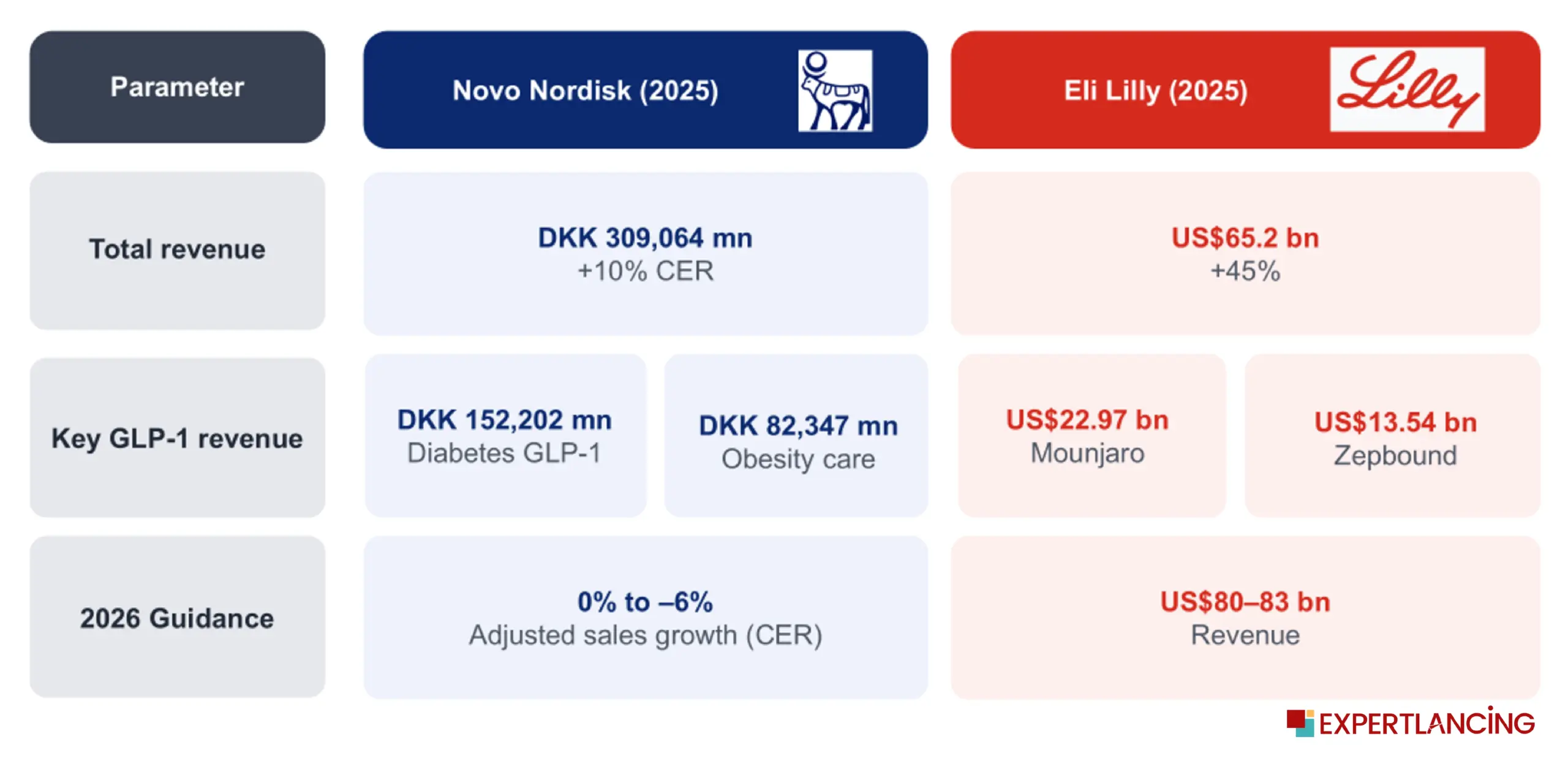
The market is already large and continues to expand. It was estimated at approximately, the global GLP-1 receptor agonist market was worth US$66.38 billion in 2025 and will reach US$82.01 billion in 2026, before increasing to US$185.32 billion by 2033. That represents a projected CAGR of 12.4% between 2026 and 2033. Company results reflect this market momentum, although the growth profiles of the two leading players are beginning to diverge.
GLP-1 Therapeutics: Products, Companies and Emerging Technologies
Approved Therapies and Emerging Delivery Formats
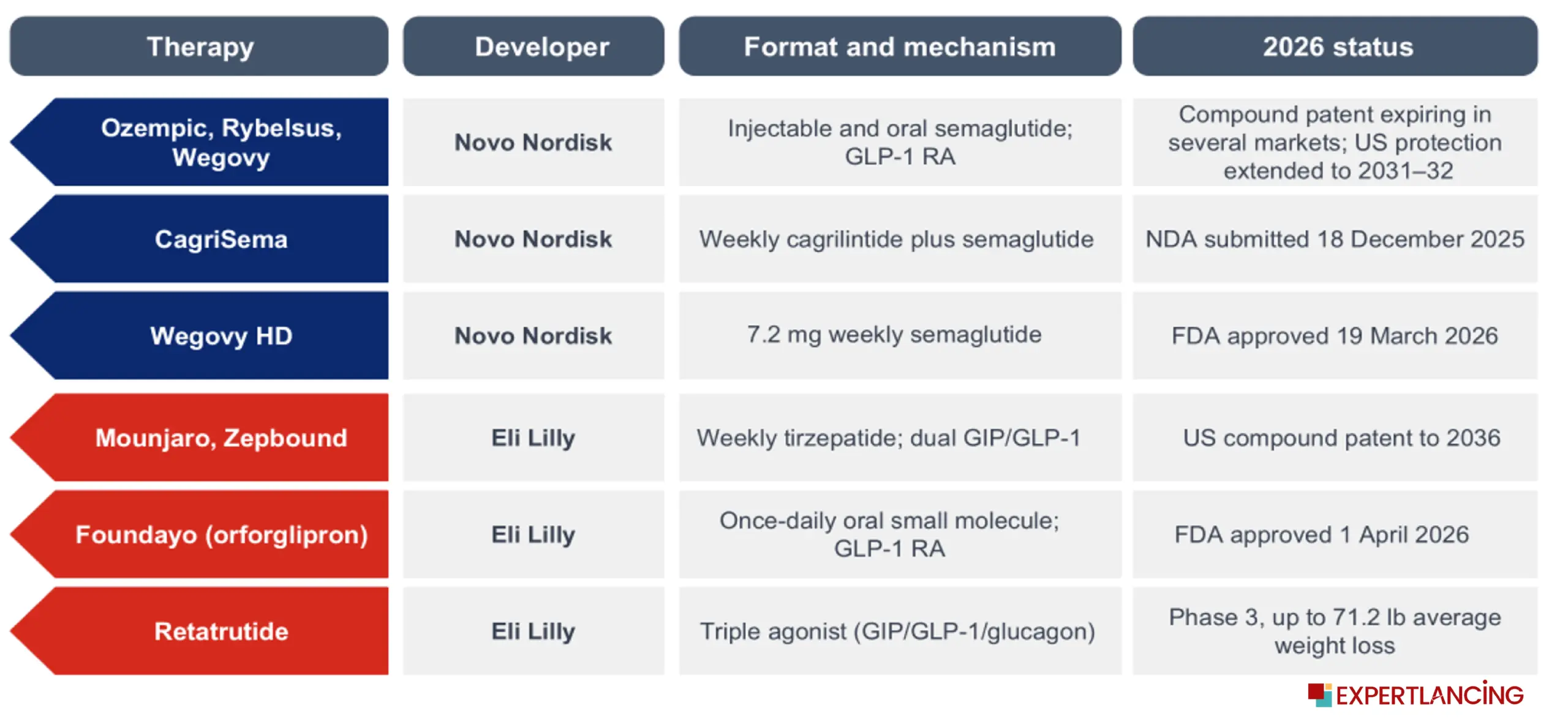
The delivery format has become a competitive battleground in its own right. When the FDA approved the once-daily Wegovy pill on 22 December 2025, oral GLP-1 therapy for obesity became a commercial reality. In the 64-week OASIS 4 trial, people taking the pill started at an average of 235 lb, and if everyone had stayed on treatment they lost about 16.6% of their body weight, or roughly 39 lb. Those on placebo started at 231 lb and lost just 2.7%, about 6 lb. In other words, 76% of those taking the drug dropped at least 5% of their body weight, compared to 31% who took a placebo, according to Novo Nordisk’s acceptance announcement. The FDA followed with approval of a higher 7.2 mg Wegovy HD injection on 19 March 2026, granted just 54 days after filing under the Commissioner’s National Priority Voucher pilot.
Lilly’s oral entry, Foundayo (orforglipron), was approved 1 April 2026 as the first small-molecule oral GLP-1 for chronic weight management, with ATTAIN-1 data showing 12.4% weight loss at the highest dose among those who stayed on treatment against 0.9% for placebo.
Multi-agonist engineering is where much of the next wave of innovation sits. Tirzepatide’s dual GIP/GLP-1 mechanism underpins its differentiated weight-loss profile, while Novo Nordisk’s CagriSema combines semaglutide with the amylin analogue cagrilintide. The REDEFINE 1 trial of CagriSema reported 20.4% weight loss at 68 weeks versus 3.0% for placebo and 22.7% when all patients stayed on treatment, according to the NDA submission announcement, with the FDA expected to complete its review during 2026.
Next-Generation Molecules and Alternative Delivery Approaches
Beyond currently approved therapies, developers are pursuing new molecular mechanisms and delivery approaches. These are designed to extend efficacy and improve tolerability. They also address limitations associated with existing GLP-1 treatments. This shift has significant manufacturing implications. Oral small molecules rely on conventional chemical synthesis rather than complex peptide chains. This potentially eases the capacity constraints that have shaped the injectable market. Supply chain investment reflects the scale involved. Lilly is committing more than US$1 billion to expand contract manufacturing in India, as reported by Reuters.
GLP-1 Patent Landscape and the Emerging Patent Cliff
GLP-1 Patent Filing Trends and Key Technology Domains
The patent activity for GLP-1 medicines has increased significantly. Innovation is expanding beyond the active medication to formulations, delivery systems and novel indications. It is also expanding to next-generation therapeutics. The JAMA investigation covered ten GLP-1 receptor agonists. These were approved by the FDA between 2005 and 2021. The investigation discovered 186 patents linked with these medicines. Of these, 164 were submitted prior to approval and 22 later. Also, 54% focused on drug-delivery devices. This emphasizes the importance of delivery technology in extending product protection. Recent patent activity has also focused on modified GLP-1 compounds and oral medicines. It has focused on multi-agonists and combination therapies as well. This indicates the industry’s drive toward fresh techniques to improve efficacy, convenience, and therapeutic applications.
The patent activity also illustrates how GLP-1 protection extends beyond the active compound itself. Patents covering formulations, delivery systems, dosing approaches and methods of treatment can create additional layers of protection around a marketed therapy. As these patents expire at different times, the resulting loss of exclusivity can occur progressively rather than on a single date.
Patent Protection and the Emerging GLP-1 Patent Cliff
A few major originator companies, mainly Novo Nordisk and Eli Lilly, control the majority of the GLP-1 market. Rather than depending on a single core patent, each uses a multi-tiered portfolio to protect its primary products. These portfolios include formulations, delivery systems, dosage schedules, and treatment techniques in addition to the original compound patents.
The chronology of patent expiration demonstrates a trend in important markets. The protection environment for major GLP-1 medicines is becoming more and more fragmented. The forthcoming GLP-1 patent cliff is unlikely to happen as a single worldwide event. Rather, it is likely to happen as a series of market-specific expiration points. These points could gradually alter competitive entrance, pricing and market dynamics, as demonstrated by the difference in patent lifetime across jurisdictions.
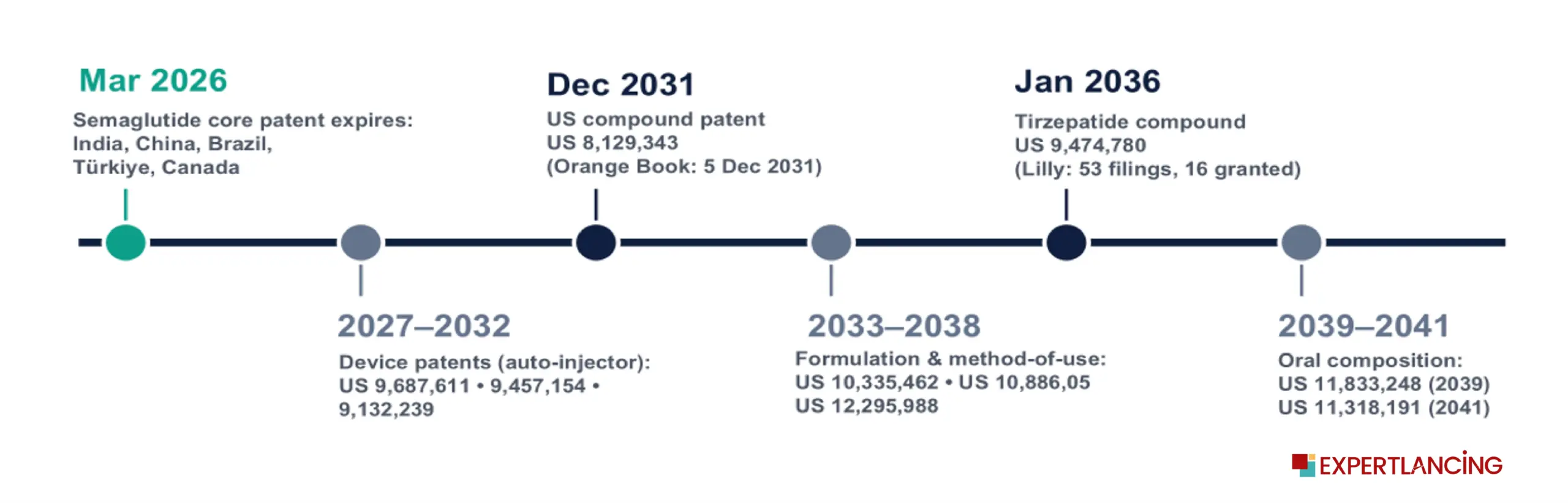
The GLP-1 patent cliff is better understood as a sequence of market-specific expiry events than as a single global loss of exclusivity. The markets losing semaglutide protection from 2026 – India, Canada, China, Brazil and Türkiye – together represent about 40% of the world’s population. They also account for an estimated 33% of adults living with obesity, according to IQVIA, yet they contribute a comparatively small share of current revenue. This is because North America accounts for roughly three-quarters of GLP-1 market value. The US and Europe remain protected into the early 2030s. What the industry faces, therefore, is less a single drop than a rolling, jurisdiction-by-jurisdiction erosion of exclusivity. This begins in high-volume, high-unmet-need emerging markets and reaches the most valuable market only after a multi-year transition.
Impact of the GLP-1 Patent Cliff on Competition and Innovation
Pricing Pressure and Emerging Market Entry
The pricing pressure is emerging through different mechanisms across markets. In countries where patent protection is ending earlier, generic competition is becoming more relevant, while in the United States, policy-led price negotiations are creating a different form of pressure.
The regulations in India are already moving in the direction of generic semaglutide. The Central Drugs Standard Control Organisation’s Subject Expert Committee approved Dr. Reddy’s Phase III report during its September 2025 meeting and recommended permission to manufacture and market the production and distribution of semaglutide injection for type 2 diabetes. This indicates increased pricing competition and moves a domestic generic closer to introduction.
In the United States, price pressure comes from policy rather than generics. With effect from January 2027, CMS has negotiated a monthly price of US$274 for semaglutide, which is almost 71% less than the reference list price. A lower Medicare and Medicaid price of US$245 per month is set by a White House deal with Novo Nordisk and Eli Lilly.
Compounded copies of these drugs filled supply gaps during the shortages, but that route is now largely closed. The FDA declared the tirzepatide shortage resolved in December 2024 and the semaglutide shortage resolved in February 2025. During 2025 it then ended its enforcement discretion for 503A pharmacies and 503B outsourcing facilities. Compounders can therefore no longer rely on the shortage exception to produce copies.
Follow-On Product Development and Lifecycle Management Strategies
Patent expiry does not automatically mean commoditization. Secondary patents cover formulations, devices and methods of treatment. This means generic and biosimilar entrants must navigate a dense thicket. Litigation is likely. Novo Nordisk has sued Dr Reddy’s and Sun Pharma in India. It did so to enforce semaglutide patents. At the same time, competition is shifting toward differentiated mechanisms and delivery formats. It is also shifting toward dosing strategies and clinical outcomes rather than price alone.
Lifecycle management is becoming a board-level discipline for originators. A molecule’s economic value can be increased beyond its compound patent by new formulations and dose strengths, device advancements, fixed-dose combos, and indication expansion. Distribution strategy is similarly important because originators employ local alliances and other brands to reach smaller markets and new patient categories.
Future Outlook for GLP-1 Therapy
The next five years are likely to be shaped by the interaction between three factors. These are patent expiry, market entry and continued product innovation. Earlier loss of exclusivity could create opportunities for additional manufacturers. This applies to markets such as India, China and Brazil. Longer protection in the US and Europe may preserve a greater role for originator products. At the same time, new formulations, mechanisms and therapeutic indications could shift competition. The shift could be toward differentiated products rather than direct price competition. The result is likely to be a GLP-1 market. In this market, access expands at different rates across regions. Meanwhile, innovation continues to create new layers of commercial value.
The Strategic Takeaways: From the ExpertLens
- GLP-1 drugs started as diabetes treatments and have become a major obesity and metabolic health franchise, one projected to be worth US$185.32 billion by 2033.
- Competition is shifting from price to delivery format and mechanism, led by oral options, higher-dose injectables and multi-agonists.
- The patent cliff will occur gradually as semaglutide protection will expire in 2026 in emerging economies, while the protection will last until the early 2030s in the US and Europe.
- Policy-led price pressure and generic entry are opening access, so winners will treat IP, lifecycle innovation and market intelligence as one strategy.
What the GLP-1 Patent Cliff Means for the Next Phase of the Market
The GLP-1 industry is entering a new phase, as significant therapeutic expansion combines with the steady degradation of patent protections. Rather than a single worldwide patent cliff, the market is expected to see a series of country- and product-specific expiry events that open up opportunities for new entrants while putting pressure on originators. Simultaneously, ongoing innovation in compounds, delivery forms, formulations, and therapeutic uses has the potential to redefine competition beyond the present product generation. Understanding the time of patent expiration in relation to technological and commercial advancements will become increasingly crucial for organizations operating in this industry.
As the GLP-1 market evolves, businesses need a clear understanding of changing patent landscapes, emerging technologies and competitive dynamics. Expertlancing supports these decisions through its integrated capabilities in IP Research, Technology Advisory and Market Intelligence. Our Patent Landscape Analysis and Patent Monitoring services help organizations track patent expirations, assess competitor portfolios and identify emerging IP trends. Through Technology Scouting and Technology Assessment, we help businesses evaluate new compounds, formulations, delivery mechanisms and therapeutic applications. Our Market Research and Competitive Intelligence capabilities further enable organizations to assess market shifts, understand competitor strategies and identify opportunities for growth.
By connecting IP developments with technology and market insights, Expertlancing helps businesses make informed decisions and navigate the next phase of competition in the GLP-1 market.
Explore how Expertlancing’s services can support your strategic priorities in the evolving pharmaceutical and life sciences landscape. Connect with our experts.
About The Author