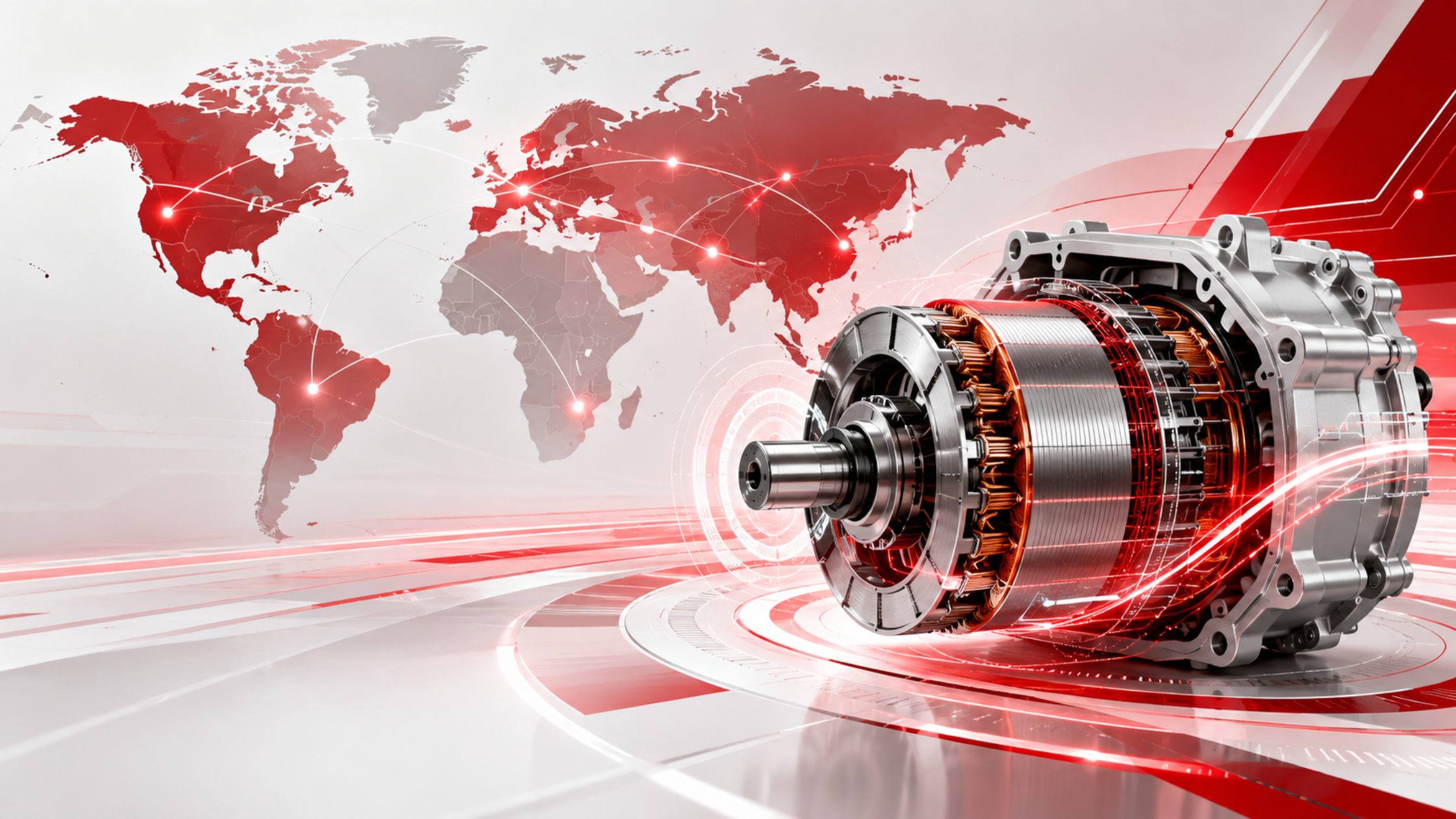
For much of the electric-vehicle era, the battery has been treated as the defining strategic component of the powertrain. Now, magnet motors are emerging as another critical area of innovation, with the next major contest potentially taking place inside the electric motor. Most high-performance electric vehicles use permanent-magnet synchronous motors because they offer high torque density, compact packaging and strong efficiency. That performance comes with a strategic dependency: powerful permanent magnets rely on rare-earth elements such as neodymium, praseodymium, dysprosium and terbium.
A new generation of motor developers is trying to replace these physical magnets with dynamically controlled electromagnetic fields. The emerging proposition is being described as the software-defined magnet.
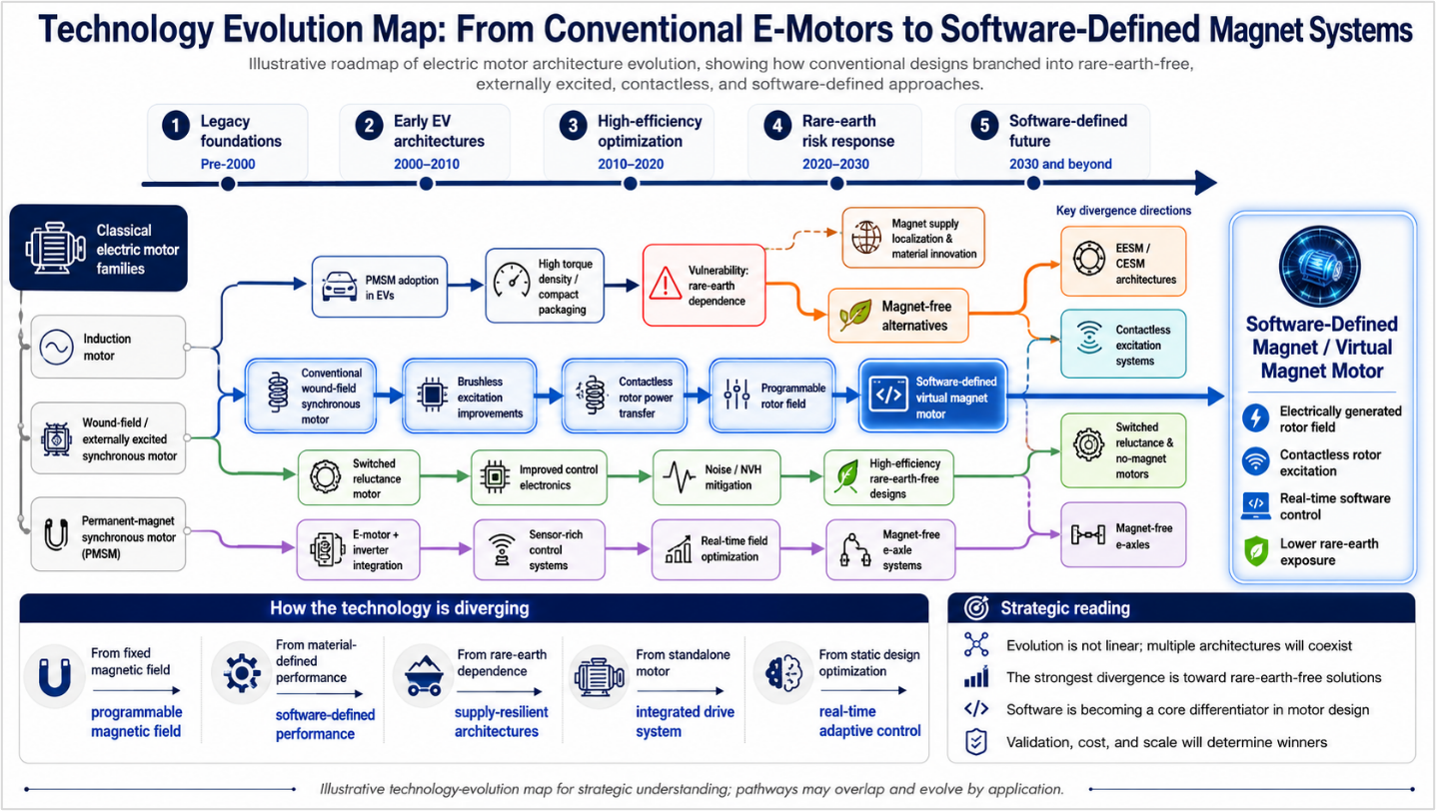
The term sounds almost contradictory. Software cannot produce magnetism by itself.
Software cannot produce magnetism by itself, but it can control where, when, and how strongly a motor generates a magnetic field. By combining an electrically excited rotor, contactless power transfer, advanced power electronics and real-time control algorithms, engineers can reproduce the operating behaviour of a permanent-magnet motor without embedding permanent magnets in the rotor.
The strategic shift is significant: part of the motor’s performance moves from a fixed material property into a programmable control system.
From Permanent-Magnet Motors to Software-Defined Magnet Motors
In a conventional permanent-magnet synchronous motor, magnets embedded in or attached to the rotor create a fixed magnetic field. The stator’s rotating electromagnetic field interacts with this rotor field to generate torque. The permanent magnets need no continuous electrical excitation, which supports efficiency and compactness. The trade-off is that the rotor field is largely fixed once the motor is manufactured.
A software-defined virtual-magnet motor takes a different route. Electrical energy is transferred to rotor windings, and these windings generate the rotor’s magnetic field. Power electronics and control software continuously adjust the excitation according to speed, torque demand, temperature, efficiency targets and operating conditions.
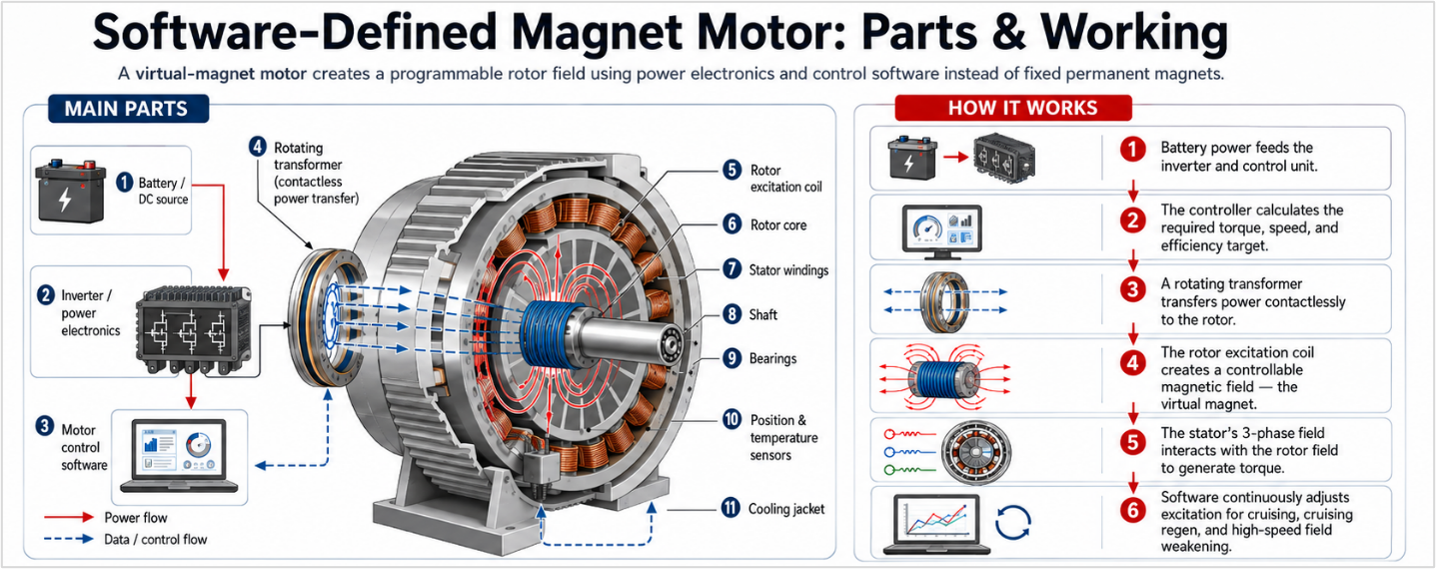
The architecture typically contains four interconnected layers:
- An electrically excited rotor that creates the magnetic field.
- A contactless or inductive power-transfer system that supplies energy to the rotating rotor without conventional brushes or slip rings.
- Power electronics that manage stator and rotor excitation.
- Control algorithms that determine the optimal field strength and torque-producing current in real time.
In this design, the “magnet” is virtual because its behaviour is created dynamically rather than permanently embedded in the machine.
How India’s Vimag Labs Is Advancing Software-Defined Magnet Motors
The idea gained renewed attention in July 2026 when Bengaluru-based Vimag Labs announced that it had received its fifth Indian patent for its Virtual Magnet Synchronous Motor (VMSM) platform.
The patent, titled “A Robust Rotating Transformer Excited Synchronous Motor and Its Control”, covers an architecture that uses a rotating transformer, power electronics and control algorithms to generate and regulate the rotor’s magnetic field. The company says the motor is brushless, slip-ring-free and does not need rare-earth permanent magnets. With this grant, the company’s IP portfolio stands at five granted patents, ten applications under examination and fifteen trademarks across motor architecture, software controls, power electronics and application-specific implementations.
Vimag Labs operates commercially through the Volektra brand, with development centres in Germany, the US and Poland. Volektra’s own material claims approximately 95% efficiency for its contactless power-transfer stage and 94% cycle efficiency for the motor. These are company figures and have not yet been independently validated across standardised automotive duty cycles.
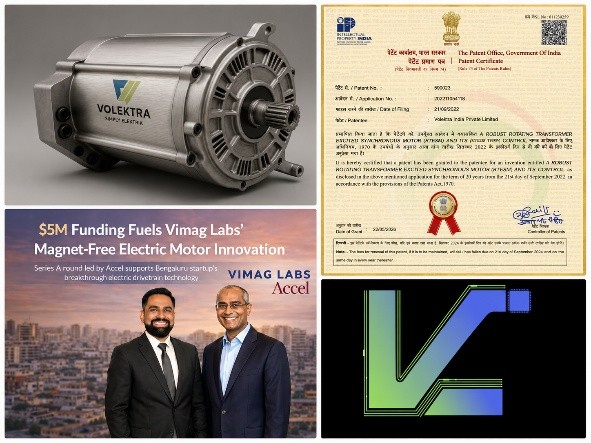
The company raised USD 5 million in January 2026 in a Series A round led by Accel, with participation from Chakra Growth Fund and Thinkuvate. It plans to use the capital to commercialise its motor platform and expand into automotive, industrial, defence and energy applications. The company has stated its technology is at Technology Readiness Level 7, with real-world vehicle testing underway.
Vimag has reported pilot programmes with two-wheeler and passenger-vehicle manufacturers, plans to extend to light commercial vehicles and industrial systems in the 200 kW to 600 kW range, and a manufacturing agreement with Jendamark. These pilots will be more consequential than the patent itself. Automotive manufacturers ultimately evaluate motor technologies based on validated efficiency maps, power density, thermal performance, durability, noise, cost, and manufacturing repeatability, rather than architectural novelty alone.
Why Software-Defined Magnet Motors Are Gaining Attention
Three forces are pushing magnet-free motors back onto the strategic agenda.
How Rare-Earth Dependence Is Reshaping Magnet Motor Technology
High-performance permanent magnets are the most strategically important use of rare-earth materials. The International Energy Agency estimates that permanent magnets account for around 95% of total rare-earth consumption by value.
The supply chain is also highly concentrated. The IEA reports that China accounts for around 60% of mined production of magnet rare earths, above 90% of refining and almost 95% of permanent-magnet production. The European Commission states that 98% of the EU’s rare-earth magnet demand is met through Chinese imports.
This risk is no longer theoretical. China’s export controls on heavy rare earths in April 2025 forced several carmakers in the US and Europe to cut utilisation or temporarily shut factories, and prices in importing markets stayed elevated even after volumes recovered.
The constraint, therefore, is not simply geological availability. The larger constraint sits in separation, refining, alloy production, magnet manufacturing and intellectual property, segments where China retains a dominant position.
How Power Electronics Are Advancing Magnet-Free Motors
Earlier magnet-free architectures involved compromises in packaging, rotor excitation, efficiency or maintenance. Slip rings and brushes introduced wear, while additional excitation hardware increased motor size and system complexity.
More compact inverters, better semiconductor switches, faster control processors and contactless rotor-excitation systems are changing the engineering equation.
ZF’s In-Rotor Inductive-Excited Synchronous Motor (I2SM) transfers excitation energy through an inductive unit inside the rotor shaft, removing brushes, slip rings and the extra seals they demand. ZF positions it as a compact, production-ready alternative to permanent-magnet synchronous motors, and reports the inductive exciter cuts rotor energy-transfer losses by 15% versus conventional separately excited machines, with up to 50% lower production CO2 footprint than a comparable permanent-magnet motor.
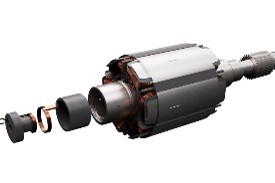
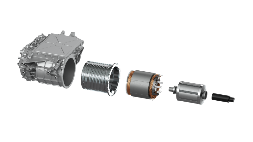
MAHLE has similarly developed a magnet-free contactless-transmitter motor, reporting efficiency above 95% at almost all operating points. MAHLE and Valeo have signed a joint development agreement for the iBEE (inner Brushless Electrical Excitation) e-axle, targeting upper-segment vehicles with peak power from 220 kW to 350 kW. Valeo reports the system has achieved efficiency parity with permanent-magnet motors across the driving map on the test bench.
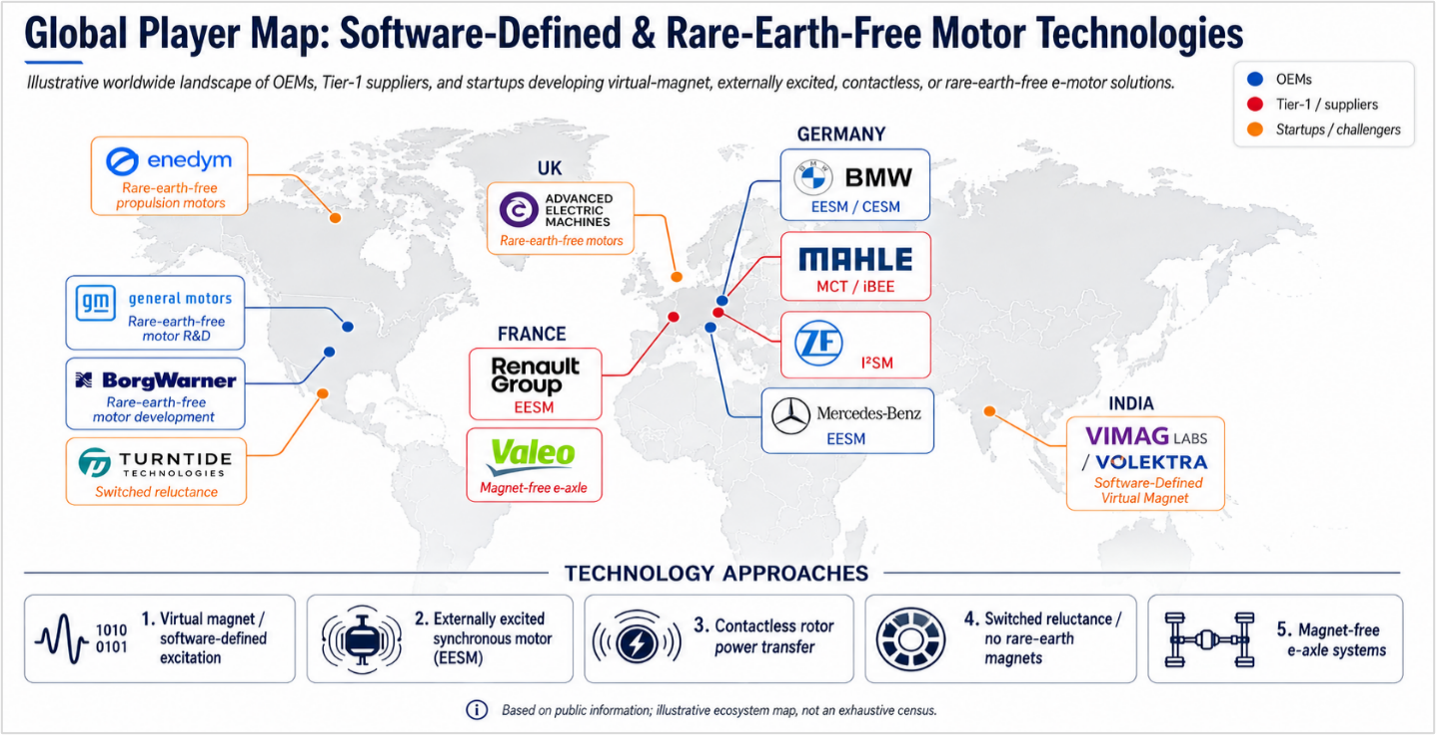
The landscape is broadening beyond established OEMs and Tier-1 suppliers, with specialist startups pursuing virtual-magnet, contactless-excitation and switched-reluctance architectures. Europe currently leads in externally excited and magnet-free motor development, while emerging players in North America and India are pushing software-defined control and rare-earth-free propulsion. The market is evolving as a portfolio of competing architectures rather than converging on a single replacement for the permanent-magnet motor.
How Software Is Reshaping Magnet Motor Performance
Modern electric drives are already cyber-physical systems. Software heavily influences torque delivery, regenerative braking, thermal protection, efficiency optimisation, traction response, and fault management.
A virtual-magnet architecture extends this principle to rotor magnetisation itself. The rotor field can be weakened during high-speed operation, strengthened during high-torque demand, adjusted to manage temperature and optimised for different duty cycles. Instead of designing a motor around one largely fixed magnetic state, developers can operate it across a wider programmable envelope.
Magnet-Free Motors: What Makes the New Generation Different?
The “software-defined” label should not hide the engineering history. Electrically excited synchronous motors, wound-field motors, induction motors and synchronous-reluctance motors have existed for decades. BMW already uses current-excited synchronous motors in the i4, i5, i7 and iX. BMW’s fifth-generation eDrive system avoids rare-earth materials by generating the rotor field through electrical excitation.
The innovation frontier, therefore, is not simply eliminating magnets. It is eliminating magnets without accepting an unacceptable penalty in power density, efficiency, maintenance, packaging or cost. Software-defined motor developers are attempting to solve this through deeper integration of motor geometry, inductive excitation, power electronics and algorithms.
| Motor architecture | Principal advantage | Principal challenge |
| Permanent-magnet synchronous motor | High efficiency and torque density | Rare-earth dependency and fixed rotor field |
| Induction motor | No magnets and established manufacturing | Rotor losses and lower efficiency in some operating regions |
| Synchronous-reluctance motor | Simple, magnet-free rotor | Torque density, noise and control complexity |
| Conventional wound-field synchronous motor | Controllable rotor field and no rare-earth magnets | Brushes, slip rings or additional excitation hardware |
| Contactless virtual-magnet motor | Controllable field without permanent magnets or mechanical contacts | Electronics complexity, excitation losses, qualification and cost |
Beyond Rare Earths: The Strategic Opportunity for Magnet Motors
The strongest business case for software-defined magnets may not be the elimination of rare earths alone.
Programmable Performance
A common motor platform could be calibrated for multiple vehicle types, operating environments or performance levels. Manufacturers could differentiate drivetrains partly through software rather than redesigning the complete magnetic architecture.
Reduced Material-Price Exposure
Permanent-magnet costs are affected by rare-earth prices, processing concentration, export restrictions and geopolitical disruption. A magnet-free platform substitutes part of that exposure with copper, electrical steel, semiconductors and control electronics. It does not eliminate supply-chain risk; it changes its composition.
New Intellectual-Property Positions
In permanent-magnet machines, manufacturers derive much of the value from magnetic materials, rotor geometry, thermal design, and manufacturing processes. In a software-defined motor, additional value shifts toward excitation topology, control algorithms, digital models, semiconductor integration and system calibration. This opens the door to licensing-based business models, where companies supply reference designs, controllers, software and engineering support rather than manufacturing every motor themselves.
Lifecycle Optimisation
A programmable drive could receive calibration improvements during its operational life, tuned for efficiency, thermal behaviour or a known duty cycle. This also raises functional-safety, cybersecurity, homologation and warranty questions. Manufacturers must strictly control which parameters they allow engineers to modify after certification.
Key Challenges to Commercialising Software-Defined Magnet Motors
Second, the contactless excitation system adds components, controls and potential failure modes. Reliability must be demonstrated over vibration, thermal cycling, overspeed, electrical transients and long vehicle lifetimes.
Third, advanced software cannot compensate for poor electromagnetic or mechanical design. Motor performance still depends on laminations, windings, cooling, bearings, air gaps, insulation and manufacturing tolerances.
Fourth, automotive qualification is slow. A promising laboratory motor must pass validation at the component, inverter, electric-drive-unit and vehicle levels before an OEM commits it to series production.
Finally, permanent-magnet motors will keep improving. Magnet recycling, reduced-heavy-rare-earth formulations, ferrite-assisted designs and diversified magnet supply chains could reduce some of their current disadvantages.
India is a live example of both strategies running together. In November 2025, the Union Cabinet approved a ₹7,280-crore scheme to build 6,000 tonnes per annum of integrated rare-earth permanent-magnet manufacturing capacity, with capacity allotted to five beneficiaries through global competitive bidding. The units are expected to begin production within two to three years. Magnet localisation and magnet elimination are therefore likely to develop in parallel, not as mutually exclusive strategies.
Our Perspective: The Future of Software-Defined Magnet Motors
The real significance of the software-defined magnet is not that software has replaced physics. It is that the location of engineering value is changing.
Permanent magnets encode motor performance into materials and physical geometry. Virtual-magnet systems move part of that performance into power electronics, sensing and algorithms.
This creates a new competitive equation:
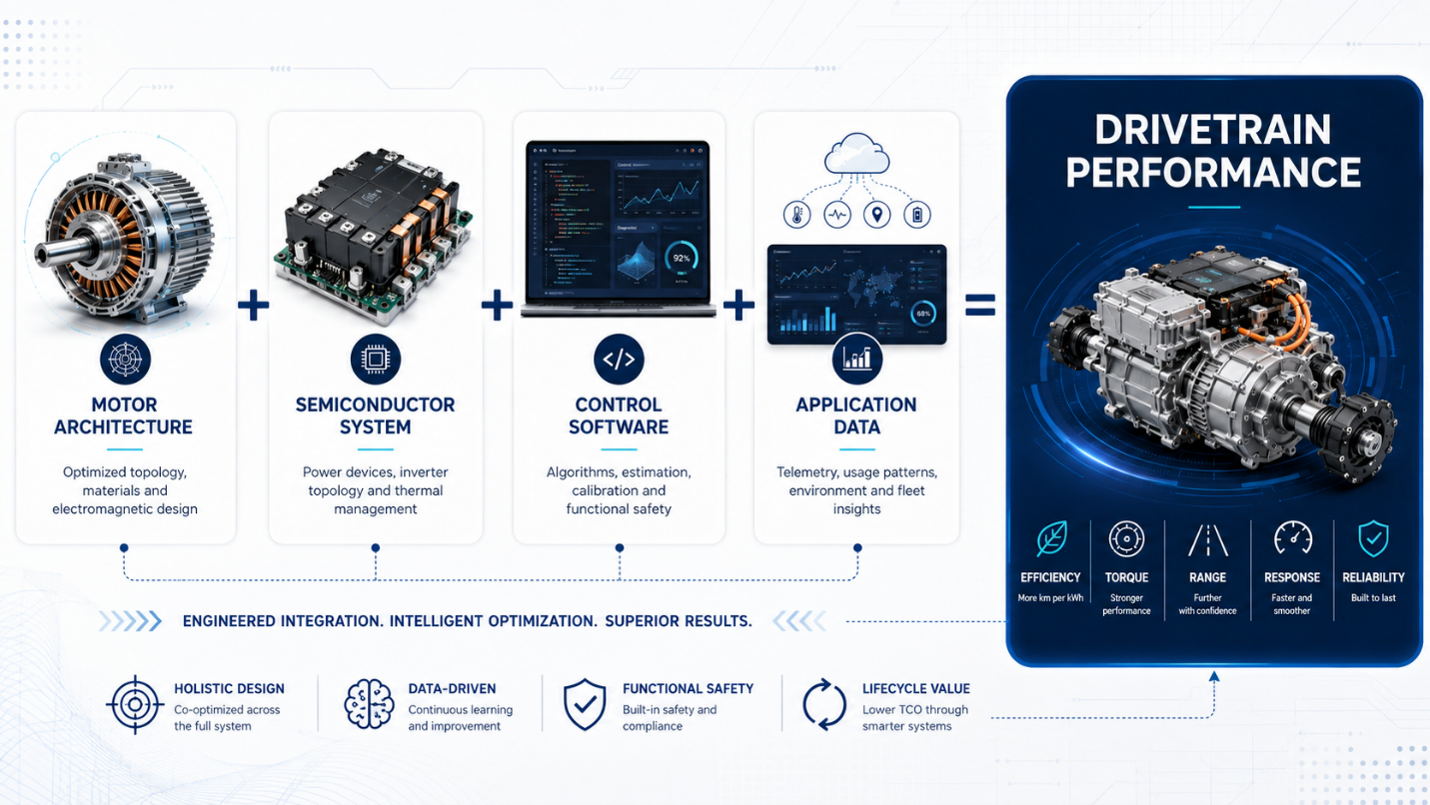
The most successful companies will not necessarily be those with the most sophisticated motor or the most advanced algorithm in isolation. They will be those that can co-optimise the full system and prove its value under real operating conditions.
For Vimag Labs, the next milestone is therefore not another patent. It is credible, independently validated evidence that its virtual-magnet platform can match or outperform established alternatives on efficiency, power density, cost, durability and manufacturability.
If that evidence emerges, software-defined magnetism could become more than a rare-earth workaround. It could mark a broader transition in which electric motors evolve from fixed electromechanical products into configurable, continuously optimised propulsion platforms.
The future electric motor may still rely on copper and steel, but software will increasingly shape its performance and competitive advantage.
Where Technology Intelligence Can Shape the Next Innovation
As electric motor technologies evolve, understanding the direction of innovation requires more than tracking individual breakthroughs. From identifying emerging motor architectures to assessing patent activity and competitor developments, structured research can help businesses evaluate technology shifts and their strategic implications.
Expertlancing is a global IP research, technology advisory, and market intelligence firm that helps organisations understand complex technology landscapes and make informed strategic decisions. Its capabilities span patent landscape analysis, technology scouting, competitive intelligence, and market research. By combining patent data with technical and market insights, Expertlancing helps clients identify emerging technologies, evaluate innovation trends, and uncover potential opportunities across technology domains.
With a team of 60+ professionals in India and a global presence across the USA and Japan, Expertlancing brings together IP researchers, technical experts, and domain specialists to examine innovation from multiple perspectives. Whether the objective is to map developments in electric motor technologies, understand competitor R&D activity, or assess emerging opportunities in a rapidly evolving market, its research approach aligns with each client’s specific strategic needs.
Looking to understand emerging technologies and identify new innovation opportunities? Connect with our experts to discuss your research needs and explore how our IP intelligence and technology advisory capabilities can support your next strategic decision.