Patent classification is the backbone of any serious prior-art search, freedom-to-operate study, or technology-landscape analysis. The recent H01L-to-H10 semiconductor classification transition has fundamentally changed how searchers organize and search semiconductor and electronic-device patents. When the classification schemes change, previously effective searches can quietly start missing the most recent and relevant filings. This can happen without the searcher realizing that coverage has declined. Between 2024–2026, both the International Patent Classification (IPC) and Cooperative Patent Classification (CPC) systems have undergone significant changes. The most consequential change was the wholesale reorganization of how semiconductor and electronic devices are classified.
The new classification significantly restructures H01L, which served as the primary classification for semiconductor devices for decades. Most semiconductor device subject matter has migrated to the new H10 series. H01L now covers only residual subject matter following the 1 January 2026 revision. Understanding the H01L-to-H10 semiconductor classification change is therefore essential for anyone conducting semiconductor prior-art searches, FTO studies, patent landscapes, or technology monitoring. This study explains the key changes and provides a classification mapping table and practical search strategies. It also outlines how searchers can adapt their approach and maintain comprehensive coverage.
A Quick Refresher: IPC vs. CPC
The two schemes serve different but overlapping roles. The IPC, administered by WIPO, is the global standard used by virtually every patent office in the world. A new IPC version enters into force each year on 1 January. The CPC is jointly maintained by the European Patent Office (EPO) and the US Patent and Trademark Office (USPTO). It extends the IPC with greater technical granularity, with roughly 250,000 subdivisions, and is updated several times a year rather than once. For a comprehensive search, you almost always want to use both, because CPC provides finer technical granularity while IPC ensures global coverage across offices that do not apply CPC.
The Biggest Change: Semiconductors Migrate from H01L to the New H10 Series
The single most important change is the migration of semiconductor device subject matter from H01L to the new H10 classification series. This H01L-to-H10 semiconductor classification shift is not a minor coding update. It represents a fundamental restructuring of where chip patents live. H01L has been re-scoped as residual to class H10. It is now formally deleted from the IPC and CPC as of 1 January 2026, with backfile reclassification continuing for some time afterward.
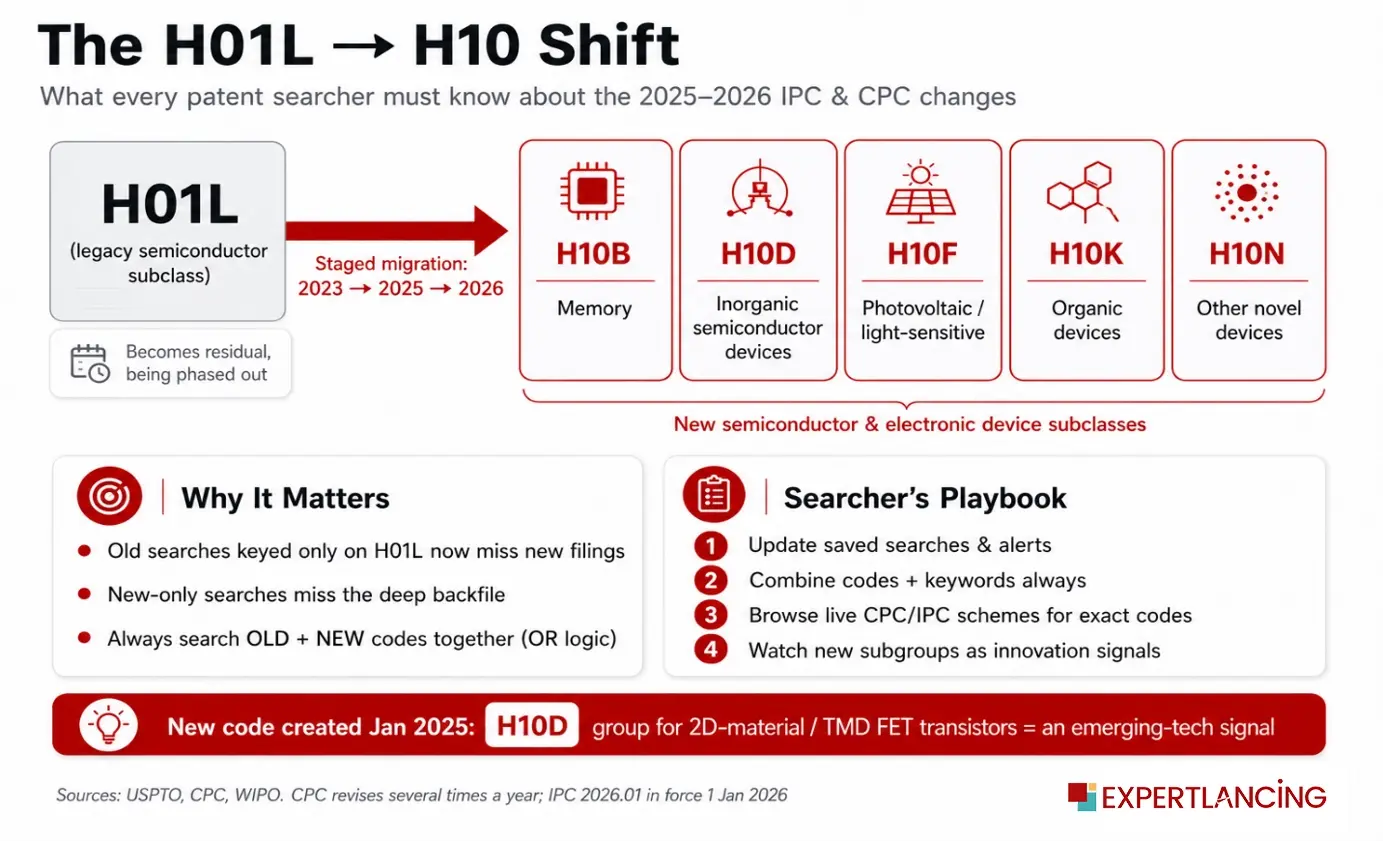
For patent searchers, the practical implication of the H01L-to-H10 transition is that a search strategy built exclusively around legacy H01L classifications may increasingly lose visibility into newer semiconductor filings. At the same time, searching only the new H10 classifications can leave gaps in the historical prior-art record.
Comparative Mapping: Legacy H01L to New H10 Classifications
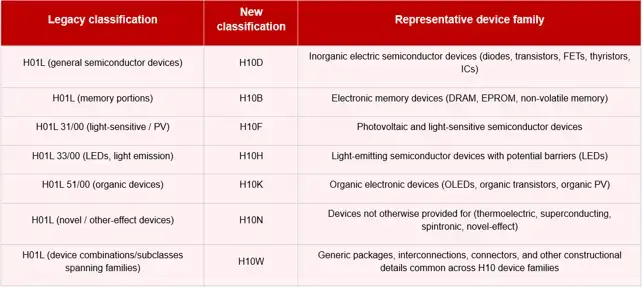
The following table maps the legacy subclass to its successor H10 subclasses for quick reference. The new classification distributes device families once grouped under H01L across dedicated, more specific subclasses.
Table 1: H01L-to-H10 Classification Transition Mapping for Semiconductor Devices
A useful detail for materials searchers: the new H10D structure includes a dedicated, newly created group for field-effect transistors with two-dimensional material channels, such as transition-metal dichalcogenide (TMD) FETs. (Confirm the exact creation date against the current CPC revision changelog before citing it.) The creation of such a narrow, brand-new subgroup is itself a signal, because classification authorities generally introduce new codes when a technology area becomes sufficiently mature or significant to warrant separate identification.
Indicative H01L-to-H10 Classification Transition Timeline
The migration was rolled out in stages rather than all at once. Broadly, the H10 subclasses came into force sequentially during the 2024–2026 period. Early subclasses (including the organic-device family, H10K) were introduced around 2024. The bulk of the inorganic device and memory subclasses took effect through 2025. H01L was substantially restructured in the 1 January 2026 revision, with semiconductor subject matter primarily transferred to H10. This staged H01L-to-H10 semiconductor classification transition means that patent databases can contain both legacy and newly classified records during the same period. Even after deletion, the legacy H01L codes remain visible on older documents. The EPO notes that backfile reclassification is continuing gradually.
Common Search Mistakes During the H01L-to-H10 Transition
Because the transition remains staged and backfile reclassification is incomplete, several predictable errors can silently undermine a search. Recognizing these H01L-to-H10 semiconductor classification gaps is the first line of defense against incomplete patent searches.
- The first and most common mistake is searching only on H01L. A strategy or saved alert that still relies solely on the legacy subclass will increasingly miss recent filings classified solely under H10, precisely the new frontier inventions a technology-scouting search most wants to catch.
- The second, and equally damaging, is searching only on the new H10 codes. This misses the deep backfile of prior art still residing under H01L on documents that have not yet been reclassified, which is exactly what undermines a thorough invalidity or freedom-to-operate search.
- A third error is assuming reclassification is complete and instantaneous. It is neither. During the transition, the same technology can appear under H01L on an older family member and under H10 on a newer one, so relying on a single code for a patent family can fragment the result set.
- A fourth is dropping keywords and trusting codes alone. Because reclassification is imperfect and some recent filings may not yet carry their final H10 code, classification-only searches can miss relevant documents.
- A fifth, more subtle, is ignoring combination-set behavior changes. The CPC notes that the new H10 class does not use combination sets from the old scheme. Searchers should therefore revisit search logic based on those conventions.
Illustrative Search Strategy Examples
The correct practice during this transition is to combine legacy and new classification codes using OR logic. Anchor the classification search with relevant technical keywords for broader coverage. The examples below use Questel Orbit syntax for illustration. Equivalent search strategies can be readily adapted to other patent databases, such as Google Patents, Espacenet, PatBase, Lens.org, and Derwent Innovation, although field names, operators, and query syntax may vary across platforms.
#1. Combining legacy and new classifications
CPC = (H01L OR H10D) – the foundational move; avoid relying on either classification alone during the transition period. For a narrower device family, pair the matched codes, for example CPC = (H01L-027/+ OR H10B+) for memory, or CPC = (H01L-033/+ OR H10H+) for LEDs.


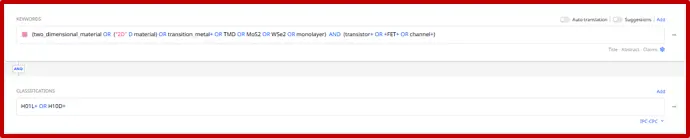
#2. Combining classification codes with keywords (a 2D-materials example)
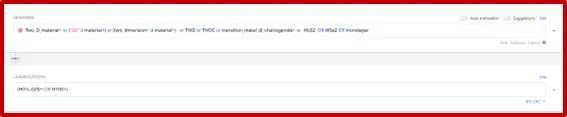
CPC = (H01L OR H10D) AND TAC = (“two-dimensional material” OR “2D material” OR “transition metal dichalcogenide” OR TMD OR MoS2 OR WSe2 OR monolayer) AND TAC = (transistor OR FET OR channel) where TAC denotes a title/abstract/claims keyword field.
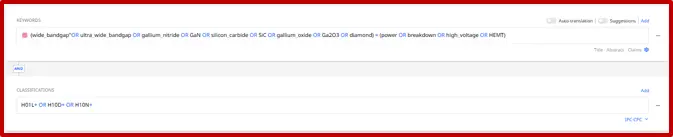
#3. An exhaustive-search approach (wide-bandgap power devices)
CPC = (H01L OR H10D OR H10N) AND TAC = (“wide bandgap” OR “ultra-wide bandgap” OR “gallium nitride” OR GaN OR “silicon carbide” OR SiC OR “gallium oxide” OR Ga2O3 OR diamond) AND TAC = (power OR “breakdown” OR “high voltage” OR HEMT).
Then add a citation layer (forward and backward citations of the top hits) and an applicant/inventor layer to catch documents the classification and keywords alone miss. For maximum recall, run the same query against the IPC equivalents as well, since not all offices apply CPC.
A practical refinement: filter results by classification-symbol creation date or version tag to surface newly created H10 subgroups, which serve as early indicators of emerging innovation trends, and sort separately by citing-patent count to find recent filings that are already influential.
A Practical Use-Case Example
Consider an invalidity (prior-art) search conducted for a recently granted patent on a TMD-channel transistor. A searcher who builds the strategy purely on the new H10D 2D-material FET group will find the recent, well-classified art but may miss earlier foundational disclosures filed years ago and still classified under H01L-029/+ that have not yet been reclassified. The most relevant invalidating reference is frequently an older document, exactly the kind most exposed to this gap. The robust approach is CPC = (H01L-029/+ OR H10D+) AND TAC = (2D-material keywords), layered with backward citations, which captures both the modern and legacy art.
The same logic applies to freedom-to-operate work, where missing an in-force legacy-classified patent can be commercially serious, and to technology landscaping, where mixing the two code eras prevents an artificial discontinuity in filing trends right at the 2024-2026 boundary, the period analysts most want to read accurately.
Impact on Patent Databases and AI-Assisted Search Tools
These changes ripple through the tooling layer in ways searchers should anticipate. Commercial databases and analytics platforms (such as Lens.org, Espacenet, PatBase, PatSnap, etc.) reclassify their holdings on their own schedules, so the same query can return different results across platforms during the transition, depending on how extensively each platform has implemented H10 classification. Trend charts and landscape dashboards are especially vulnerable: a naive CPC-over-time view can show a misleading collapse in H01L and a sudden spike in H10 that reflects reclassification, not real innovation activity, so analysts must normalize across the old and new codes before concluding.
AI-assisted and semantic search tools are less affected, because they rank on textual and conceptual similarity rather than codes alone, which is one reason a hybrid approach is increasingly best practice. However, many AI tools still use classification as a filter or a feature, and models trained or tuned on pre-transition data may under-weight the new H10 codes. The EPO has itself introduced AI-powered classification tooling to help with exactly this kind of categorization challenge. The pragmatic takeaway is to treat AI search as a complement that improves recall, while still validating with a properly bridged classification-plus-keyword query.
Practical Recommendations for Searchers
The core takeaways translate into a handful of concrete habits. First, audit and update any saved searches, alerts, and templates that rely on H01L, adding the corresponding H10 subclasses with OR logic. Second, always combine classification with keywords, and add citation and applicant layers for exhaustive work. Third, when scoping a new area, browse the live CPC and IPC schemes directly through the EPO, USPTO, or WIPO scheme browsers to confirm current codes rather than reusing them from memory. Fourth, normalize across old and new codes before producing any trend or landscape chart. Fifth, validate critical results across more than one database, since reclassification progress varies. And sixth, because the CPC revises several times a year, periodically re-check the codes underpinning any long-running watch or study.
Conclusion
The restructuring of H01L and the migration into the H10 series mark a significant classification shift. For patent searchers, this means the classification landscape has fundamentally changed. This transition is staged rather than instantaneous, making it important to bridge legacy and current codes. Searchers should also bridge the old and new codes together with robust keywords, citations, and cross-database validation. Updating search strategies can improve access to recent innovations through the new, more granular codes. Those who do not will quietly lose sight of exactly the filings that matter most.
How Expertlancing Helps You Stay Ahead
As patent classification systems continue to evolve, keeping search strategies up to date is essential for uncovering relevant prior art and accurately tracking emerging technologies. Expertlancing helps organizations navigate complex patent searches by combining classification expertise with advanced keyword, citation, and technology-focused analysis.
Connect with our experts to explore how we can support your prior-art searches, freedom-to-operate studies, and technology landscapes.