
At a Glance
Through compression popping technology supplier scouting, a leading Asian food and snack company sought to enter the high-growth compression popping segment to meet surging consumer demand for healthier, oil-free puffed snacks. Facing a complex and fragmented global equipment landscape with no established Korean supplier base, the company engaged our strategic advisory team to conduct a structured manufacturer scouting and technology benchmarking exercise across three continents.
The Challenge
A Fast-Growing Healthy Snack Market
The global puffed and extruded snack market, valued at approximately $52.9 billion in 2024, is projected to reach $88.4 billion by 2034 at a CAGR of 5.3%.
Within this expanding sector, compression popping technology has emerged as a particularly attractive production method because it produces light, crispy snacks without frying, directly addressing the consumer shift toward healthy snack production equipment for plant-based, oil-free, and protein-fortified snack options.
The snack processing equipment market itself is projected to reach $19.7 billion by 2035, growing at 6% annually.
Need for New Production Capability
For the client, a well-established Asian food manufacturer with strong domestic market share in conventional snack categories, the strategic imperative was clear: invest in compression popping capability or risk ceding the fastest-growing snack segment to competitors already scaling this technology.
The company’s existing production infrastructure relied on oil-based frying and conventional extrusion, neither of which could deliver the texture, nutritional profile, or “clean label” positioning that modern consumer demand.
Fragmented Supplier Landscape and Capital Risk
The challenge was compounded by three factors:
First, the market for compression popping equipment suppliers and snack processing equipment manufacturers is highly fragmented, with Tier 1 players concentrated in Europe and the United States and virtually no established base of Korean snack equipment manufacturers for this specialized technology.
Second, the technology itself spans multiple compression modalities including pneumatic, hydraulic, and rotary systems, each with distinct trade-offs in throughput, energy efficiency, and product versatility.
Third, the client lacked internal technical benchmarks for evaluating these systems, meaning any procurement decision carried significant capital risk.
The company needed an independent, structured scouting process to map the supplier landscape, evaluate technology readiness, and deliver a decision-grade shortlist before the next capital planning cycle.
Our Supplier Scouting and Benchmarking Approach
The advisory team deployed a four-stage scouting and evaluation methodology designed to move from broad landscape mapping to a validated, decision-ready supplier shortlist for food equipment supplier scouting.
Stage 1: Technology Landscape Mapping and Compression Modality
The team began by defining the technical scope of compression popping equipment across four core modalities: pneumatic-driven double-compression, hydraulic compression, oil-based popping, and dry (hot air) popping machinery.
Each modality was mapped against key performance parameters including compression cycle precision, material compatibility (elastomeric materials, aluminum honeycomb structures, auxetic foams), production capacity ranges (up to 40 pounds per hour for industrial units), and energy consumption profiles.
This baseline analysis established the technical vocabulary and evaluation criteria that would govern every subsequent stage.
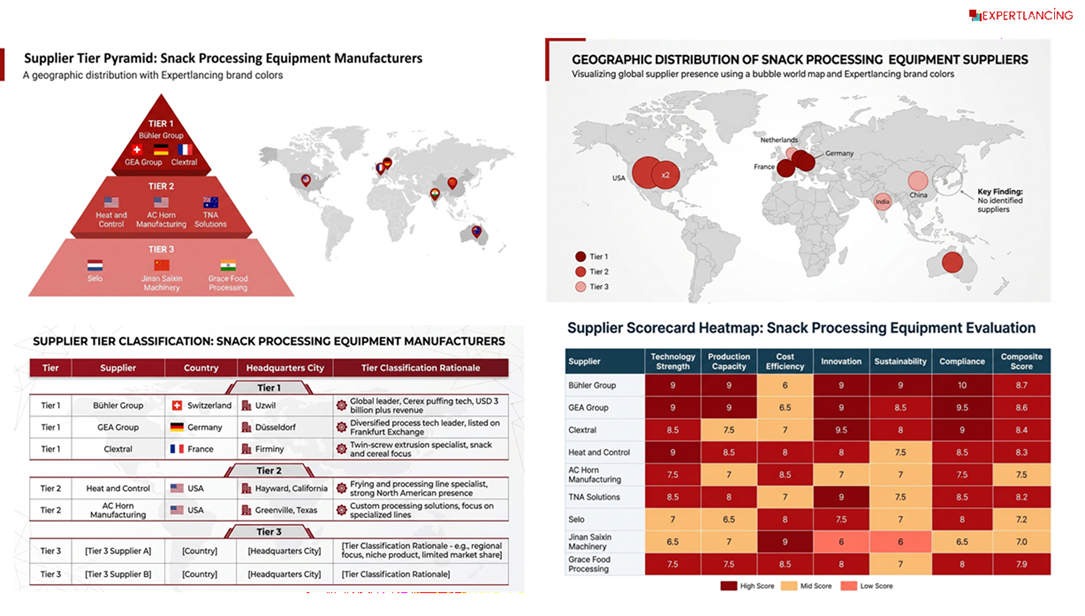
Stage 2: Global Supplier Identification and Tiered Classification.
Drawing on secondary research, industry databases, and expert consultations, the team identified and profiled suppliers across 8 countries spanning Europe, North America, Asia-Pacific, and India.
Suppliers were classified into three tiers: Tier 1 global leaders (Bühler Group, Clextral, GEA Group), Tier 2 niche and specialized players (Heat and Control, AC Horn Manufacturing, TNA Solutions), and Tier 3 emerging innovators (Selo, Jinan Saixin Machinery, Grace Food Processing).
Each supplier was profiled against product range, technology strength, production capacity, compliance certifications, and innovation investment.
Stage 3: Multi-Criteria Evaluation and Competitive Benchmarking.
The team developed an 18-parameter supplier benchmarking for food manufacturing framework encompassing six evaluation domains: technical capabilities, production and capacity, compliance and certifications, supplier reputation and experience, after-sales support, and cost and commercial terms.
All 9 suppliers were scored and benchmarked. Innovation scores ranged from 5/10 (Grace Food Processing) to 9/10 (Bühler Group and GEA Group).
Technology strength, production capacity, cost efficiency, and sustainability initiatives were each rated and cross-compared to identify optimal trade-offs for the client’s specific requirements.
Stage 4: Risk Mitigation Framework and Supplier Audit Protocol.
Recognizing that a single-source procurement strategy would expose the client to unacceptable supply chain risk, the team designed a comprehensive risk mitigation framework.
This incorporates supplier financial health audits, diversification mandates (minimum two suppliers per technology category), real-time IoT-enabled monitoring protocols, buffer inventory strategies for critical components, and long-term contracts with price protection clauses.
A six-step supplier audit process was established covering preliminary screening, on-site inspection, sample testing, compliance verification, pilot production runs, and long-term performance monitoring.
Key Findings and Insights
The analysis revealed several important supplier and technology insights:
- The global compression popping equipment landscape is dominated by three European manufacturers.
- Bühler Group and GEA Group both scored 9/10 on innovation and maintained strong sustainability credentials.
- Bühler’s recent acquisition of Cerex puffing technology, launched commercially in mid-2025 in three configuration sizes, positions it as the clear technology leader for grain-based puffed snack production.
- Tier 3 suppliers such as Jinan Saixin Machinery offered high production capacity at significantly lower cost, but their lower innovation and sustainability scores created risk for premium market positioning.
- GEA Group uniquely combined high ratings across technology strength, production capacity, cost efficiency, innovation, and sustainability.
- Compliance readiness varied significantly across supplier tiers, with all Tier 1 suppliers holding ISO 22000, FDA, and CE certifications, while several Tier 3 suppliers lacked one or more critical certifications required for export-market compliance.
The Impact
- 9 Qualified Suppliers Identified Across 8 Countries– A structured, tiered shortlist replaced an opaque and fragmented market landscape, giving the client decision-grade visibility.
- 18-Parameter Evaluation Framework Delivered– A reusable scoring model across six domains ensures consistent, objective supplier evaluation for this and future equipment procurement decisions.
- $2M+ Capital Procurement Decision De-Risked– The benchmarking analysis provided the data foundation for the client’s capital committee to approve investment with confidence, avoiding the cost of failed pilot programs or supplier mismatches.
Strategic Takeaway
As the healthy snack category continues its trajectory toward $88 billion by 2034, manufacturers without compression popping capability face structural competitive disadvantage.
This engagement demonstrates that structured supplier scouting and supplier benchmarking can reduce procurement risk, clarify technology trade-offs, and convert a fragmented global equipment market into a clear, actionable roadmap for capital investment.
The client has since initiated pilot production runs with two Tier 1 suppliers and is evaluating long-term technology transfer arrangements for Korean market localization.
Next Step
Looking to identify compression popping equipment suppliers or benchmark specialized food manufacturing equipment for your next product line? Contact us to design a food equipment supplier scouting and equipment benchmarking program calibrated to your technology requirements, compliance standards, and commercial objectives.