
Key Takeaways
- The circular economy market is projected to approach $900 billion by 2030, with the digital circular economy growing at 20%+ annually.
- IoT sensors, AI, digital twins, and blockchain form the core technology stack enabling closed-loop manufacturing at scale.
- Digital twins have demonstrated up to 75% waste reduction (GE) and are set to become a $260 billion market by 2032.
- The EU’s Digital Product Passport and global regulatory pressure are accelerating adoption.
- Circular business models deliver measurable financial returns: 23% average profit margin improvement within three years for early adopters.
- The barriers – infrastructure gaps, capital costs, data fragmentation – are real, but the economic and regulatory momentum is overwhelming.
Introduction
For most of industrial history, manufacturing followed a simple, unforgiving logic: extract, produce, use, discard. Raw materials entered one end of the pipeline; waste exited the other. The Earth absorbed the difference – until it couldn’t anymore.
Today, a fundamental rethinking is underway. Closed-loop manufacturing, a model where products, components, and materials are continually recovered, reprocessed, and reintroduced into production, is moving from a sustainability aspiration to an operational strategy. Smart technology is the engine driving this change: IoT sensors, artificial intelligence, digital twins, and blockchain.
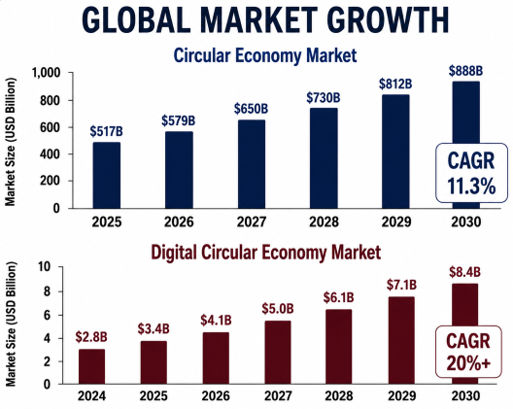
The numbers tell a compelling story. The global circular economy market was valued at $517 billion in 2025 and is estimated to reach $900 billion by 2030, growing at a CAGR of 11.3%. The digital circular economy, the tech-enabled layer that makes closed-loop manufacturing operationally viable, was valued at $2.8 billion in 2024 and is forecast to reach $8.4 billion by 2030, expanding at over 20% annually.
This is not incremental progress. This is an industrial transformation.
What Is Closed-Loop Manufacturing?
In a conventional linear model, a car is manufactured, sold, driven for a decade, and then crushed. It contains steel, aluminium, plastics, and rare earths that are largely unrecoverable in their original form. Value is lost at the end of life.
In closed-loop manufacturing, this is inverted. It regards every product as a node in an ongoing stream of materials: components are built for disassembly, real-time data are gathered on usage patterns, end-of-life products are channeled through reverse logistics, and recovered materials are reintroduced into production. Nobody just leaves the system for no reason.
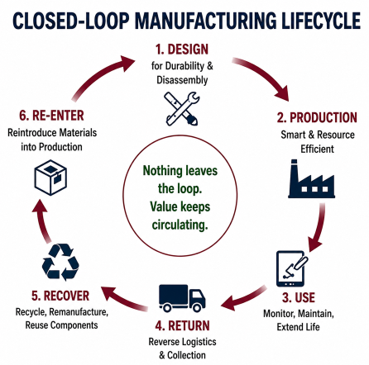
This is the physical backbone of the circular economy, an economic model that decouples growth from resource consumption by designing out waste and keeping materials in use at their highest value for as long as possible.
The problem has been operational, historically. How do you actually track every component, predict when products will need servicing, optimize the return of materials, and make sure nothing gets lost in the loop? For decades, it had been too complicated and too expensive.
Smart manufacturing technology has changed the game.
The Technology Stack Powering the Loop
- IoT: The Nervous System of the Circular Factory
Closed-loop manufacturing is built on a foundation layer of Industrial IoT sensors. They are embedded in machinery, products, and logistics infrastructure, creating constant streams of data: temperature, vibration, energy consumption, and material flow that make the whole production-to-recovery cycle visible.
According to NTT DATA researchers, IoT sensors can be used to monitor resource usage in real time, enabling more efficient management of raw materials and a significant reduction in unnecessary waste. When every gram of material and every joule of energy is tracked, inefficiency has nowhere to hide.
The economics are there now for mass deployment. The price of industrial IoT sensors has fallen to around $0.10–$0.80 per unit, which makes the full instrumentation of the factory floor economically attractive even for mid-scale manufacturers. Democratization of sensing infrastructure is a precondition for closed-loop operations at scale.
- AI and Machine Learning: Turning Data into Decisions
Raw sensor data is considered inert or blank because, on its own, it has no meaningful value or actionable insight. It is AI that transforms this raw data into intelligence by analyzing, interpreting, and extracting meaningful patterns and insights. In closed-loop manufacturing, AI operates across the full lifecycle. During production, machine learning optimizes material usage in real time, reducing scrap. In the use phase, AI-driven predictive maintenance monitors equipment, detects degradation early, and extends product life. At the end-of-life, AI-based sorting and routing direct returned materials to optimal recycling, remanufacturing, or reuse streams, maximizing value recovery. According to the UNIDO Circular Economy and Digitalization working paper (2025), AI analyzes return data to improve sorting efficiency, ensuring minimal material loss and maximum reuse at original quality levels.
Profitability through AI application has been found by some research conducted during 2024-2025. It has been revealed that firms adopting the principle of circular economy – most of which are AI-based – show an average profit margin increase of about 23%.
- Digital Twins: Simulating the Loop Before You Run It
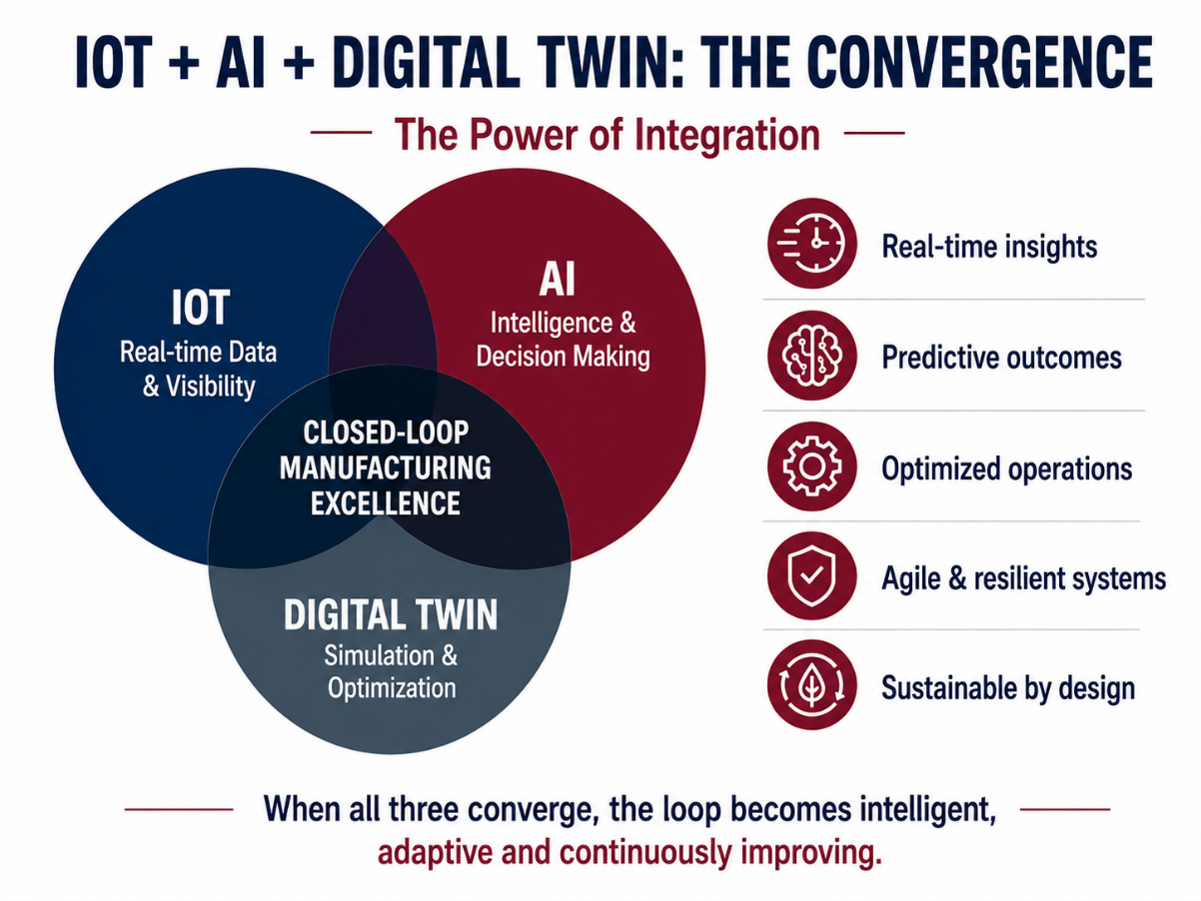
The digital twin, which involves creating a real-time virtual version of physical products or systems, is changing the nature of closed-loop manufacturing. It is possible to test, simulate, or design products without using any physical material. Simulations can be used to test new designs before even making prototypes, and the whole production process can be optimized before implementation. The combination of the digital twin and AI in a circular economy allows for closed-loop control and predictive analytics and is know as
Their economic impact is already proven at scale. General Electric reduced product waste by 75% and quality complaints by 38% using process digital twins. The market is projected to grow from $25 billion in 2024 to $260 billion by 2032, at a 40% CAGR. Crucially, digital twins require AI for intelligence and IoT for real-time data; without this convergence, systems lack either insight or agility, limiting the full value of closed-loop manufacturing.
- Blockchain: Trusting the Loop
A closed-loop process relies on trust, trust that the recycled materials used are genuine, the parts are of good quality, and the statements made by suppliers are valid. This is where blockchain comes in handy by providing an immutable audit process throughout the life cycle of the product, starting from sourcing raw materials to manufacturing, usage, recycling, and reuse. The EU’s Digital Product Passport (DPP) reinforces this shift, requiring products to carry transparent, traceable data on composition, origin, and lifecycle, capabilities effectively enabled through blockchain technology.
Indeed, blockchain-powered circularity is already a reality. In April 2025, circularise launched blockchain-based digital product passports for Samsonite’s circular luggage line, enhancing material traceability and supporting circular design principles. In October 2024, SUEZ acquired a 20% stake in Renault Group’s circular economy platform, “The Future Is NEUTRAL”, aiming to scale automotive recycling and strengthen closed-loop systems across Europe.
From Theory to Factory Floor: Closed-Loop in Practice
Philips and the “Pay-per-Lux” Model
Closed-loop manufacturing logic was first demonstrated by Philips with its innovative Product as a Service concept: Instead of selling their lighting equipment to the Schiphol Airport in Amsterdam, Philips kept ownership while selling their lumens as lighting services. This means that Philips had all reasons to design the products with durability, high efficiency in terms of power usage, and ease in recovering materials after the products’ life cycle was completed, as they were responsible for the maintenance of the assets and recovery of materials for future production cycles.
The Automotive Sector’s $127 Billion Bet
The auto industry has invested a total of $127 billion in circularity initiatives starting from 2023, with the vehicle-as-a-service model and component remanufacture being central to its efforts. In light of rapid growth in the electric vehicle segment, there has been an increased emphasis on reimagining battery life cycles, rare earth material recycling, and end-of-life vehicle management. Circular production has ceased to be an idealized goal and has become a core element of operations.
Closed Loop Partners’ Impact at Scale
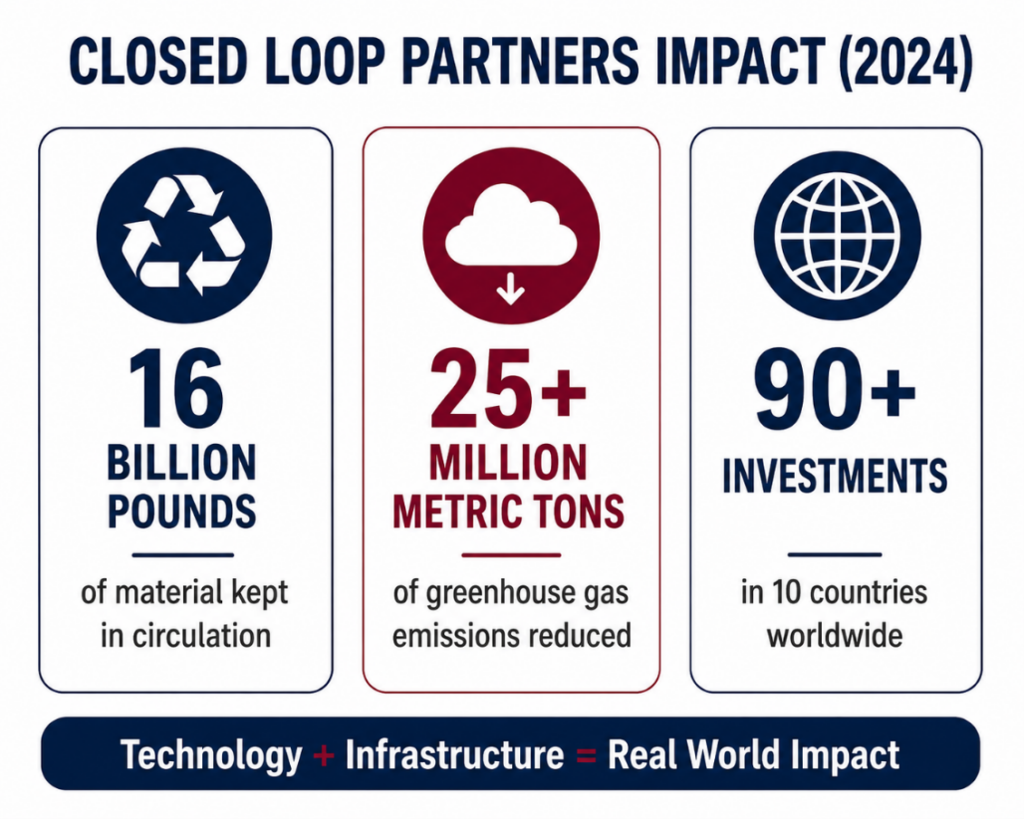
Closed Loop Partners, an investment company that focuses on circular economy infrastructure, achieved by the end of 2024, having kept about 16 billion pounds worth of material in circulation, as well as reducing greenhouse gas emissions by over 25 million metric tons through 90 investments made across 10 different countries. These figures do not simply exist; rather, they are facts that come from the correct implementation of technology infrastructure.
The Barriers That Remain
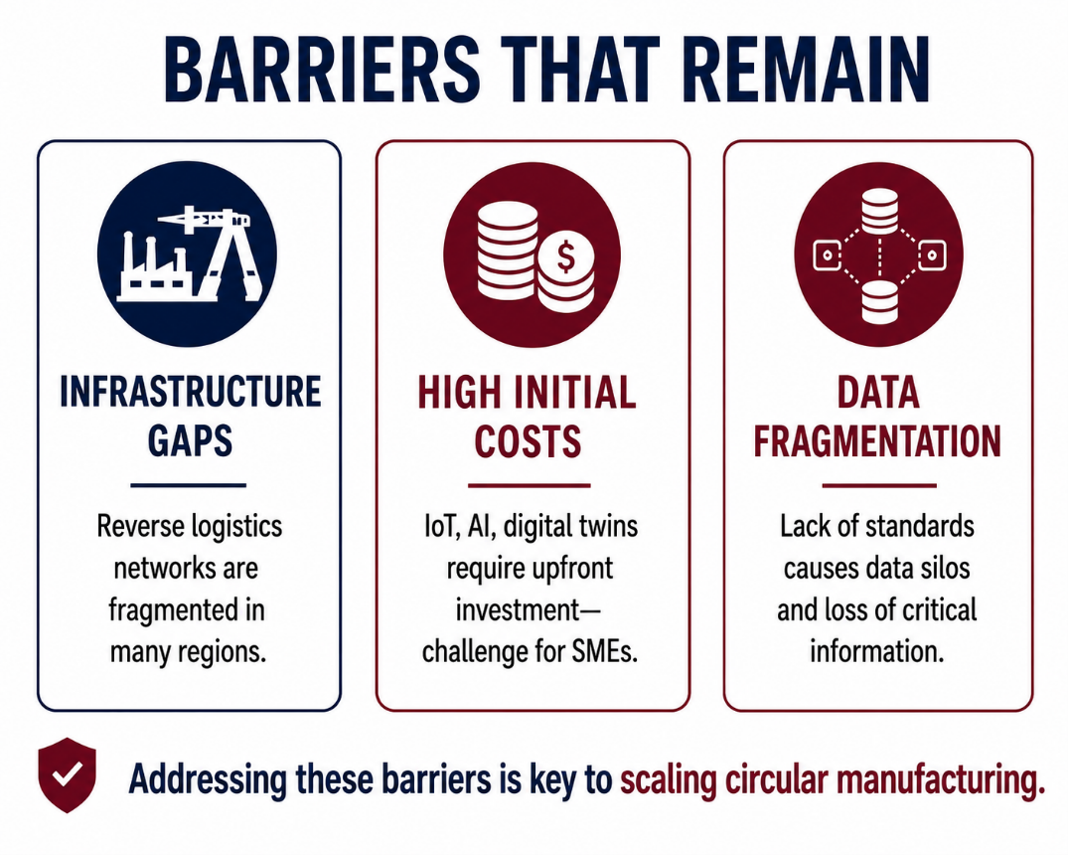
In order to demonstrate intellectual honesty, one must accept that achieving a closed loop in manufacturing on a massive scale is an ongoing process, with numerous issues remaining. Firstly, there is the issue of fragmented infrastructure. Reverse logistics channels, which refer to the network by which returned products are sent back for reprocessing, are lacking in many parts of the world.
Initial high cost represents another challenge, especially for small to medium manufacturers. The implementation of extensive IoT sensing, advanced AI analysis tools, and digital twins requires resources that may not be available to small manufacturers.
Finally, standardizing the collected data represents yet another problem. Closed-loop manufacturing systems rely on smooth data exchange among manufacturers, logistics companies, recyclers, and remanufacturing firms. However, without standardized data and data platforms, important information gets lost at each step along the way.
And yet, the trajectory is clear. The North American circular economy market is expected to grow at a CAGR of 25.65% through 2031. Pressure from regulatory bodies such as the EU Digital Product Passport and carbon border adjustment mechanisms is making linear production expensive. Additionally, the circular economy is creating 2.2 million job opportunities worldwide, with an additional 125,000 added last year.
The Strategic Imperative
It is easy to describe the concept of closed-loop manufacturing as a cost incurred due to living in a more regulated and resource-limited world. The fact is that this perspective fails to emphasize the benefits inherent in this process.
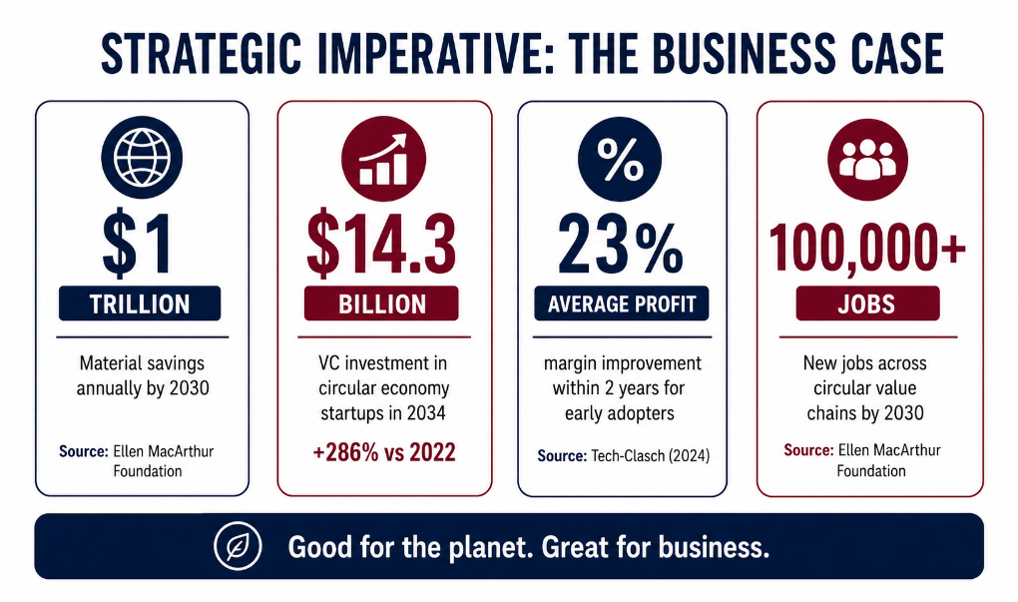
According to the calculations made by the Ellen MacArthur Foundation, circular business models could generate $1 trillion in material savings annually by 2030, while creating 100,000 new jobs across circular value chains. Investment in startups working on the principle of circular economies has surged in venture capital financing to $14.3 billion in 2024 – a staggering growth rate of 286% compared to 2022 figures.
This is where smart technology comes in. Digital simulations of a complete product cycle. IoT technology provides visibility into each and every material flow. Artificial intelligence is making the most of recovery opportunities at every step of the way. Blockchain ensures the trust system on which circular supply chains depend.
By adopting this technology today, companies can not only improve their impact on the environment but also create the operations management capabilities that will define competitiveness in the coming years of manufacturing. The straight line had a long run. The loop is the future.
Conclusion
Closed-loop manufacturing is no longer a conceptual ideal and it is becoming the architecture of modern industry. As IoT, AI, digital twins, and blockchain converge, they transform circularity from a sustainability goal into a measurable, profitable, and scalable operating model. While challenges around infrastructure, cost, and data standardization persist, the combined force of economic incentives and regulatory pressure makes the transition inevitable. Companies that act now will not only reduce waste but also build resilient, future-ready operations. The era of linear production is ending; competitive advantage will belong to those who can master the loop.
Recommendation For Stakeholders
Invest in Integrated Digital Infrastructure: Make sure that IoT devices, AI analysis, and digital twins are implemented through a coherent strategy that provides real-time monitoring, predictive decision making, and optimization throughout the manufacturing and recovery loop processes.
Design for Circularity from the Outset: Make sure that your products have been designed in a way that allows you to disassemble and reassemble them effectively, as well as to reuse, remanufacture, and recover high-value materials.
Build Robust Reverse Logistics Systems: Ensure that take-back and sorting systems are developed so that used products are recovered and fed back into manufacturing operations rather than being wasted.
Adopt Lifecycle-Based Business Models: Switch from traditional business models, which sell products only once, to lifecycle business models, such as Product-as-a-Service, where ownership is retained.
Align with Regulatory and Data Standards Early: Adopt standards early on for Digital Product Passports and other important information flows, and ensure smooth interoperability throughout the whole lifecycle.