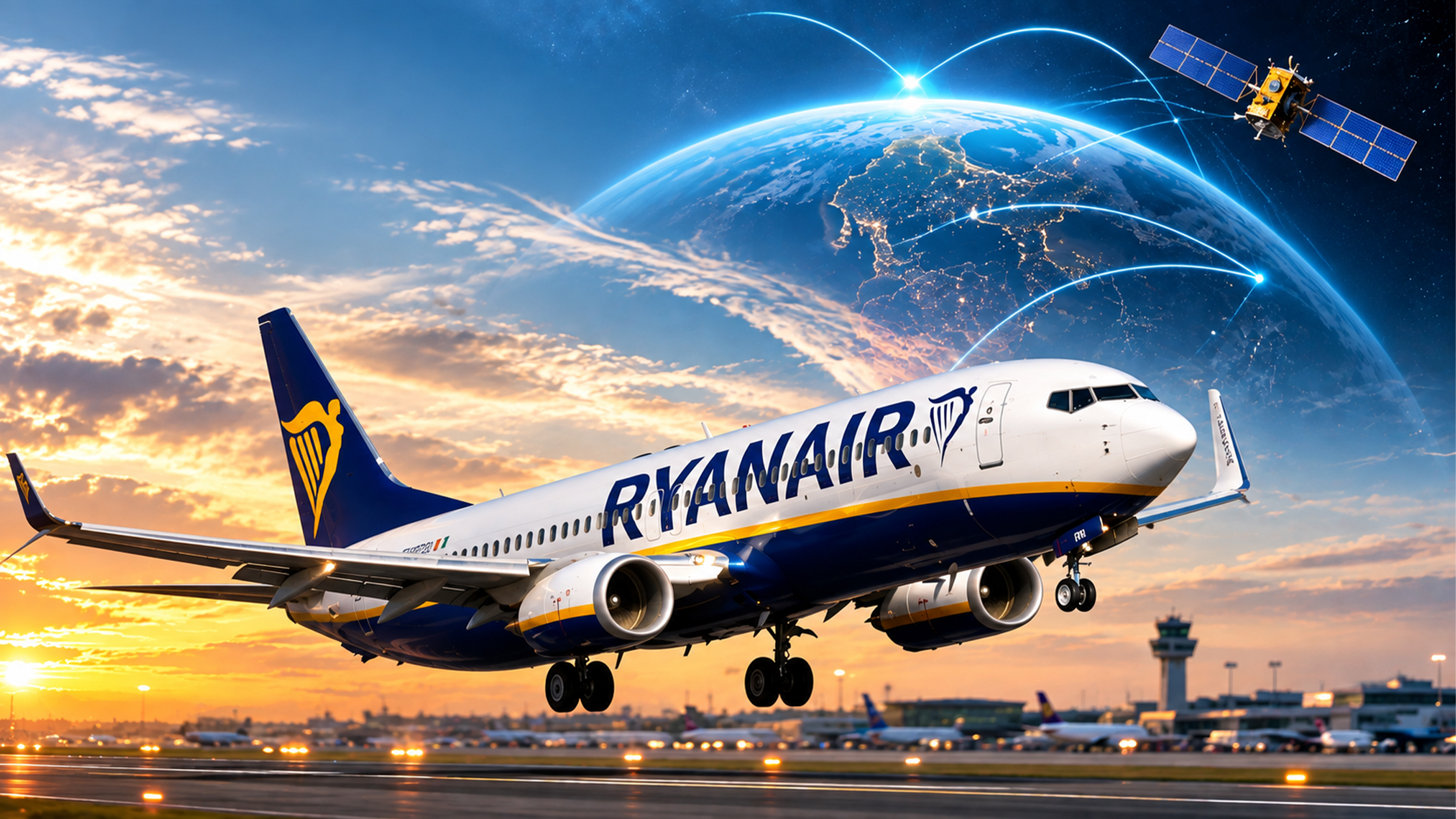
Ryanair CEO Michael O’Leary recently explained, bluntly and publicly, why his airline won’t put Starlink antennas on its planes: bolting an antenna onto the fuselage for in-flight Wi-Fi adds drag and weight, which shows up as extra fuel burn, and on flights that average about an hour, that math never closes. Behind that debate sits a much bigger question: could 6G NTN eventually change how aircraft connect to networks in the first place?
It’s a real, well-documented argument playing out in aviation right now. It also happens to sit at the edge of a much bigger, quieter story: the mobile industry’s earliest planning for 6G already treats “connectivity in the sky” as a first-class citizen of the network, not a bolted-on afterthought, and Airbus is one of the plane-makers sitting at that standards table. If that work lands the way its backers describe, the antenna-on-the-fuselage debate O’Leary just picked could look, in hindsight, like the last chapter of an old argument.
In January 2026, O’Leary told Reuters that fitting Starlink antennas across Ryanair’s fleet would bring a roughly 2% fuel penalty from the added weight and drag and that he doubted passengers would pay for Wi-Fi on flights that average about an hour. He put the potential cost to the airline at $200–250 million a year.
Starlink Pushes Back
SpaceX did not let that stand.
Elon Musk called the claim “misinformed” on X. Starlink’s VP of Engineering, Michael Nicolls, countered that the real-world fuel penalty for Starlink’s low-profile aviation terminal on a 737-800 is closer to 0.3%, not 2%.
Nicolls argued that O’Leary’s number reflects outdated, bulkier antenna designs rather than Starlink’s current hardware.
The spat escalated publicly. Musk called O’Leary an “utter idiot,” and O’Leary fired back that Musk knew “zero” about aviation drag.
Whatever the true number, the underlying tension is real and industry-wide.
It is not unique to Ryanair. Any external satellite antenna adds physical hardware on the outside of an airframe. The hardware comes with costs related to drag, weight, maintenance, and certification.
Starlink’s newer terminals have reduced some of these costs. However, the basic trade-off remains. That’s precisely why full-service carriers like Lufthansa, United, Qatar Airways, and Air France have judged the trade-off worth it for long-haul comfort and revenue, while an ultra-low-cost, short-haul operator like Ryanair has judged it isn’t.
The Bigger Question: What Comes Next
Here’s the twist. While airlines are still relitigating whether a satellite Wi-Fi antenna is worth 0.3% or 2% of fuel burn, the telecom and space industries are already working on the next layer of connectivity. The goal is to make direct connectivity between satellites (or high-altitude platforms) and ordinary devices,a built-in feature of the cellular standard itself.
That could eventually include aircraft.
Instead of being a separate service that an airline has to buy, install, and maintain, satellite connectivity could become part of the wider cellular network architecture.
What is 6G NTN
This isn’t speculative fan theory. It has a name: Non-Terrestrial Networks (NTN).
The 3GPP, the global standards body that defines generations of cellular technology, introduced the first formal NTN specifications in Release 17 (2022). These specifications cover direct connections between satellites, high-altitude platform stations (HAPS), and ordinary handsets.
The industry is now working to make Work is now underway to make 6G NTN integration “native” rather than bolted onto 5G’s architecture, with commercial 6G standardization expected to begin around 2028–2030.
How Airbus Is Shaping the 6G Connected Sky
Airbus isn’t a bystander in this process. It is one of the lead industrial players shaping this direction. Two concrete threads matter here:
6G-SKY: Building a Connected Sky
6G for Connected Sky (6G-SKY), a Celtic- The next consortium of 17 partners across Germany, Sweden, Austria, and Hungary is led by Airbus. Its explicit goal is to develop a unified network architecture spanning satellites, HAPS, and direct air-to-ground communication (DA2GC) for aircraft and drones. The project is also designed specifically to feed input into 3GPP’s 6G standardization process.
SpaceRAN: Extending Connectivity Into Orbit
In March 2026, Airbus publicly detailed a broader connectivity push. This included a demonstrator called SpaceRAN, built to process network routing in orbit and cut latency for non-terrestrial links. Airbus also highlighted new antenna work for direct air-to-ground communication. and participation in “several organizations shaping the standardization of this technology.”
In other words, Airbus isn’t just watching the Starlink-versus-airlines drag debate from the sidelines. It’s trying to help write the technical rulebook for how aircraft connect to networks in the 6G era.
Why 6G NTN Could Matter Beyond the Antenna Debate
If NTN connectivity becomes a native part of 6G rather than a specialized aviation retrofit, the economics of “how do you get internet into a plane” change in a structural way.
The connectivity stack shifts from “add hardware” to “use the network.”
Today, in-flight Wi-Fi means physically equipping an aircraft. This can include Starlink terminals, or legacy Ku/Ka-band systems, or air-to-ground antennas. Each option brings its own weight, drag, power, and maintenance burden.
In a 6G world, satellites and HAPS could become another part of the network. Connectivity could move between terrestrial and non-terrestrial infrastructure much like it moves between cell towers today.
This would not eliminate the need for receiving hardware. However, it could change how that hardware is designed, standardized, and deployed.
It could also change how the cost is shared across the industry.
Airbus has a genuine incentive to push this, and not just an altruistic one.
As an airframer, Airbus benefits if connectivity becomes lighter, cheaper, and more standardized at the airframe level. This could reduce the systems-integration burden and the weight penalty that airlines like Ryanair are complaining about.
But Airbus is also already a connectivity vendor in its own right. It sells “HBCplus,” a multi-orbit in-flight connectivity offering that competes in the same market as Starlink Aviation.
That makes Airbus’ role more nuanced.
By helping shape the 6G NTN standard, Airbus could influence the architecture within which it’s own connectivity products and competing systems will eventually operate.
Standards-setting is a classic strategic level.
Whoever helps write a technical standard tends to shape which architectures are cheap and easy to build versus which are awkward and expensive.
GSM patents, for example, played an important role in the development of 2G and 3G royalty models. USB-C offers another example of how standardization can reshape an entire accessory ecosystem.
The same principle could apply to 6G NTN.
An airframer with a seat at the 6G NTN table has real influence over questions like: does the satellite/HAPS-to-device link terminate at a phone, at a small aircraft-level relay, or at a legacy external antenna? Each answer favors a different set of vendors.
6G NTN: What Still Needs to Be Solved
A well-researched take has to keep a few important limitations in view. The technology is promising, but several challenges remain. Direct-to-phone satellite service today is not the same problem as in-flight connectivity.
Starlink’s Direct-to-Cell service (via T-Mobile’s T-Satellite) and AST SpaceMobile’s competing network currently work because an ordinary phone, outdoors, with a clear view of the sky, can complete a weak but workable link to a satellite.
As of mid-2026, that service is largely limited to text messaging and emergency alerts. Voice is still in testing, while full broadband-equivalent service is targeted for 2027 at the earliest.
A phone sitting inside an aluminum-and-composite aircraft fuselage at 35,000 feet is a much harder link-budget problem.
The fuselage itself can attenuate the signal. This is one reason why aircraft still need some form of external antenna or relay today, including Starlink’s small aviation terminal.
Commercial 6G standardization is still years away.
3GPP’s 6G work is only in early study phases. Formal specification work I expected later this decade, with commercial rollout realistically expected in the early-to-mid 2030s.
That distinction matters. “Airbus is in the room” is meaningfully different from “Airbus has already defined the outcome.”
The technology, standards, spectrum environment, and commercial models still have to develop.
Even a native 6G NTN standard likely still needs an antenna somewhere.
The more probable outcome isn’t “no hardware at all,” but hardware that’s smaller, standardized, and better integrated into the airframe design from the start. It could also be shared across carriers and airlines rather than added as a separate retrofit. That could still reduce the burden behind the “2% fuel penalty” argument that fueled the debate. However, it would not make all radios or antennas disappear.
The Takeaway
The Ryanair–Starlink fight highlights a real, current argument about a genuinely awkward trade-off in today’s aviation technology: external satellite antennas versus fuel burn. But it’s being fought with yesterday’s architecture. A few hundred kilometers away from that Twitter/X spat, in 3GPP working groups and Airbus-led consortia like 6G-SKY, the next generation of the underlying standard is being written specifically to make “connectivity from the sky” a default feature of cellular networks rather than a specialized retrofit every airline has to individually justify.
What This Could Mean for Aviation
If this approach succeeds, the economics of in-flight connectivity could change. The transition will depend on physics, spectrum politics, standards, and commercial adoption. It could also take years to reach commercial scale.
Airlines may eventually face a different connectivity equation. Instead of choosing between specific external antenna systems, they could use more standardized and integrated 6G NTN hardware.
That does not mean the antenna debate disappears overnight. It means the technology behind that debate could change. The question may shift from how much fuel an external antenna consumes to how aircraft can connect to a wider 6G NTN network with less hardware and integration overhead.
Sources: Reuters (via multiple outlets including Advanced Television, Aerotime, and MarketScreener) on the Ryanair–Starlink dispute, January 2026; Airbus Newsroom, “Pioneering global connectivity through terrestrial and non-terrestrial networks,” March 2026; 6G-SKY project consortium documentation (Celtic-Next); 3GPP and IEEE ComSoc technical overviews of NTN standardization (Release 17 onward); SatelliteInternet.com and 5G Training industry trackers on Starlink Direct-to-Cell and AST SpaceMobile status, 2026.