The automotive industry has largely settled the destination: zero-emission mobility. The pace of automotive electrification, however, continues to vary across regions and market conditions. The open question is no longer whether electrification will happen. It is how quickly, through which powertrain technologies, and in which markets.
Europe has chosen a battery electric vehicle (BEV)-first pathway, shaped by regulation and the planned 2035 combustion-engine phase-out. Japan, led most visibly by Toyota, has continued with a multi-pathway approach that keeps hybrids, plug-in hybrids, battery-electric vehicles, hydrogen and cleaner combustion technologies in the portfolio.
The debate is often framed as a choice between leadership and delay. That framing is too simplistic. Both approaches are rational responses to different market conditions. The more relevant strategic question is not “BEV-first or multi-pathway?” It is: which powertrain mix is right for which market, at which point in time?
Powertrain Adoption Is Electrifying, But Not Uniformly
Europe provides the clearest test of the BEV-first model because regulation is pushing strongly. Yet consumer adoption still shows a more balanced transition.
In 2025, hybrids were the leading powertrain in the EU, accounting for 34.5% of new registrations. Battery-electric vehicles accounted for 17.4%, while petrol and diesel together still held 35.5% of the market. Plug-in hybrid electric vehicles (PHEVs) represented 9.4%, up from 7.2%.
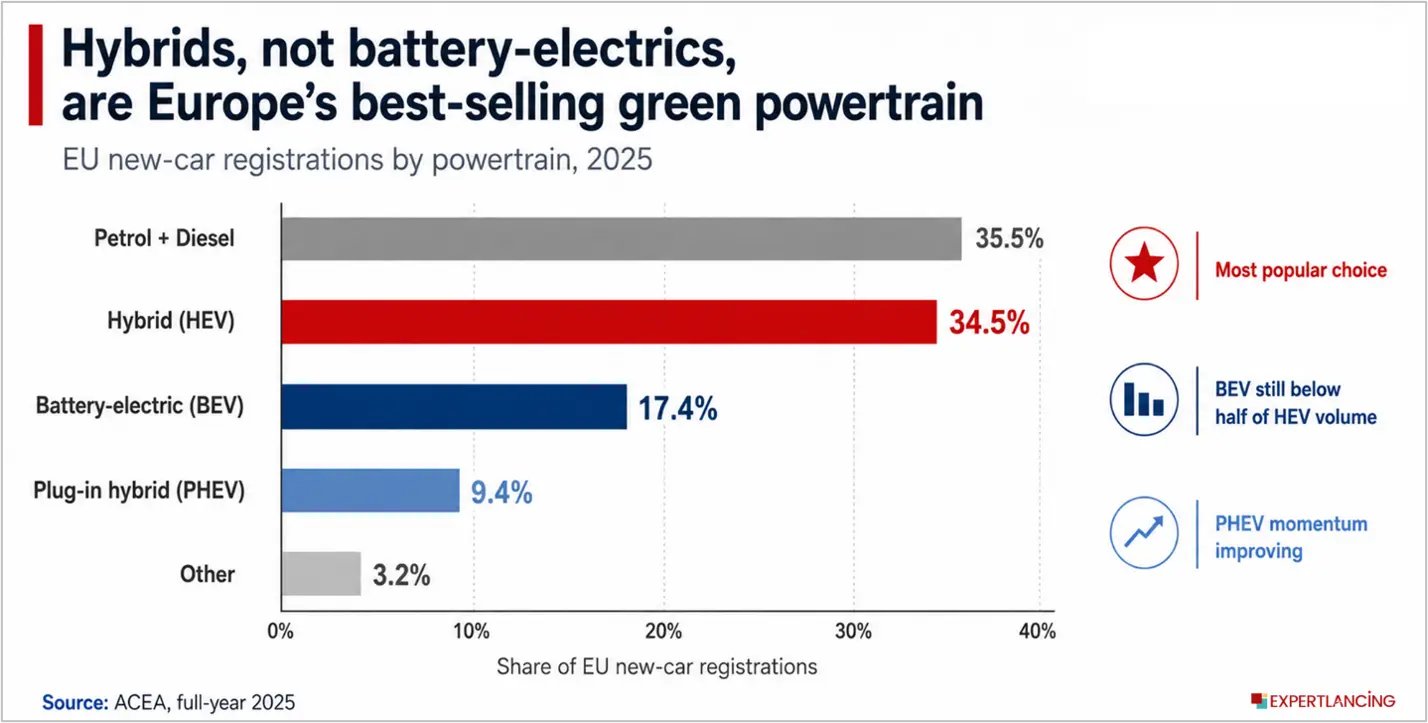
The broader European BEV trajectory is positive, but gradual. BEV share reached about 19% across Europe in 2025 and moved past 22% in the first half of 2026.
This does not weaken the long-term case for BEVs. It shows that vehicle electrification continues to be constrained by affordability, charging access, product availability and consumer confidence. In markets where these conditions are not yet mature, hybrids and plug-in hybrids remain commercially relevant.
Japan shows the same logic from a different angle. Hybrids account for over 30% of new sales, while nearly 80% of combustion cars sold in 2025 were priced below ¥4 million. Only a limited set of EV models were available below ¥4.1 million. When the affordable product does not exist, the market does not move simply because the technology is available.
Multi-Pathway Powertrain Is a Commercial Strategy, Not a Defensive Position
Toyota demonstrates why multi-pathway should not be dismissed as resistance to change. In FY2025, Toyota sold roughly 4.7 million electrified vehicles, while battery-electric vehicles represented only 188,000 units. Yet Toyota remained the world’s largest automaker, selling around 12 million vehicles in 2024, and delivered net income of about ¥4.765 trillion, or roughly US$31.45 billion, in FY2025.
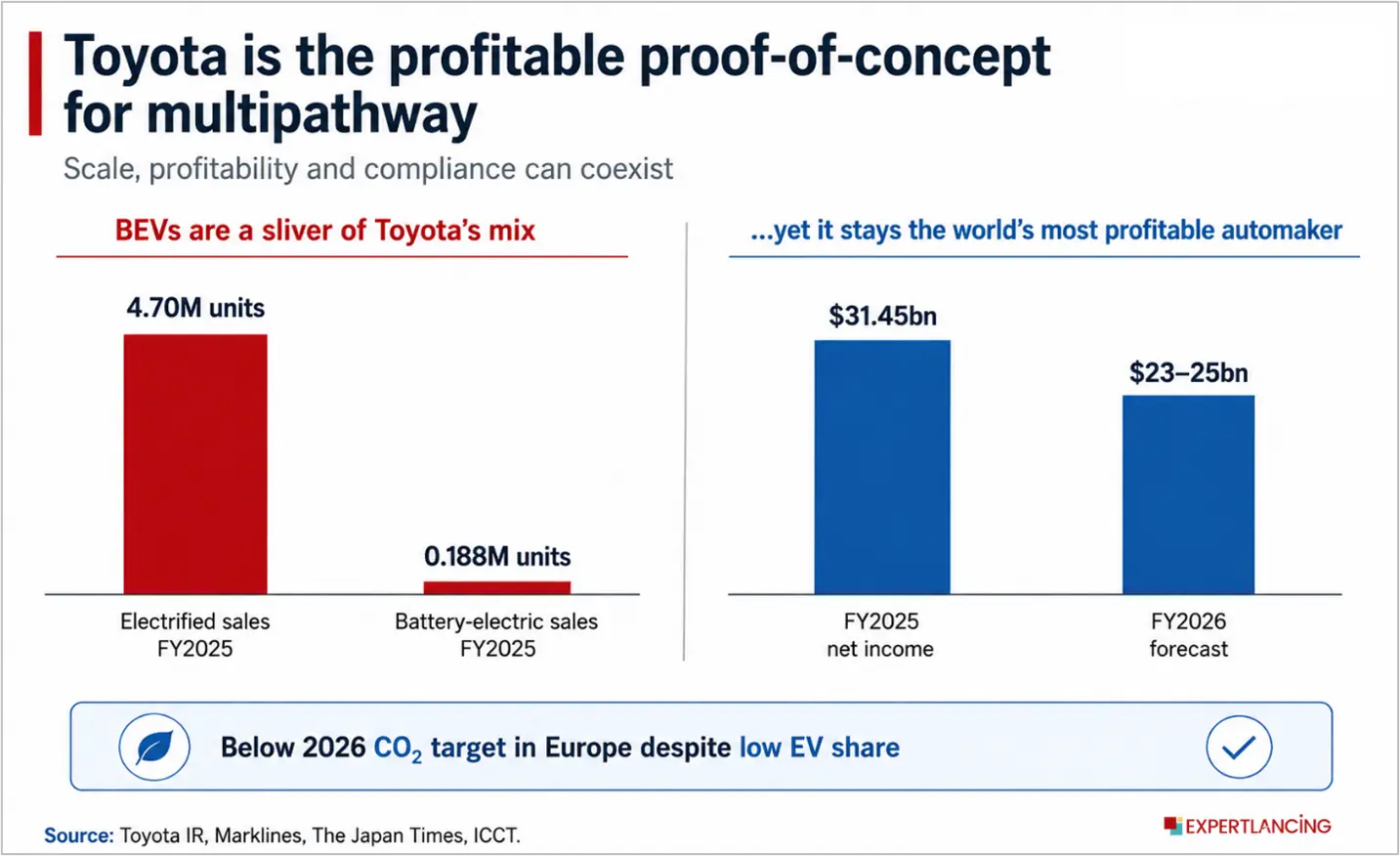
Toyota also remained below its 2026 European emissions target despite having one of the lowest EV shares among major manufacturers in Europe. This matters because it challenges the assumption that multi-pathway is simply delay. In Toyota’s case, hybrid powertrain portfolio has reduced fleet emissions while preserving profitability and scale.
Affordability strengthens the case. New-vehicle prices have risen 15 to 25% since 2020, with average transaction prices now above US$45,000. Hybrids sit at only a 5 to 10% premium over comparable combustion vehicles, while BEVs still carry a 15 to 20% premium. Cost parity is not expected until 2028 to 2029.
Battery technology is also still moving. Sodium-ion has moved out of the mass-market window until after 2031, while solid-state batteries remain several years from commercialization. That makes platform flexibility strategically valuable, especially for companies that operate across both mature and emerging markets.
BEV-First Powertrain Remains the Right Endgame in Mature Markets
The case for multi-pathway does not remove the strategic importance of BEVs. In markets with strong regulation, dense charging networks and rising consumer readiness, BEV-first remains the correct long-term posture.
Europe cannot step away from this path. The EU’s 2035 combustion-engine end date remains in place. Recent regulatory flexibility allows compliance to be assessed across 2025, 2026 and 2027 combined, and carmakers can offset up to 10% of tailpipe emissions using low-carbon steel and renewable fuels. The direction of travel, however, has not changed.
The software-defined vehicle transition also favours electric powertrain platforms designed around software-first architectures. Digital and software-related revenue is projected to rise from about 15% of industry revenue today to 51% by 2035, while 45% of OEMs and suppliers now rank the software-defined vehicle as their top strategic priority.
Charging infrastructure is improving as well. Europe had about 1.17 million public charging points by early 2026, with fast DC charging growing by more than 30% year on year. The strategic challenge is therefore not whether to electrify. It is whether European OEMs can bring BEVs to market at the right cost, with the right software capability, and with enough scale to compete against Chinese entrants.
China is the Competitive Variable that Changes the Equation
Powertrain strategy cannot be separated from China’s cost and speed advantage. Chinese brands’ share of the Western European market is expected to rise from 3.4% in 2024 to 6.0% in 2025, 7.5% in 2026, and 9.9% by 2030. On EVs alone, Chinese share reached around 11% in 2025.
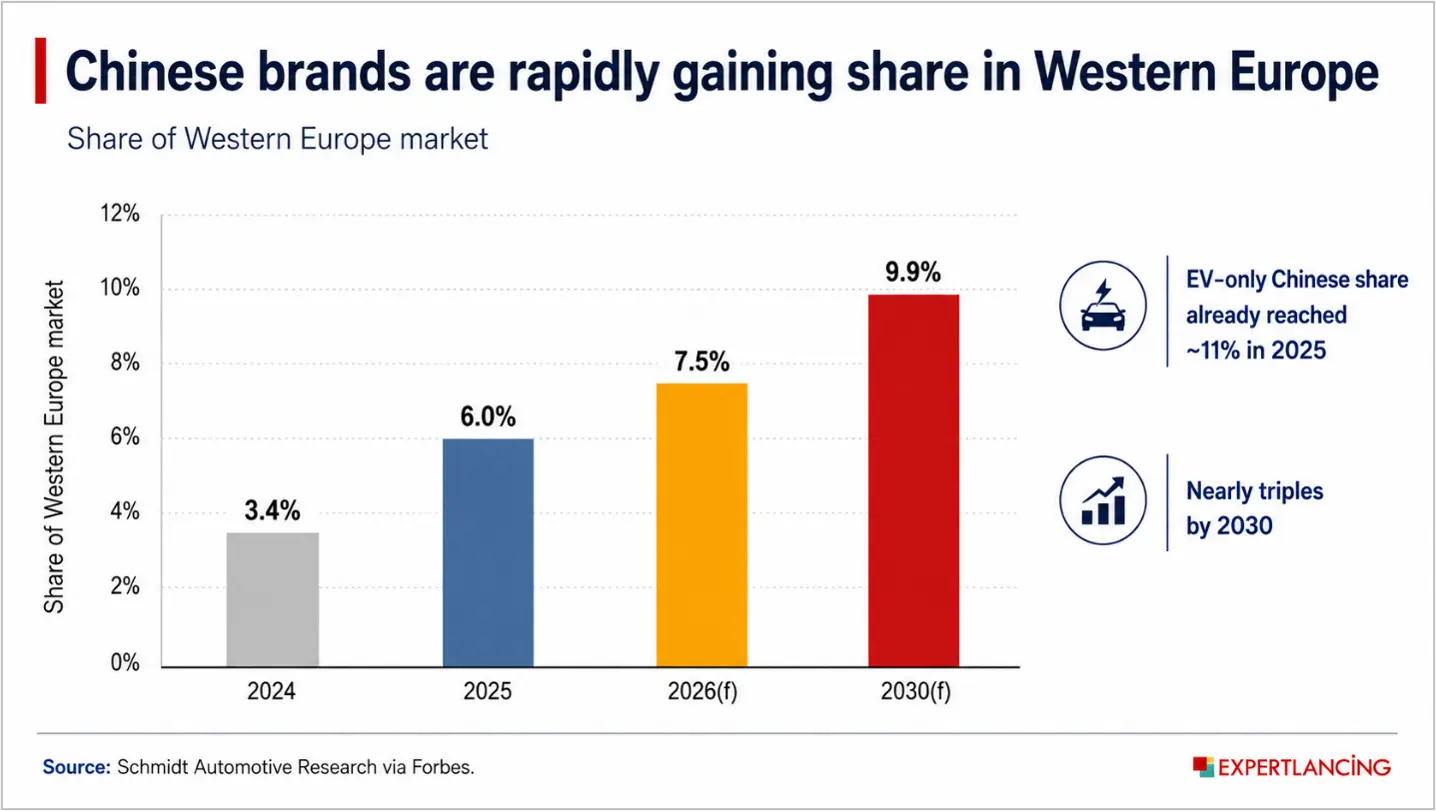
This creates pressure on both strategic camps. BEV-first players face Chinese competition directly in the segment where China is strongest. Multi-pathway players cannot assume hybrids are protected either, as Chinese automakers are also becoming stronger in plug-in hybrids.
The strategic lesson is straightforward: a powertrain decision without a cost and competitiveness answer is incomplete.
The Winning Model is Portfolio Discipline by Market Archetype
Automakers need to manage powertrain strategy through market archetypes, not global ideology.
In highly regulated and infrastructure-ready markets, the priority should be BEV-first with a strong cost roadmap. This applies to markets such as the Nordics, the Netherlands and urban Germany.
In regulated but uneven markets, the right posture is BEV-led but hybrid-hedged. Broader Europe, Italy, Spain and Poland fall into this category, where hybrids can protect volume and margin while BEVs scale.
In market-led regions such as Japan and the United States, multi-pathway remains rational because consumers are still deciding based on affordability, convenience and product fit.
In emerging markets such as India, Southeast Asia and Africa, a full multi-pathway model is necessary. BEVs, hybrids, biofuels, hydrogen and cleaner combustion will coexist for longer because infrastructure, income levels and use cases vary widely.
Implications for Industry Players
- For OEMs, the priority is portfolio flexibility. A single global powertrain answer will not work. Companies need to set the mix market by market and build the platform flexibility to reweight as regulation and battery technology move. In Europe, a BEV cost roadmap that can meet Chinese pricing is essential.
- For suppliers, the opportunity lies in platform adaptability. Multi-pathway creates demand across multiple powertrain systems, while the larger strategic prize remains the shift toward software and electronics.
- For investors, pure-play narratives should be tested carefully. BEV-only exposure in an unready market carries volume risk, while a hybrid-only strategy carries stranding risk as regulation tightens. Toyota’s numbers show that a well-run multi-pathway portfolio can be both profitable and compliant, but only when paired with cost competitiveness against China.
- For policymakers and the ecosystem, the evidence points to one lesson: regulatory certainty drives investment and adoption, while easing targets slows both. Japan is also targeting a 30% global share of software-defined vehicles by 2030, while addressing an ageing society where more than 29% of people are aged 65 or older.
Strategic Takeaway
The industry does not need to choose one road everywhere. It needs to understand which markets are ready for BEV acceleration, which require a transition portfolio, and which will remain multi-pathway for longer.
The destination is zero emissions. The route will differ by geography, regulation, infrastructure and consumer economics. The winning companies will not be the most ideologically committed. They will be the most disciplined in timing, portfolio allocation and competitiveness.
Conclusion
Powertrain strategy is no longer a binary choice between BEV-first and multi-pathway. It is becoming a portfolio allocation decision shaped by regulation, infrastructure, affordability, technology maturity and competitive pressure from China. BEVs remain the long-term direction in mature and regulation-led markets, but hybrids, plug-in hybrids and other transition technologies will continue to play a strategic role where consumers, infrastructure and economics are not yet ready.
The winners will be automakers and suppliers that can balance transition speed with market realism. Success will depend not only on choosing the right technology, but on timing the mix correctly, protecting margins, scaling software-defined platforms and staying cost competitive across regions.
How Expertlancing Research Helps Automotive Businesses Stay Ahead
Keeping up with these shifts takes more than reading the latest headlines. Technologies evolve, competitors shift their focus, and patent activity often signals where the market is heading next. Seeing the bigger picture is what helps businesses make decisions with confidence.
At Expertlancing, we combine technology scouting, patent intelligence, competitive benchmarking, and innovation research to help businesses understand where the market is moving and what those changes could mean for their strategy.
If your team is evaluating new technologies, keeping track of competitors, or planning for what’s next in mobility, connect with our experts to see how our research and intelligence services can support your business goals.