The tariff was meant to be a trade barrier. It has become a bargaining tool. Chinese EVs in Europe have continued to gain ground despite the EU’s countervailing duties of 7.8% to 35.3% on Chinese-made battery electric vehicles (BEVs) imposed in October 2024 on top of the standard 10% import duty. The maximum combined rate reached 45.3%, yet exports did not fall as sharply as expected. Chinese manufacturers changed strategy instead, moving beyond exports into local assembly, contract manufacturing, licensing, joint ventures and negotiated price undertakings.
EU Tariffs on Chinese EVs: The New Trade Regime
Definitive countervailing duties on Chinese BEVs took effect on 30 October 2024 under Regulation (EU) 2024/2754, after a 13-month investigation that found the Chinese BEV supply chain benefited from unfair subsidies threatening EU producers (S&P Global Mobility). It was the Commission’s first own-initiative anti-subsidy action, the first without a parallel anti-dumping case, and the first on a product where the EU is a net exporter (Bocconi IEP). The duties run for five years; China has challenged them at the WTO, and BYD, Geely and SAIC filed EU court challenges in January 2025 (guide). Rates apply on top of the existing 10% import duty:
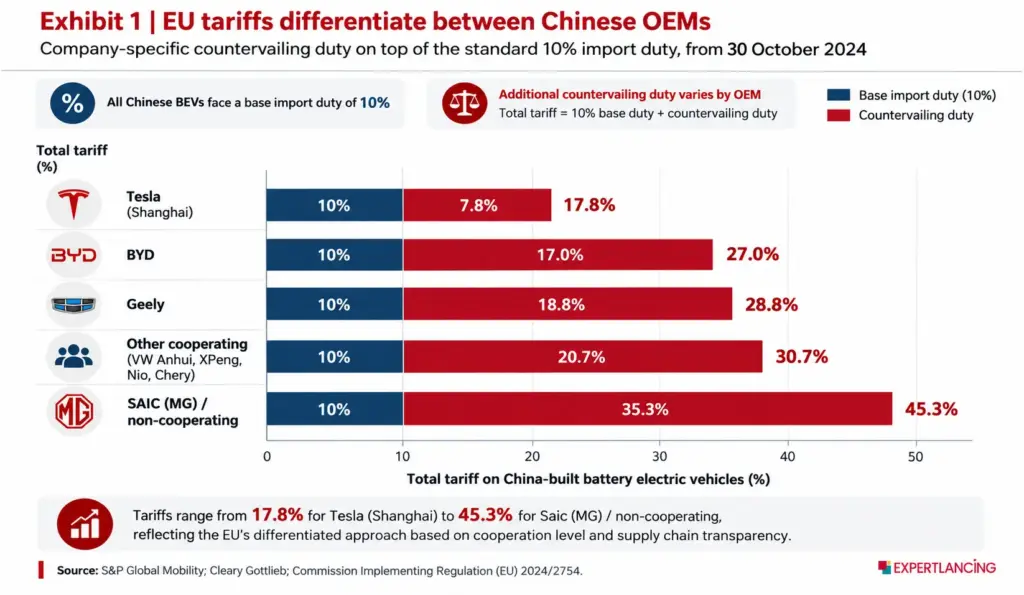
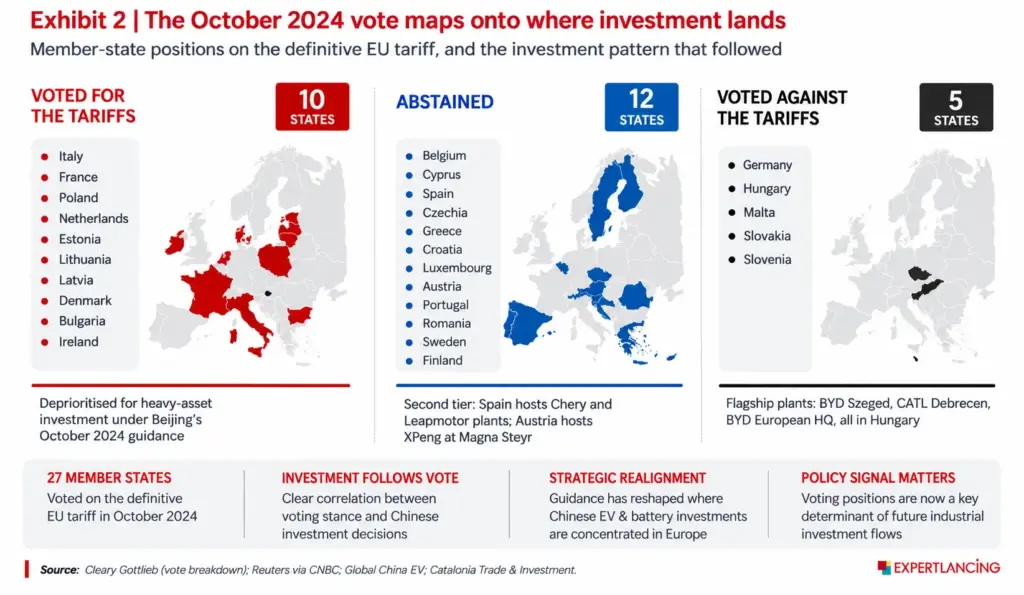
Rates are set per firm by assessed subsidy exposure and cooperation, so the tariff divides Chinese OEMs, and cooperating firms can request accelerated reviews. The October 2024 member-state vote, ten in favour, twelve abstaining and five against, is the best guide to where investment lands (Cleary Gottlieb). For Chinese EVs in Europe, these differences in tariff exposure are increasingly shaping how manufacturers approach market entry and investment.
From Tariff Wall to Negotiated Door
On 12 January 2026 the Commission published guidance on price undertakings: commitments to a minimum selling price that, if accepted, waive the duties, covering price, sales channels and future EU investment (UPI). China’s commerce ministry called it a soft landing within WTO rules (Gasgoo).
On 10 February 2026 the Commission accepted the first undertaking, from Volkswagen (Anhui) and its EU partner SEAT: the China-built Cupra Tavascan is now free of the 20.7% duty under a confidential minimum price and volume cap, with conditions including EU investment and a pledge not to export other BEV models (DG Trade; EVXL). The stakes were real: the duty had nearly wiped out the operating profit of VW’s SEAT/Cupra division in the first nine months of 2025, and the Tavascan sold about 36,000 units in Europe in 2025 against a 70,000 target (Reuters via China-Global South).
The exemption sets a precedent, with BYD and Geely expected to file next. It turns the tariff from a fixed cost into a negotiable one priced in volume restraint and EU investment, though some economists warn a minimum price acts as an EU-sanctioned floor (CEPR/VoxEU). Analysis must now run model by model.
The Forces Reshaping Chinese EVs in Europe
Four tensions keep both sides moving. The Commission found China’s spare EV capacity to be roughly double EU demand and framed the duties as protecting millions of jobs (Evertiq). Yet the EU’s fleet CO2 targets and the 2035 combustion phase-out require affordable EVs, where Chinese BEVs already undercut petrol cars in the small-car segment (BBVA Research), so tariffs that price them out fight the EU’s own timetable. China’s export-permit regime, effective 1 January 2026, limits BEV exports to licensed automakers (Bloomberg), pushing competition from volume toward value (CBT News). And Beijing’s October 2024 guidance steered investment by how each state voted (Reuters via CNBC).
How Chinese EV Makers Are Entering the European Market
The defining feature of the post-tariff period is the variety of entry modes. For Chinese EVs in Europe, this has meant a shift from direct exports toward localized production, contract manufacturing and joint ventures.
BYD: Greenfield Localization in Hungary
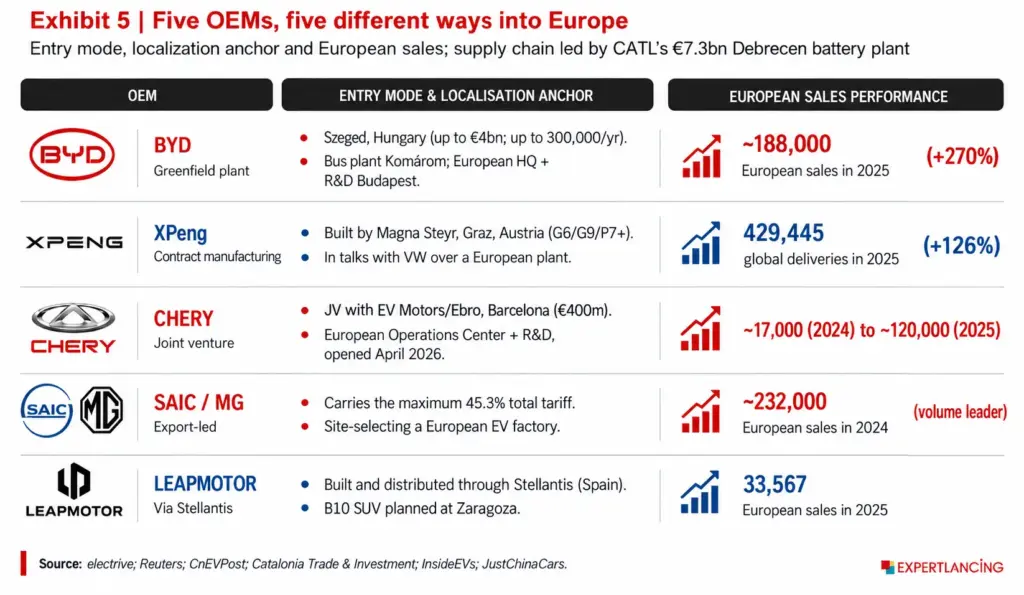
BYD chose greenfield localization. Its Szeged plant in Hungary, its first European car factory, carries reported investment up to €4 billion and planned capacity up to 300,000 vehicles (Global China EV); trial production began in January 2026 (electrive). The ramp is contested: early reports pointed to series production from Q2 2026, but in June 2026 executive Stella Li told Reuters assembly would begin in Q4 2026 (Reuters). BYD has moved its European headquarters to Budapest and reported European sales up about 270% in 2025 to almost 188,000 vehicles.
XPeng: An Asset-Light Manufacturing Strategy
XPeng went asset-light: G6 and G9 output began in September 2025 at Magna Steyr in Graz, Austria, making the cars EU-built, with the P7+ added in January 2026 (InsideEVs; CnEVPost). In May 2026 it confirmed talks with Volkswagen about using a VW plant in Europe (Electrek). Group deliveries reached 429,445 in 2025, up 126%.
Chery: Expanding Through Joint Ventures
Chery took the joint-venture path, reviving the Ebro brand with Spain’s EV Motors at Barcelona for €400 million, targeting 150,000 vehicles by 2029, and in April 2026 opened its first European Operations Center and R&D Institute there (Catalonia Trade & Investment). It grew European volumes from about 17,000 units in 2024 to around 120,000 in 2025, leaning on hybrids and combustion variants outside the duty (EVs & Beyond).
SAIC, Leapmotor, Nio and Zeekr: Alternative Routes to Market
SAIC’s MG carries the heaviest 35.3% duty (45.3% total) yet stays the Chinese volume leader, with nearly 232,000 European sales in 2024, absorbing the tariff by shifting toward hybrids and petrol models (AutoChina). Leapmotor runs through Stellantis, which builds and distributes its cars, and sold 33,567 vehicles in Europe in 2025 (JustChinaCars). Nio and Zeekr stay premium, with limited local manufacturing. Beneath the vehicles, CATL’s €7.3 billion battery plant in Debrecen, Hungary, anchors a Chinese-led cell base inside the EU (SCMP via Yahoo).
What the Trade Data Shows
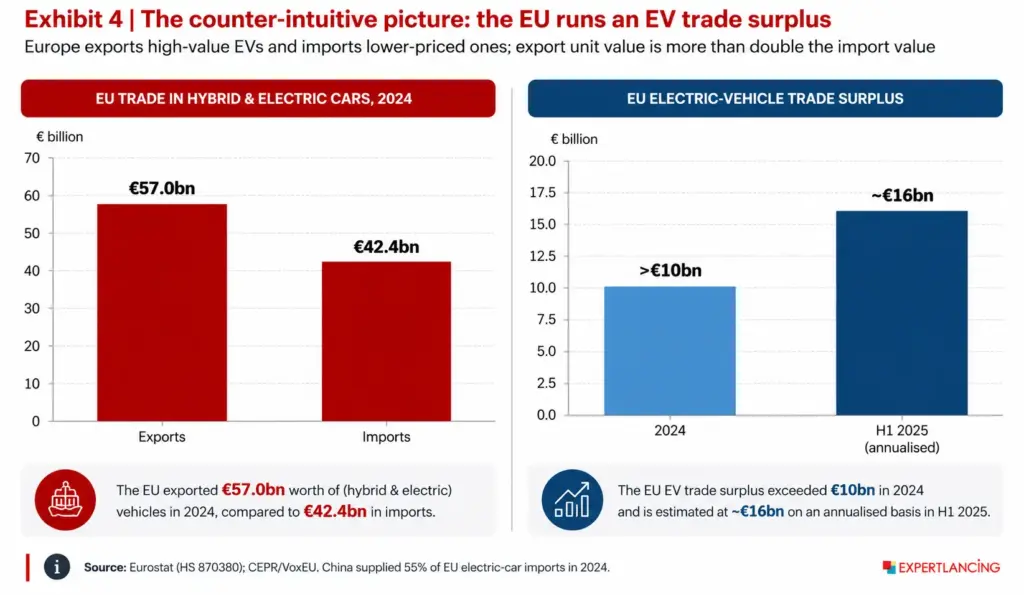
The trade data provides another view of how Chinese EVs in Europe are gaining ground. The one-way-flood story is contradicted by the value data. The EU has run a growing EV trade surplus, above €10 billion in 2024 (a year in which EV imports from China fell) and about €16 billion annualised by mid-2025 (CEPR/VoxEU), because the average EU-made EV sells for more than double the unit value of a Chinese-made import. Within electrified cars, the EU imported €42.4 billion in 2024, down 12% on 2023, and exported €57 billion, and China supplied 55% of its electric-car imports, up from 49% (Eurostat). The wider car trade ran a €89.3 billion surplus, with China the largest import supplier at €12.7 billion (Eurostat).
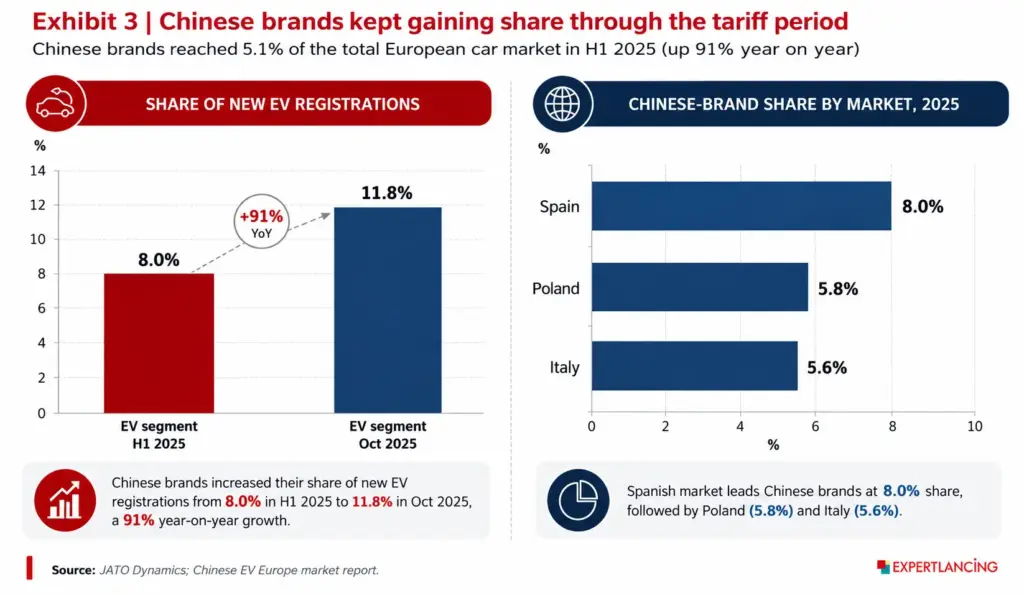
The pressure is real but concentrated. Chinese brands took about 8% of new EV registrations in H1 2025, rising to 11.8% in October 2025, and reached roughly 8.0% of the car market in Spain, 5.8% in Poland and 5.6% in Italy (JATO); the share losers have been mid-market incumbents such as Ford and Nissan (EV/CARBA). The aggregate balance says Europe is winning while the segment data says its incumbents are losing exactly where the EU’s climate targets need them to win.
A Comparison of European Market Strategies
| Dimension | BYD | XPeng | Chery | Nio | Zeekr (Geely) |
| Entry mode | Greenfield plant (Szeged, HU; up to €4bn); bus plant Komárom; EU HQ and R&D in Budapest; seeking a 2nd plant | Contract build at Magna Steyr, Graz (AT); Munich R&D; in talks over a VW plant | JV with EV Motors/Ebro, Barcelona (€400m); European operations and R&D hub | Export-led; battery-swap network; local assembly if it nears 6,000 units/month | Export-led within Geely’s multi-brand group |
| Applicable CVD (pre-undertaking) | 17.0% (27.0% total) | 20.7% (30.7% total), avoided via EU build | 20.7% on BEVs, eased by EU assembly and hybrids | 20.7% (30.7% total) | 18.8% via Geely (28.8% total) |
| Pricing tier | Broad, entry to premium; aggressive (+311% H1 2025) | Premium-tech (G6/G9/P7+) | Value/mainstream, multi-powertrain (Omoda, Jaecoo, Ebro) | Premium | Premium |
| Local-content commitment | Highest: vehicles, buses, batteries (planned), R&D, HQ | Medium: EU-built vehicles, EU R&D, no owned plant yet | High and rising: assembly toward full manufacturing, local suppliers | Low; swap stations as localisation proxy | Low; leans on Volvo/Polestar legacy |
| Government-relations posture | Aligned with Hungary (opponent); collective-negotiation track; likely early applicant | Low-friction: EU-made status sidesteps the dispute; closer to VW | Deep ties to Catalan and Spanish institutions (abstainer) | Low profile | Group-level; Geely challenging duties in court |
Sources: sections above; JATO; Reuters; Catalonia Trade & Investment; JustChinaCars.
What Chinese EV Expansion Means for European Incumbents
The threat is concentrated in small and mid-size EVs and in price-sensitive markets such as Spain, Italy and Poland, where JATO puts the average Chinese price advantage near £8,000 in Spain (JATO). Europe still leads in high-value EV exports, but that does not close the affordable-segment gap the 2030 fleet targets make unavoidable. Incumbents need credible sub-€25,000 BEVs on European cost bases, or partnerships that deliver them, before the 2030 crunch. The line between incumbent and challenger is dissolving, shown by Stellantis-Leapmotor, VW-XPeng and Magna-XPeng, and by the first exemption going to a European company importing from its own Chinese plant.
Where Traditional Market Analysis Can Miss the Shift
The “45% tariff” headline applies to one group only: BYD pays 27.0% total, Geely 28.8%, most others 30.7%, and the first exemption has already cut one model’s countervailing burden to zero. The duty did not stop the volume: Chinese-brand registrations grew 91% in the first tariff year. Treating “Chinese EVs” as a single BEV category misses the hybrid lines outside the measure. An XPeng built in Graz or a BYD built in Szeged counts as EU-origin, so tariff-based screening understates Chinese supply. And export permits and investment guidance mean corporate behaviour partly tracks state policy. No single timeline is safe: BYD’s Hungarian ramp was reported as both “Q2 2026” and “Q4 2026” within four months, so plans should carry ranges, not point estimates.
Key Takeaways: What Is Changing for Chinese EVs in Europe
- Tariffs are no longer fixed: In January 2026, the EU began letting Chinese exporters swap countervailing duties for a minimum import price instead. VW’s China-built Cupra Tavascan was first to get this deal in Europe, and other Chinese automakers are now applying too.
- Sales kept rising anyway: Chinese brands took 5.1% of Europe’s car market in H1 2025, up 91%. BYD sold over 70,500 units, up 311%, and outsold Mercedes in June 2025. Growth held into 2026.
- The trade balance tells a different story: Europe’s EV trade surplus hit €10 billion in 2024 and an annualized €16 billion in H1 2025, since Europe exports pricier EVs while importing cheaper ones. The real pressure is in affordable small and mid-size EVs.
- Localization is picking winners: BYD’s Hungary plant started trial production in January 2026 (up to €4B, 200-300K capacity a year) (Global China EV; electrive). XPeng builds cars in Austria, Chery in Spain. Investment is landing in the countries that opposed or abstained on the 2024 tariff vote.
- Beijing is steering too: China now requires export permits for EVs as of 2026, and told automakers to favor countries that opposed the tariffs.
The takeaway: a single tariff figure isn’t the thing to plan around. Price floors, quotas, exemptions and factory locations are what’s actually shifting, and they move every quarter.
Make Sense of What’s Changing
Markets rarely shift because of a single factor. Competitor moves, regulatory changes, technology developments, investments, and customer demand can all reshape the landscape.
Expertlancing helps businesses connect these signals through market intelligence, competitive intelligence, technology research, and IP intelligence, providing the evidence and insight needed to evaluate opportunities and make informed strategic decisions.
Have a question about a market, technology, or competitive landscape? Contact Us to explore it further.