India’s new framework for UPI MDR charges marks a shift away from an adoption-led payment model. It moves toward a more sustainable commercial structure. Consumers, P2P transfers, low-value merchant payments, and qualifying small merchants remain protected, while selected higher-value merchant transactions will contribute to ecosystem economics.
Compared with markets such as Brazil, Indonesia, Singapore, and Malaysia, India still has a low-cost model. It is also highly regulated. The 0.4% MDR and ₹300 cap are particularly important because they keep effective charges low for high-value transactions. The strategic question is now shifting from UPI adoption to UPI sustainability. The goal is to make banks and payment providers more profitable.
This should not reduce affordability. It should not make UPI harder to use.
What is changing is the economics behind the payment.
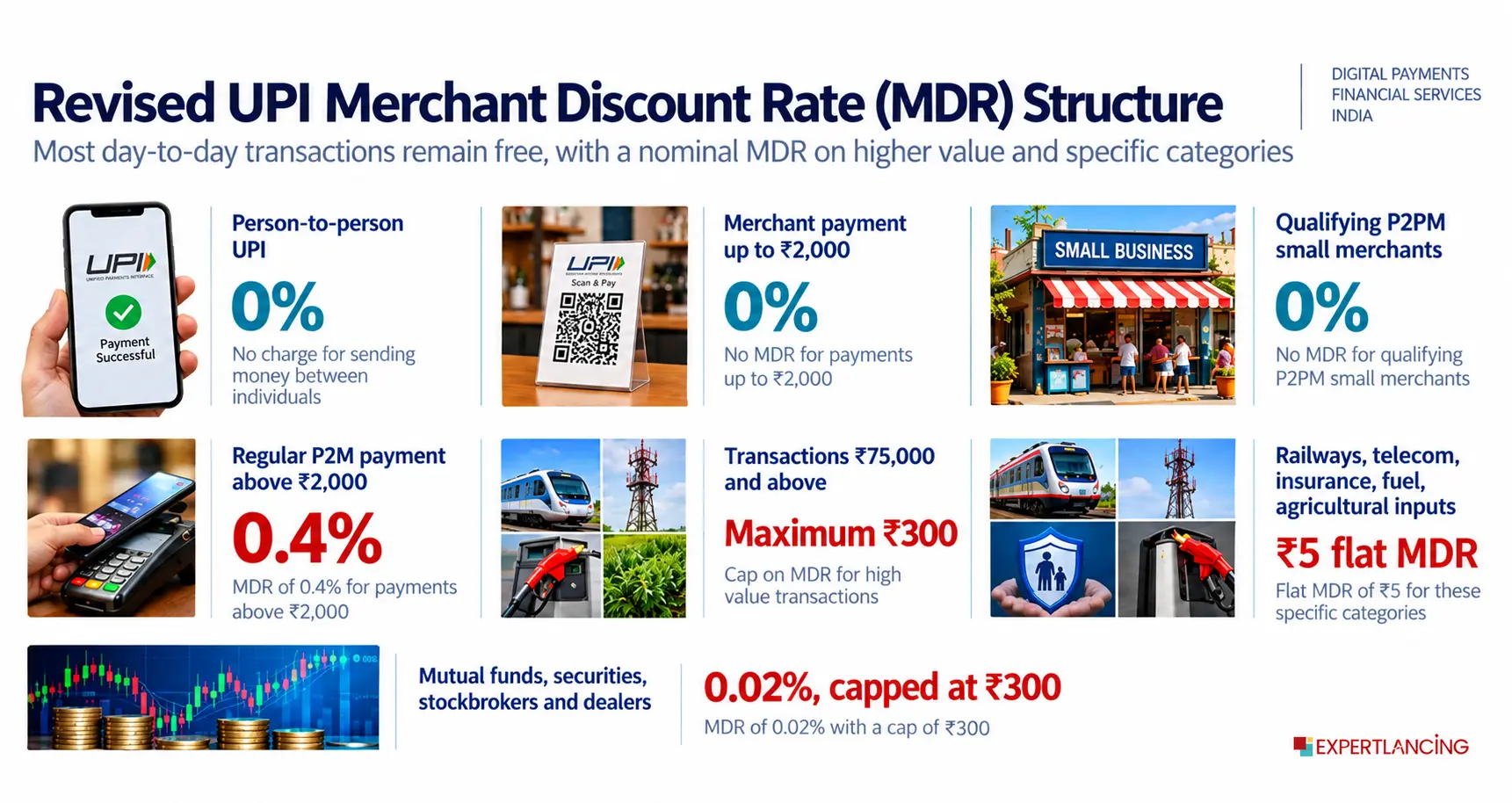
On 15 September 2026, the Government of India announced a new Merchant Discount Rate, or MDR, framework. It applies to selected UPI merchant transactions. Under the framework, person-to-merchant payments above ₹2,000 will attract a 0.4% MDR.
The fee will be capped at ₹300 for transactions of ₹75,000 and above.
Person-to-person transfers will remain completely free. Merchant payments up to ₹2,000 will remain free. Qualifying small merchants who receive up to ₹1 lakh per month via UPI QR codes will pay zero MDR. The new pricing takes effect from 15 October 2026.
At first sight, this may appear to mark the end of “free UPI”. That interpretation misses the bigger strategic shift.
India is not moving UPI from free to paid. It is shifting from a subsidy-led growth model to a hybrid payment model. In this model, larger commercial activity helps fund the payment infrastructure. This support covers both maintenance and expansion.
That distinction is important.
UPI has reached a scale where economics can no longer be ignored.
UPI is no longer an emerging payment technology. It has become one of the core transaction infrastructures of the Indian economy.
In August 2026, UPI processed 24.51 billion transactions worth approximately ₹29.82 lakh crore. The number of banks live on UPI reached 752. These figures are reported directly by the National Payments Corporation of India.
| UPI indicator | Latest reported figure |
| Monthly transactions, August 2026 | 24.51 billion |
| Transaction value, August 2026 | ₹29.82 lakh crore |
| Banks live on UPI, August 2026 | 752 |
| Share of India’s digital payments, FY2025-26 | ~84% |
| Share of global real-time payment volume, 2025 | ~49% |
| Source: NPCI UPI Statistics, Government of India UPI update | |
The Government reported that UPI accounted for around 84% of India’s digital payment transactions in FY2025-26, while India’s UPI ecosystem represented approximately 49% of global real-time payment volume in 2025.
At this level of activity, the system requires significant investment in transaction processing, bank infrastructure, fraud prevention, cybersecurity, dispute management, system availability, customer support, and future capacity.
For several years, however, the direct commercial economics of UPI remained unusual.
India’s first phase was effectively an adoption-led model.
The government had deliberately maintained zero MDR for UPI while using incentives to support parts of the payment ecosystem.
For FY2024-25, for example, the Union Cabinet approved a ₹1,500 crore incentive program for low-value BHIM-UPI merchant transactions. Transactions up to ₹2,000 involving qualifying small merchants attracted a government-funded incentive of 0.15% while maintaining zero MDR for the merchant and consumer.
This approach made strategic sense during UPI’s expansion phase. The priority was to reduce payment friction, encourage merchants to accept digital payments, and build consumer behavior around instant account-to-account payments.
But a network processing close to 25 billion transactions every month eventually requires a more sustainable economic model.
What exactly changes under the new UPI framework?
The new UPI MDR charges are deliberately segmented rather than applying one charge across all UPI transactions.
The government estimates that MDR will affect only around 4% of merchant transactions, meaning roughly 96% of P2M transactions will remain unaffected.
Another important point is that MDR is not a government tax and is not intended to be paid by the customer. According to the Ministry of Finance, MDR will be distributed among payment ecosystem participants, including banks, payment service providers and UPI application providers. Banks have also been advised to prevent merchants from passing the MDR directly to customers.
How does India compare with other countries?
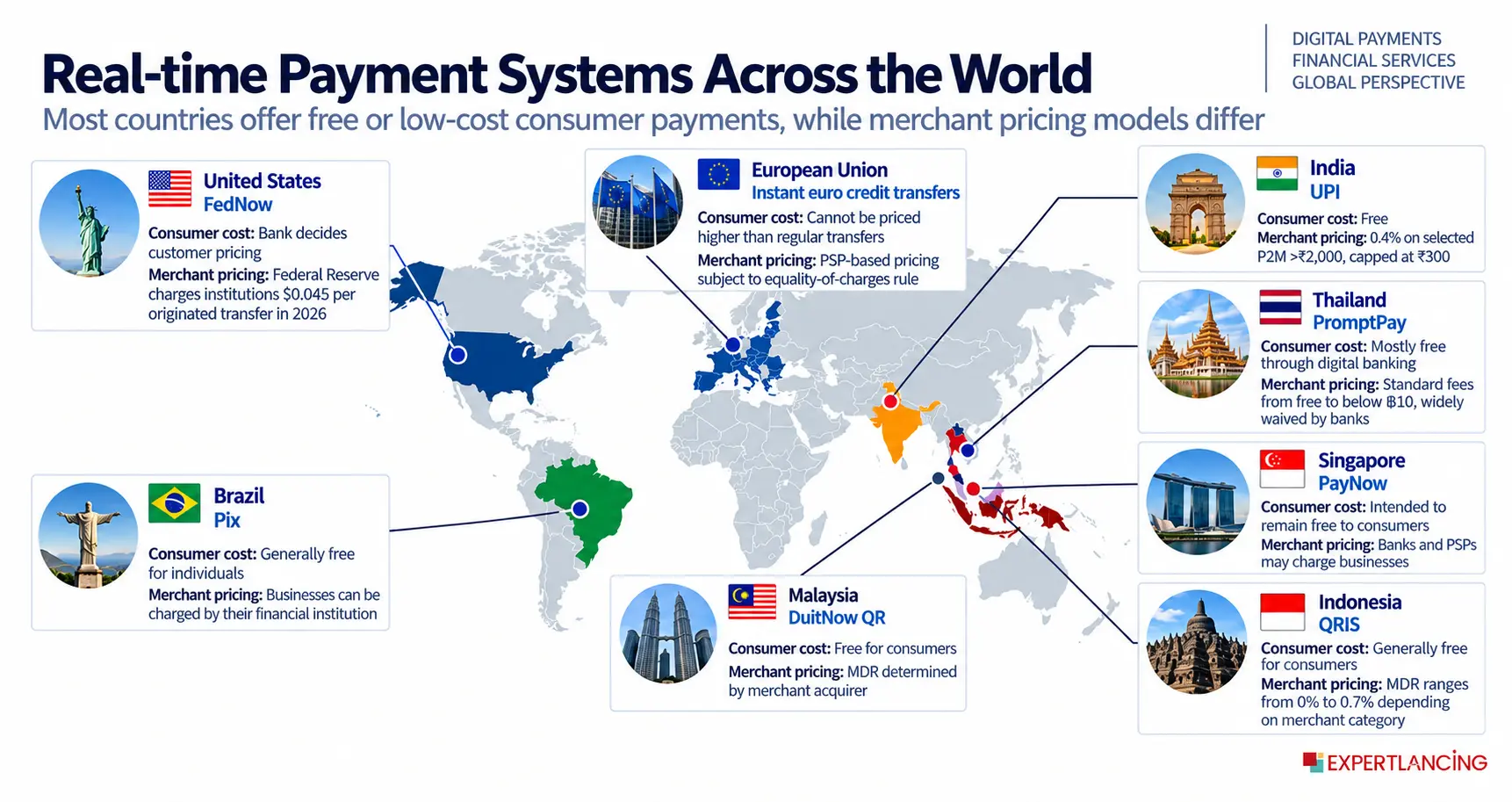
There is no single global model for pricing instant payments. Different countries have made different choices about who should pay for the infrastructure.
Brazil: free individuals, market-priced businesses
Banco Central do Brasil states that individuals are generally not charged for sending or receiving Pix payments, although certain commercial-use circumstances can attract fees. Businesses can be charged for Pix transactions by their financial institutions. Unlike India, Brazil does not prescribe one national merchant MDR such as 0.4%.
This means Brazil relies more heavily on competition between banks and payment providers, while India is creating a more regulated merchant-pricing framework.
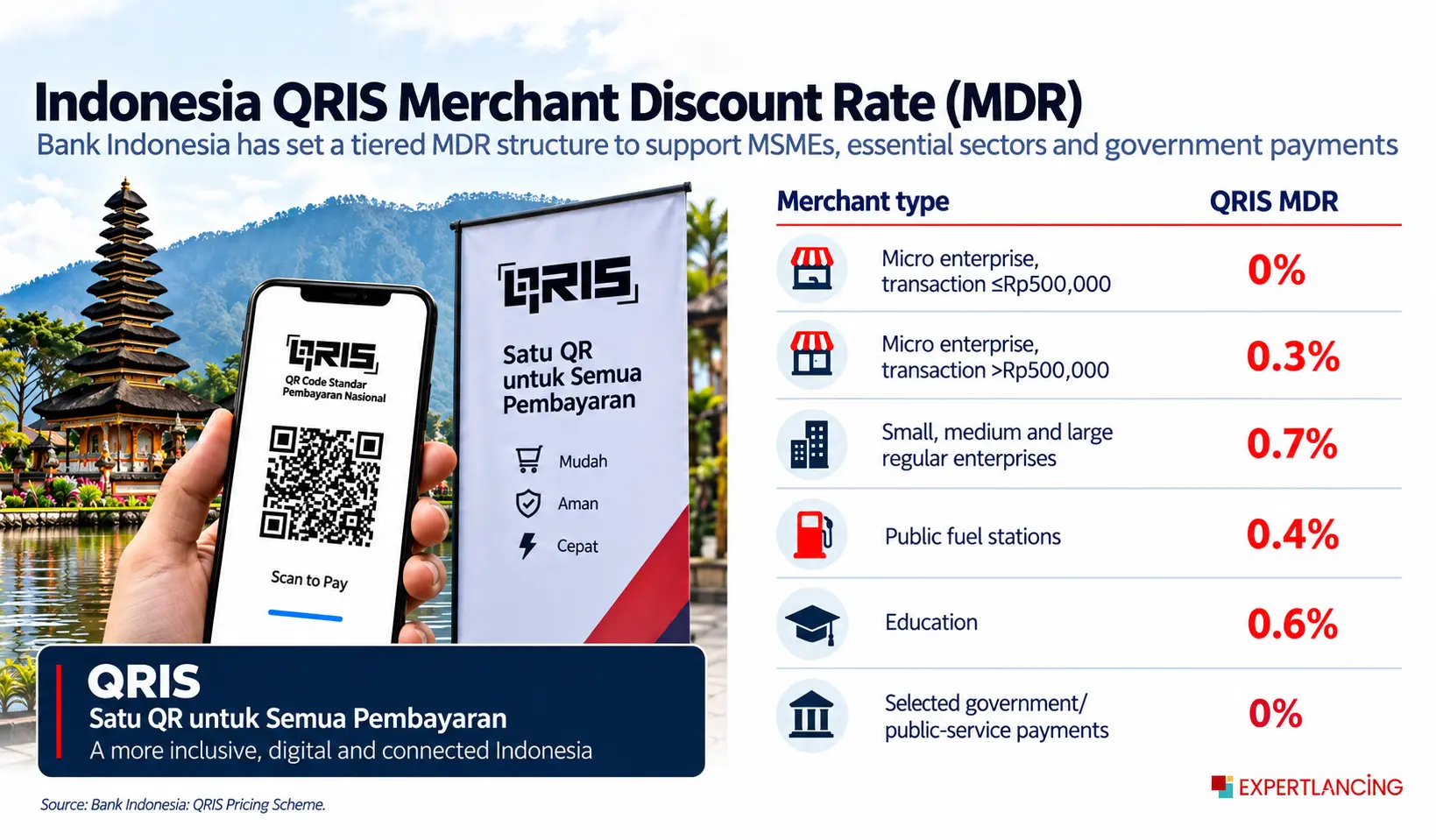
Indonesia: perhaps the closest QR-payment benchmark
Indonesia’s QRIS provides an especially useful comparison because it is a nationally interoperable QR system with regulated MDR. Against this benchmark, India’s standard 0.4% MDR is relatively moderate, particularly for larger merchants.
Singapore, Thailand, and Malaysia follow different paths.
Singapore’s PayNow is intended to remain free for end consumers, and merchants are prohibited from imposing PayNow surcharges on consumers. Banks and payment service providers, however, can charge businesses for PayNow services.
Thailand uses a largely flat-fee structure. The Bank of Thailand lists standard PromptPay fees ranging from zero for transactions up to ฿5,000 to below ฿10 for transactions above ฿100,000. Importantly, it also notes that most banks have waived digital payment transaction fees since 2018.
Malaysia’s DuitNow QR is free for consumers, while merchants may pay an MDR determined by their acquiring bank or e-wallet provider.
India therefore provides more national-level certainty over what larger merchants will pay.
The ₹300 cap may be more important than the 0.4% headline rate
The most strategically interesting part of the UPI MDR charges may not be the 0.4% MDR itself. It may be the ₹300 maximum charge.
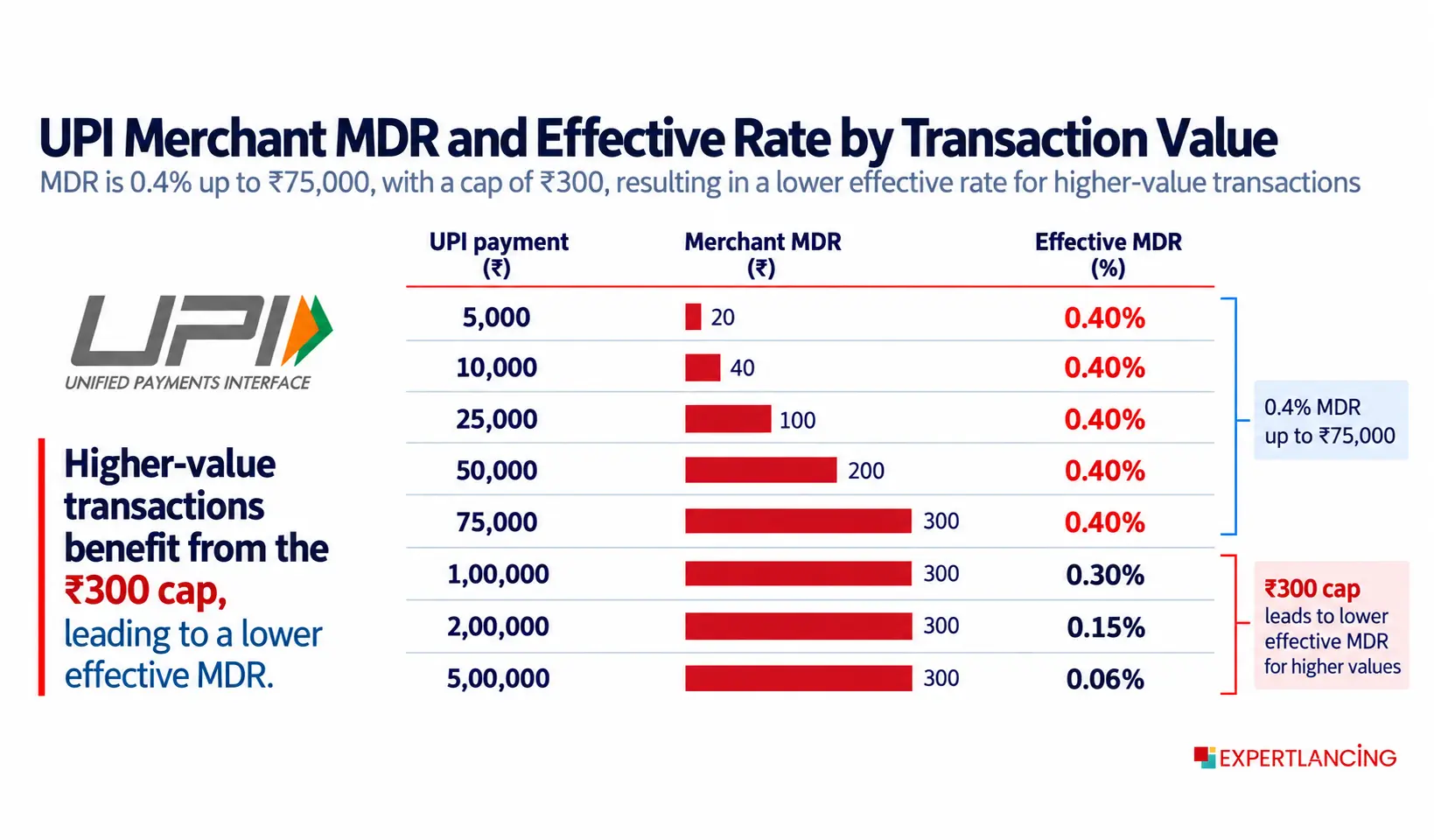
The effective payment cost therefore falls rapidly once transaction values move above ₹75,000. This could make UPI increasingly attractive for higher-value categories such as consumer electronics, appliances, healthcare, education, travel and selected B2B payments.
The policy is therefore not simply about generating payment revenue. It could also help UPI expand further into high-ticket commercial payments.
The strategic question is shifting from adoption to sustainability.
For much of UPI’s first decade, the objective was relatively clear: maximize adoption, minimize payment friction, and build network effects. That objective has largely been achieved.
The challenge for the next decade is different. UPI must remain inexpensive while simultaneously funding higher transaction capacity, cybersecurity, fraud prevention, customer protection, reliability, innovation, and international expansion.
India therefore appears to be moving from an adoption-first payment model towards a sustainability-led payment model for UPI MDR charges. The success of this approach will depend on three factors.
- First, merchants should not simply recover MDR by adding visible UPI surcharges to customers.
- Second, regulators and payment companies will need to monitor whether the ₹2,000 threshold creates unintended behavior such as transaction splitting or incorrect merchant classification.
- Third, the new economics should translate into measurable improvements in security, reliability, fraud management, infrastructure, and product innovation.
If India can achieve these objectives, the new MDR structure may become an important global payment-policy case study.
Conclusion
The more important story is that India is attempting to build a sustainable business model around the world’s largest real-time payment ecosystem without taking away the low-cost characteristics that made UPI successful in the first place.
The new UPI MDR charges framework should be viewed as the next stage of UPI’s evolution rather than the end of free UPI. India appears to be developing a hybrid payment model where everyday payments remain almost utility-like, while larger commercial transactions contribute towards infrastructure, security, and innovation costs.
If implemented well, this could strengthen the long-term sustainability of UPI while supporting its expansion into high-value retail, B2B, and international payments. The real test will be whether India can maintain the right balance between financial inclusion, merchant affordability, and commercial sustainability.
Want to explore what changing payment economics could mean for the future of digital payments? Connect with our experts to discuss the technology, market, and business trends shaping the payments ecosystem.