Industrial electrification is creating a new opportunity to unlock flexibility across energy-intensive industries. Global electricity demand response today mobilises roughly 100 GW of flexible capacity. That sounds significant until you consider that industrial processes alone represent an estimated 500 GW or more of technically flexible load that remains untapped.
Industrial demand response already contributes approximately 75 GW of that deployed total, making it the single largest source of flexible demand on any grid, and yet it operates at a fraction of its potential (Source: IEA, Energy Efficiency 2024, 2024).
This gap is not a technology problem. The equipment exists. Electric boilers, industrial heat pumps, thermal energy storage, and automated process scheduling are commercially deployed across Europe, North America, and parts of Asia.
The gap is a coordination problem between how manufacturers plan production, how utilities design tariffs, and how regulators structure markets.
Industrial electrification strategy is no longer a conversation about swapping gas burners for electric heaters. It is becoming a system design question: how do you turn the world’s largest energy-consuming sector into a flexible grid asset rather than a fixed, inflexible load?
That question leads to the real value of industrial electrification.
From Fuel Switching to Demand Orchestration: The Three Layers of Industrial Electrification
Traditional industrial energy systems were designed around a single objective: a stable, cheap fuel supply.
Natural gas pipelines, coal contracts, and fuel oil storage defined how factories ran. The optimisation logic was simple: secure the cheapest BTU and keep the process running at maximum throughput.
Industrial electrification demand flexibility changes that logic entirely. When a factory switches from combustion to electric process heat, it does not just change its fuel. It changes its relationship with time, price, and the grid.
This shift creates three important layers.
The first layer is fuel substitution.
This is the most visible part. Electric boilers replace gas-fired steam systems. Industrial heat pumps take over low-temperature heating duties in food processing, chemicals, textiles, and paper manufacturing.
Resistance heating, induction systems, and electric arc furnaces handle higher-temperature applications. The IEA estimates that commercially available electrification technologies can already serve over 50% of industrial heat demand below 200°C (Source: IEA, World Energy Outlook 2023, 2023).
That covers a substantial share of process heating in sectors like dairy, beverages, pharmaceuticals, and specialty chemicals.
The second layer is temporal load optimisation.
This is where the economics start to shift. Unlike a gas boiler that runs whenever steam is needed, an electric boiler paired with thermal storage can decouple energy consumption from production timing.
Production shifts away from peak-price periods, toward hours when renewable generation is abundant, and around grid congestion signals.
A cement plant running ball mills can reschedule grinding to overnight hours. A cold storage facility can pre-cool during midday solar surplus. A chemical batch process can time its heating cycle to coincide with low-cost wind generation.
Therefore, electrification can create operational flexibility instead of simply replacing one fuel with another.
The third layer and the one most companies have barely explored, is grid-integrated industrial operations.
Here, industrial facilities operate as flexible loads, virtual storage assets, demand-response participants, and renewable balancing mechanisms. They do not just consume electricity. They provide services to the grid and get paid for it.
My analyst view: Most industrial companies today are stuck at layer one. They are evaluating electrification purely as a fuel-cost or emissions-reduction decision. That is like buying a smartphone and using it only to make phone calls. The real value sits in layers two and three, and the companies that figure this out first will have a structural operating cost advantage that competitors cannot easily replicate.
Why Utilities and Manufacturers Are Suddenly Looking at the Same Problem
For two decades, manufacturers and utilities operated in separate worlds. Manufacturers bought electricity as a commodity input. Utilities sold it as a volume product. Neither had much reason to coordinate beyond the meter.
That separation is breaking down fast.
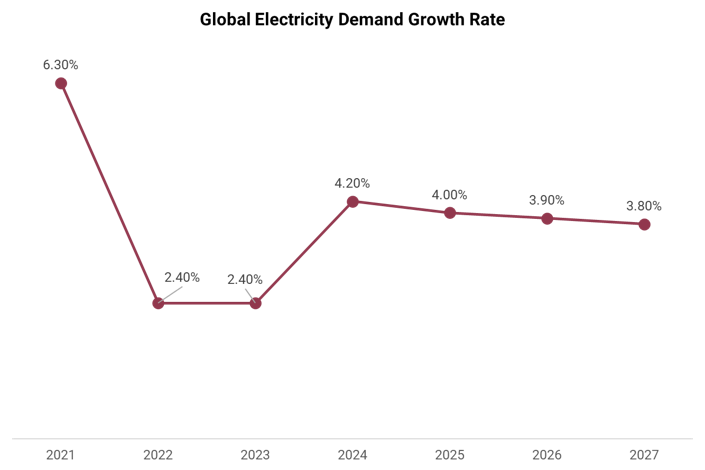
Global electricity consumption grew by approximately 4.3% in 2024, the fastest rate in years, driven by electrification of transport, heating, and industrial processes alongside surging data centre demand (Source: IEA, Electricity 2025 Analysis and Forecast to 2027, 2025).
The IEA projects electricity demand will continue growing at 3.5–4% annually through 2027, with industry representing one of the largest incremental growth engines.
For utilities, this creates a capacity problem.
The Utility Challenge
Unmanaged industrial electrification means higher peaks, longer interconnection queues, accelerated grid reinforcement spending, and increased renewable curtailment.
In Europe, grid connection wait times for new industrial loads have stretched to 5–8 years in several markets (Source: Eurelectric, Grids for Speed Connecting the Energy Transition, 2024).
In the United States, interconnection queues now exceed 2,600 GW of proposed capacity, with average wait times exceeding four years (Source: Lawrence Berkeley National Laboratory, Queued Up 2024, 2024).
The Manufacturer Challenge
For manufacturers, unmanaged electrification creates a cost problem.
Without flexibility, electrified processes face full exposure to peak tariffs, demand charges, and capacity fees. In markets with time-of-use pricing, the difference between peak and off-peak electricity costs can exceed 3–4x.
A manufacturer running an electric boiler at full capacity during peak hours may find electrification more expensive than the gas system it replaced.
This is why industrial electrification cannot be evaluated through fuel costs alone.
Flexibility Becomes Infrastructure
The overlap creates what I call a new economic compact.
Industrial flexibility becomes infrastructure.
When a manufacturer shifts 20 MW of load from peak to off-peak, the utility avoids building 20 MW of peaking capacity. When a factory curtails during a grid emergency, it provides the same service as a fast-response gas turbine at a fraction of the capital cost.
McKinsey estimates that demand-side flexibility could reduce the need for new dispatchable generation capacity by 10–20% in major markets through 2030 (Source: McKinsey & Company, The Net-Zero Transition: What It Would Cost, What It Could Bring, 2022).
What This Means For You: If you are an operations head or energy strategist at an industrial company evaluating electrification, the business case should not stop at fuel cost comparison. Model the flexibility value. Quantify what your facility could earn or save by shifting load across time periods, participating in demand response programmes, and reducing peak demand charges. In many markets, the flexibility value alone can close the gap between gas and electric process economics, even before accounting for carbon pricing or emissions compliance costs. The companies capturing this value today are not waiting for perfect tariff structures. They are installing thermal storage alongside electric boilers, automating process scheduling, and negotiating flexible grid connection agreements.
What Leading Companies Are Actually Doing
The theory is compelling. But what does flexible industrial electrification look like in practice?
Saint-Gobain: Combining Power Procurement and Process Design
Saint-Gobain, one of the world’s largest building materials manufacturers, has been systematically pairing electrification with renewable procurement.
Rather than treating these as separate sustainability initiatives, Saint-Gobain integrates power purchase agreements with process redesign, ensuring that electrified kilns and furnaces draw power during periods of high renewable availability.
The company has committed to reducing its Scope 1 and 2 emissions by 33% by 2030 against a 2017 baseline, with electrification of industrial heat as a central pillar (Source: Saint-Gobain, Annual Integrated Report 2023, 2024).
The lesson here is straightforward: electrification economics improve substantially when power procurement and process redesign are treated as a single optimisation problem rather than two separate ones.
Danfoss: Efficiency and Flexibility Together
The Danish industrial components manufacturer, Danfoss, has taken a different but complementary approach. Danfoss has positioned energy efficiency and electrified industrial systems as mechanisms to lower operating costs and reduce demand intensity simultaneously.
Their own factory in Nordborg, Denmark, operates as a showcase using heat recovery, electrified heating, and smart building controls to cut energy consumption per unit of output while maintaining production flexibility (Source: Danfoss, Sustainability Paper).
The lesson: efficiency and flexibility reinforce each other. A more efficient electrified process requires less energy to shift, making flexibility cheaper to deliver.
Aluminium Smelters: Demand Response in Practice
Alcoa and other aluminium smelters have long practised demand response, curtailing potline operations during grid stress events.
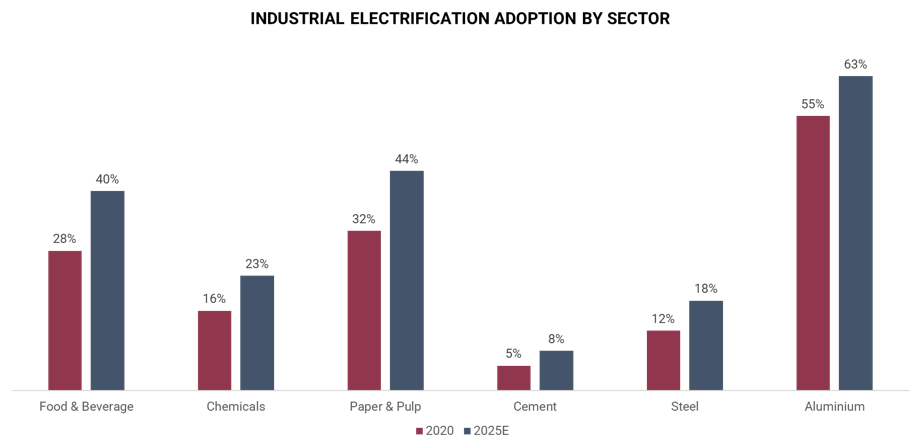
Aluminium smelting represents one of the most electricity-intensive industrial processes globally, consuming approximately 15 MWh per tonne of primary aluminium (Source: International Aluminium Institute, Aluminium Sector Greenhouse Gas Pathways to 2050, 2021).
Several smelters in Australia, Europe, and North America participate in formal demand response programmes, providing hundreds of megawatts of flexible capacity to grid operators during peak events.
My analyst view: What separates these companies from the rest is not technology adoption. It is operating model thinking. They are not asking “should we electrify?” They are asking, “How do we design our energy system so that electrification creates optionality?” That is a fundamentally different question, and it produces fundamentally different investment decisions.
The Structural Constraints Holding Back Industrial Electrification
The bottleneck slowing flexible industrial electrification is rarely equipment. It is coordination, and in some cases, it is the market rules themselves working against the desired outcome.
Tariffs frequently reward the wrong behaviour.
Recent research from MIT and other institutions examining industrial electricity consumption patterns shows that economic incentives and carbon incentives often remain misaligned (Source: MIT Energy Initiative, The Future of Energy Storage, 2022).
A manufacturer may lower its electricity bill by shifting consumption to overnight hours, but if those hours are served by coal-fired baseload generation, the carbon intensity of that consumption actually increases. Without dynamic carbon-aware pricing, facilities optimise for cost and accidentally increase emissions.
This is not a hypothetical edge case.
In markets where overnight electricity is predominantly fossil-generated, including parts of the US Midwest, India, and Southeast Asia, cost-optimal load shifting and carbon-optimal load shifting point in opposite directions.
Process constraints remain real and sector-specific.
Cross-sector studies of steel and cement production demonstrate that flexibility depends heavily on process sequencing, downstream demand patterns, storage availability, and capacity utilisation rates.
A batch chemical process with intermediate storage tanks can shift timing relatively easily.
A continuous steel casting line cannot pause mid-pour. A paper mill can vary pulping schedules, but cannot interrupt the paper machine without quality consequences. The point is this: “industrial flexibility” is not a single number.
It is a distribution highly variable across sectors, processes, and even individual production lines within the same factory.
Grid capacity is becoming an industrial competitiveness issue.
This is the constraint that most manufacturers have not yet internalised. In an increasing number of markets, the ability to secure grid connection capacity and secure it quickly is becoming as important as capital access or labour availability for site selection decisions.
Deloitte’s analysis of European industrial investment patterns shows that grid availability is now a top-three factor in manufacturing location decisions, alongside labour costs and regulatory environment (Source: Deloitte, European Energy Transition: Industrial Impacts, 2024).
Energy access is becoming production access. A factory that cannot get a 50 MW grid connection within 18 months may lose two years of production ramp-up regardless of how competitive its other economics are.
A New Industrial KPI: Flexible Megawatt-Hours
Historically, manufacturers optimised around three metrics:
- Cost per tonne
- Energy per unit
- Production throughput
These remain important.
But they are incomplete for an electrified industrial future.
The emerging operating model optimises across a composite:
Cost per tonne × Carbon intensity × Flexibility value.
This is not abstract. It translates into concrete financial outcomes.
Facilities capable of shifting load gain three distinct advantages:
- First, they can reduce procurement costs through time-of-use optimization.
- Second, they can lower peak-demand charges that can represent 30–40% of industrial electricity bills in many markets
- Third, facilities can create new revenue opportunities through demand response and other grid services.
Utilities gain equally: deferred capital expenditure on peaking plants and grid reinforcement, reduced balancing costs as renewable penetration increases, and improved utilisation of existing transmission and distribution assets.
The IEA estimates that scaling demand-side flexibility to its technical potential could save $100–270 billion annually in power system costs globally by 2030. That is not a rounding error. It is a system-level economic opportunity, and industrial flexibility represents the largest single component.
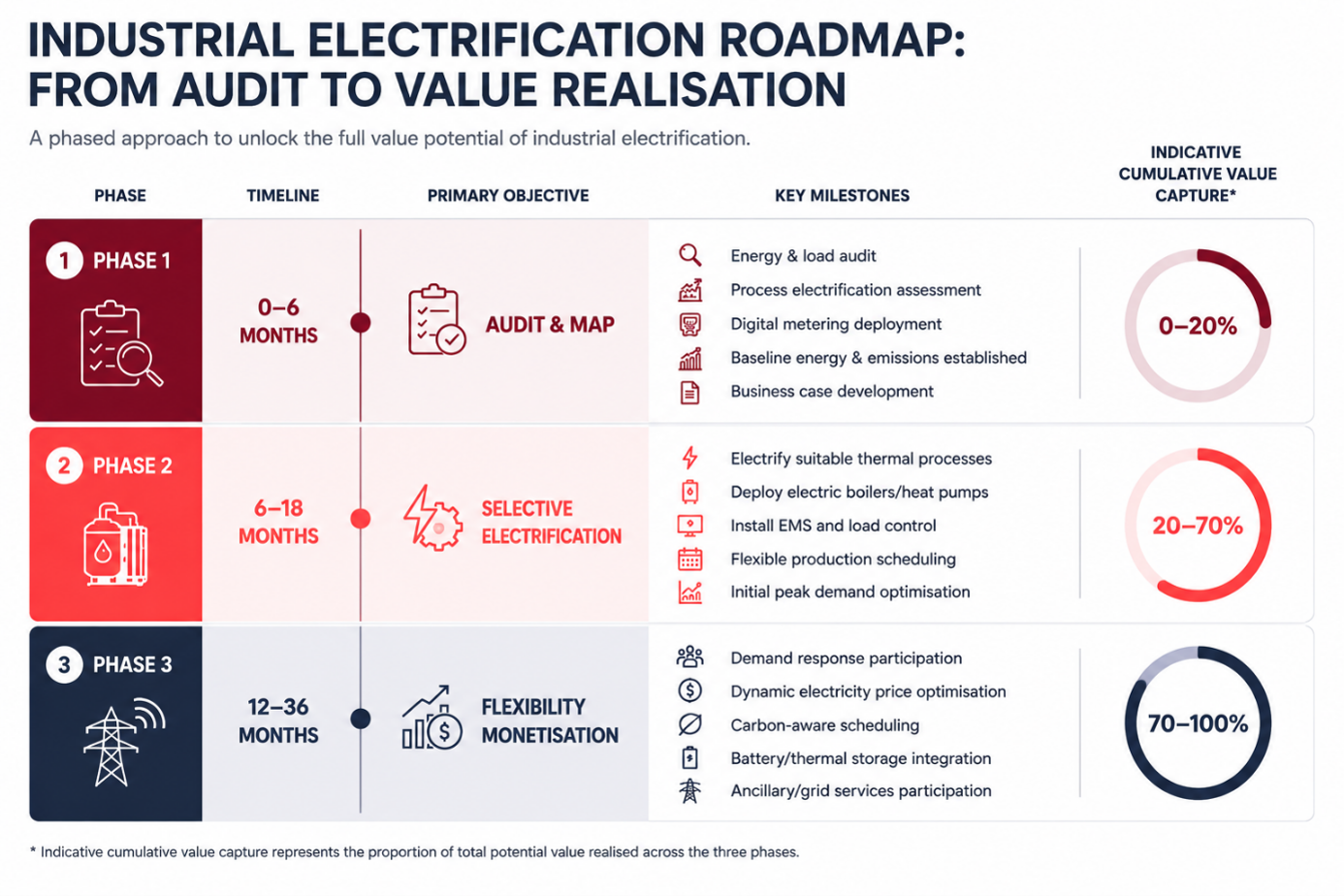
A Three-Phase Industrial Electrification Roadmap
For Industrial Manufacturers
Phase 1: Map and Quantify Flexible Loads.
Start with a detailed heat profile audit across all production processes.
Identify which loads are:
- Interruptible
- Shiftable
- Fixed
Next, evaluate thermal storage potential, hot water tanks, molten salt systems, or phase-change materials that can decouple energy input from production output. The goal is not to electrify everything. It is to identify the 20–30% of the load that offers the highest flexibility value per megawatt.
Phase 2: Electrify Selectively, Starting with Economics.
Prioritise low-temperature heat applications below 200°C where heat pump coefficients of performance (COP) of 3–5x make electrification immediately cost-competitive with gas in most markets (Source: IRENA, Innovation Outlook: Thermal Energy Storage, 2024). Electric boilers for steam generation below 20 bar are commercially mature and can be installed alongside existing gas boilers for hybrid operation, providing fuel optionality rather than requiring full commitment.
Phase 3: Monetise Flexibility Actively.
Participate in demand response programmes. Integrate automated scheduling systems that respond to price signals, grid frequency, and renewable generation forecasts. Negotiate flexible connection agreements with grid operators. Explore aggregation platforms that bundle smaller industrial loads into grid-scale flexible capacity.
For Utilities and Grid Operators
Redesign tariffs to reward flexibility rather than penalise consumption. Introduce dynamic and locational pricing that reflects real-time grid conditions.
Create industrial flex markets that enable aggregation and compensate load shifting at its true system value.
Plan grid and load together to co-develop industrial clusters with pre-built grid capacity rather than forcing individual manufacturers to queue for connections.
Where This Goes From Here: Flexibility Will Define Industrial Competitiveness
Industry represents roughly 37% of global final energy consumption, with fossil fuels still supplying over 70% of industrial energy needs (Source: IEA, World Energy Outlook 2023, 2023). Electrification creates one of the clearest pathways to reduce that dependence. But the strategic question is changing.
It is no longer:
How much industry can electrify?
It is:
How much industrial demand can become flexible?
I will state my position plainly. Within five years, flexible megawatt-hours will become a standard operating metric for energy-intensive manufacturers, sitting alongside cost per tonne and carbon intensity on every quarterly operations review. Manufacturers that move first will secure lower energy costs, more resilient operations, and preferential grid access. Utilities that enable flexible industrial growth will avoid building tens of billions of dollars in peaking infrastructure that would otherwise sit underutilised for 95% of the year.
The companies that treat industrial electrification as a fuel-swap project will capture perhaps 30% of the available value. The companies that treat it as an operating model redesign, integrating procurement, production scheduling, storage, and grid participation into a single optimisation, will capture the rest.
Industrial electrification is becoming less about replacing fuels. It is becoming more about redesigning the relationship between production and power.
The technology already exists.
The bigger opportunity is to connect that technology with better planning, flexible operations, smarter procurement, and stronger grid coordination. The companies that recognize this shift early can turn electricity from a fixed operating cost into a strategic source of flexibility.
The question is no longer whether industrial electrification will change manufacturing. The question is who will design the operating model that comes next.
Explore how our technology intelligence and market research can help you identify emerging opportunities, assess market shifts, and make more informed strategic decisions.
Connect with our experts to explore how we can support your next strategic decision.
About The Author