
The Leahy-Smith America Invents Act (AIA), signed into law in September 2011, created Inter Partes Review (IPR) process to provide a faster and more specialized way to challenge patent validity. Before IPR, validity disputes in district courts could take years, cost millions, and require extensive technical discovery. Inter Partes Review (IPR) replaced the older Inter Partes reexamination system with a trial-like proceeding before the Patent Trial and Appeal Board (PTAB), where technically and legally trained judges evaluate patentability. Congress also gave IPR a strict 12-month timeline after institution and limited its scope to anticipation and obviousness challenges based on patents and printed publications. These limits made IPR faster and more focused than district court litigation.
A quick glance summary of the IPR proceeding.
| Purpose | Challenge patent validity before the PTAB |
| Governing Law | America Invents Act (AIA), 35 U.S.C. §§ 311–319 |
| Grounds Available | Novelty (§102) and Obviousness (§103) |
| Evidence Permitted | Patents and printed publications only |
| Tribunal | Patent Trial and Appeal Board (PTAB) |
| Institution Standard | Reasonable likelihood of prevailing on at least one challenged claim |
| Illustrative Timeline | ~12–18 months from petition to final written decision |
| Quick-glance summary | Claims upheld, canceled, amended, or appealed |
Complete Inter Partes Review (IPR) Lifecycle
The Inter Partes Review (IPR) process follows a defined sequence of filings, responses, and decisions, with statutory provisions and PTAB rules governing the timing of key events. The table below provides a consolidated timeline from the filing of the petition through the final written decision and any subsequent appeal to the Federal Circuit.
| Approx. Time | Event | Governing Provision |
| Day 0 | Petition Filed | §311 |
| 3 Months | Patent Owner Preliminary Response | §313 |
| ~6 Months | Institution Decision | §314 |
| +3 Months | Patent Owner Response | Scheduling Order |
| +6 Months | Petitioner’s Reply | PTAB Rules |
| +9 Months | Sur-Reply | PTAB Rules |
| +10–11 Months | Oral Hearing | PTAB Practice |
| +12 Months | Final Written Decision | §316(a)(11) |
| After FWD | Appeal to Federal Circuit | §319 |
IPR vs. District Court Invalidity
Inter Partes Review (IPR) and district court litigation can address overlapping patent validity issues, but they differ substantially in their procedures, evidentiary requirements, and strategic consequences. The table below compares the two proceedings across key features, including the decision maker, burden of proof, permissible grounds and evidence, duration, discovery, and estoppel.
| Feature | IPR | District Court |
| Decision Maker | PTAB | Judge/Jury |
| Burden | Preponderance | Clear & Convincing |
| Grounds | §§102/103 only | All invalidity grounds |
| Evidence | Patents & printed publications | Any admissible evidence |
| Duration | ~12–18 months | Often 3–5 years |
| Discovery | Limited | Extensive |
| Estoppel | Yes | No comparable statutory estoppel |
Stage 1 – Before Filing
This stage covers everything the petitioner must assess before committing to and preparing an IPR petition. The objective is to determine whether the patent is eligible for an IPR, identify the strongest prior art and invalidity theories, assess procedural and estoppel risks, and align the proposed IPR with any parallel litigation. The petitioner can develop the grounds and evidence for the petition only after evaluating these issues.
Identifying the Target Patent
An IPR petition can be filed only against an issued U.S. patent. The petitioner also cannot have previously filed a declaratory judgment action challenging that patent’s validity. Under 35 U.S.C. § 315(b), the petitioner, real party in interest, or privy generally must file a petition within one year of receiving an infringement complaint. This deadline generally acts as a strict statutory bar, with limited exceptions such as joinder. Before filing, practitioners also verify the patent’s status, priority chain, and prosecution history. They review any prior reexamination or PTAB proceedings as well. These checks can reveal potential estoppel issues or other factors that may affect institution.
Prior Art Search
Because IPR is limited to patents and printed publications, the prior art search differs from a typical district court invalidity search. District court litigation can also involve prior sales, public uses, and other forms of evidence. Inter Partes Review (IPR) searches therefore focus heavily on patents, published applications, technical standards, academic literature, and product manuals. Each reference must also have a reliable publication date. Search teams should preserve evidence of public accessibility and provenance, particularly for older or difficult-to-date references
Choosing Grounds
The petitioner must select the strongest grounds for challenging the claims. These may be based on anticipation under § 102 or obviousness under § 103. For obviousness, the petition must explain why a skilled person would have combined or modified the cited teachings. The number of grounds also matters. Excessive or repetitive grounds can weaken a petition and make it harder to present a clear case. Petitioners therefore typically focus on a limited number of strong combinations rather than presenting every conceivable theory.
Claim Construction Considerations
Since 2018, the PTAB has applied the Phillips claim-construction standard used by district courts. Petitioners must therefore consider how the claims may be construed in parallel litigation. Consistency is especially important when an IPR and district court case are pending at the same time. Different claim-construction positions can create strategic and procedural problems. Claim construction should therefore be considered at the beginning of the Inter Partes Review strategy, rather than after the prior art has already been selected.
Estoppel and Strategic Considerations
Estoppel under § 315(e) is another major consideration. It generally attaches after a final written decision, rather than simply when a petition is filed or instituted. A petitioner may then be barred from asserting grounds that it raised or reasonably could have raised during the IPR. This makes prior art selection a high-stakes decision. A reference excluded from the IPR may later become difficult to use in another forum. Petitioners must therefore balance the strength of their selected grounds against the risk of leaving other potentially useful grounds behind
Coordination with Parallel Litigation
An IPR rarely exists in isolation. Many petitions are filed while related district court litigation is already underway. The timing of the court case, overlap between the issues, and the petitioner’s litigation positions can all affect the institution decision.
As a result, litigation and PTAB teams increasingly coordinate their strategies from the outset. This includes claim construction, prior art, invalidity positions, stipulations, scheduling, and expert evidence. The goal is to ensure that the Inter Partes Review strengthens the broader validity strategy rather than creating conflicts between parallel proceedings
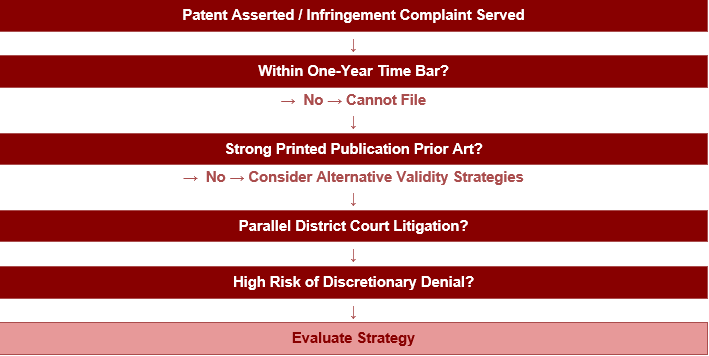
Decision Tree: Should You File an IPR?
Before committing to an IPR, the petitioner must assess several threshold and strategic considerations. The following decision path summarizes the key questions that should be evaluated sequentially, from the applicable time bar and availability of qualifying prior art to the risk of discretionary denial.
Stage 2 – Filing the Petition
Once the petitioner has completed the pre-filing assessment, identified the strongest prior art, selected the invalidity grounds, and evaluated procedural risks, the next phase is to translate that strategy into a petition that satisfies the PTAB’s formal and substantive requirements. This stage therefore moves from strategic analysis to petition preparation, supporting evidence, compliance checks, and filing.
Petition Requirements
Under 37 C.F.R. § 42.104, the petition must identify each challenged claim, the specific statutory ground, the prior art relied upon, and a detailed explanation of how the prior art discloses every claim limitation. It must also certify that the patent is eligible for IPR and that the petitioner is not time-barred or estopped.
Mandatory Notices
37 C.F.R. § 42.8 requires disclosure of all real parties in interest, related matters (including co-pending litigation and other PTAB proceedings involving the same patent), and lead and backup counsel. Real-party-in-interest disclosure has become a live litigation flashpoint in its own right: the Director’s January 2026 informative decision in Yangtze Memory Technologies v. Micron vacated two institution grants specifically because the petitioner had failed to rebut evidence that it had not named all real parties in interest, underscoring that RPI defects can now unwind an otherwise-institutable petition.
Expert Declarations
Nearly every petition is supported by a declaration from a technical expert opining on how a person of ordinary skill in the art would have understood the prior art and the challenged claims, and, for obviousness grounds, why that person would have been motivated to combine the references. Conclusory motivation-to-combine testimony can weaken an obviousness case, particularly when the petition does not adequately explain why a skilled artisan would have combined or modified the cited references.
Claim Charts
Petitions include limitation-by-limitation claim charts mapping each element of each challenged claim to specific disclosures in the prior art, typically with pinpoint citations to columns, line numbers, or paragraph numbers. The petition relies heavily on these charts, and the Board closely scrutinizes them at both the institution stage and the final written decision.
Filing Fees
Under the current USPTO fee schedule, an IPR request covering up to 20 claims costs $23,750 at filing, plus $470 for each additional challenged claim. If the Board institutes the petition, the petitioner must pay a post-institution fee of $28,125, plus $940 for each claim beyond 20. A discretionary Director Review of an institution decision or final written decision carries an additional $452 fee.
Word Limits
Under 37 C.F.R. § 42.24, a petition is limited to 14,000 words (or 60 pages if the petitioner elects the page-limit option), excluding the table of contents, mandatory notices, certificate of service, and claim listing appendix. This tight limit forces petitioners to prioritize their strongest grounds rather than padding the record with marginal combinations.
Stage 3 – Patent Owner Preliminary Response
After the petitioner files the IPR petition, the patent owner has an opportunity to respond before the PTAB decides whether to institute the proceeding. The purpose of this stage is therefore not to fully defend the patent on the merits at trial, but to identify reasons why the PTAB should decline to institute the Inter Partes Review, whether because of procedural defects, discretionary considerations, or weaknesses in the petition. The patent owner may also submit supporting evidence at this stage.
Optional Response
The patent owner may, but is not required to, file a Preliminary Response within three months of the petition being accorded a filing date. Many patent owners now file even when they intend to contest fully at trial, specifically to raise discretionary-denial arguments before the Director rather than saving all arguments for the trial phase.
Preliminary Evidence
The current Trial Practice Guide permits the preliminary response to include arguments and supporting evidence, including testimonial evidence. However, where new testimonial evidence creates a genuine issue of material fact, the institution-stage framework applies a presumption in favor of the petitioner.
Discretionary Denial Arguments
Discretionary denial is now a major hurdle at the institution stage. The Director applies a holistic framework rather than a rigid checklist. Existing considerations include Fintiv, General Plastic, and other PTAB precedent. The analysis can also consider serial petitions, parallel litigation, inconsistent positions across forums, and the patent’s age and litigation history. The framework has also expanded under Director Squires The March 2026 memorandum permits the Director to consider whether the accused products are manufactured in the United States, whether the patent owner’s competing products are made domestically, and whether the petitioner is a small business sued for infringement.
The May 2026 precedential decision in Magnolia Medical Technologies, Inc. v. Kurin, Inc. further clarified the approach. The Director denied institution after finding that the petitioner had already litigated and lost the same issues in district court. The decision emphasized that IPR should serve as an alternative to litigation, not a vehicle for repeating a failed validity challenge. For petitioners, the message is clear: strong prior art alone may not be enough. The timing of the petition, parallel litigation, prior validity challenges, and the broader circumstances of the dispute can all influence whether the PTAB reaches the merits.
Procedural Defects
Patent owners also flag time-bar violations under § 315(b), incomplete real-party-in-interest disclosures, and failures to comply with the petition’s word or page limits, any of which can result in denial without reaching the merits.
Pre-2025 vs. Current (2025–2026) IPR Practice
Recent changes in PTAB practice have altered how institution decisions and post-institution review are managed. The table below compares selected features of the traditional IPR framework with the current approach in 2025–2026, highlighting changes in institutional control, discretionary considerations, Director Review, and alternative validity proceedings.
| Topic | Traditional IPR | Current IPR (2025–2026) |
| Institution Decision | PTAB Panel | Director-Controlled |
| Main Focus | Prior Art Merits | Discretionary Denial + Merits |
| Director Review | Rare | Central Role |
| Institution Orders | Detailed | Often Summary Notices |
| Alternative Proceedings | Less Common | Ex parte reexamination has also attracted renewed attention as an alternative or complementary validity mechanism. |
Stage 4 – Institution Decision
After the petition and any Patent Owner Preliminary Response have been submitted, the next procedural step is the institution decision. At this stage, the Director determines whether the petition has satisfied the statutory threshold for institution and whether discretionary or procedural considerations warrant denying the proceeding. The outcome is critical because it determines whether the case moves forward into the Inter Partes Review (IPR) trial phase.
The “Reasonable Likelihood” Standard
Under 35 U.S.C. § 314(a), the current USPTO Trial Practice Guide describes the institution determination as being made by “the Director, or the Board acting on behalf of the Director”. This is a lower threshold than the “clear and convincing evidence” burden a challenger faces in district court, one of IPR’s core structural advantages for petitioners, though that advantage has been substantially offset in practice by the discretionary overlay described above.
Institution Decision Factors
The institution decision is influenced not only by the strength of the asserted prior art but also by procedural and discretionary considerations. The table below summarizes the key factors considered at this stage and explains their relevance to the Director’s decision whether to institute the IPR.
| Factor | Why It Matters |
| Merits of Prior Art | Threshold under §314(a) |
| Parallel District Court Trial | May trigger discretionary denial |
| Serial Petitions | Weighs against institution |
| Real Party in Interest | Procedural compliance |
| Claim Construction Consistency | Avoid conflicting positions |
| Settled Expectations | Older patents may receive greater deference |
| Domestic Manufacturing | New discretionary consideration |
| Small Business Status | May influence discretionary analysis |
Institution vs. Denial
Institution decisions may be issued as brief summary notices stating whether institution is granted or denied. For proceedings involving novel or important issues, the Director may issue a more detailed decision addressing those issues.
Partial Institution (Historically) and Current Practice
Following the Supreme Court’s 2018 decision in SAS Institute v. Iancu, the Board may no longer institute on only some challenged claims or grounds while denying others; institution is now all-or-nothing per petition. If the Director finds a reasonable likelihood of success on any claim, the Director institutes the proceeding for every challenged claim and ground presented.
Timeline
Under § 314(b), The Director must generally decide whether to institute within three months of receiving the patent owner’s preliminary response, or within three months after the response deadline if no response is filed. This generally places the institution decision about six months after the petition is filed.
Stage 5 – Trial Phase
Once the Board institutes the IPR, the proceeding moves into the trial phase. The petitioner and patent owner develop the evidentiary record and present their positions on the challenged claims. The Board’s scheduling order governs this phase and sets deadlines for briefing, limited discovery, expert cross-examination, evidentiary motions, and, where applicable, claim amendments or additional briefing. The following steps describe the principal activities that occur during this phase.
Scheduling Order
Upon institution, the Board issues a Scheduling Order setting deadlines for the patent owner’s response, petitioner’s reply, patent owner’s sur-reply, and the oral hearing, with the proceeding generally scheduled to reach a final written decision within twelve months of institution under § 316(a)(11).
Discovery
IPR discovery is far more limited than district court discovery. Routine discovery is largely confined to cross-examination of declarants and production of information inconsistent with positions taken in the proceeding. Additional discovery requires a motion showing that it is “in the interests of justice,” a standard the Board applies narrowly.
Cross-Examination of Experts
Each side may cross-examine the opposing party’s declarants, and deposition testimony can be important to the Board’s assessment of disputed issues such as motivation to combine, claim construction, and the state of the art.
Motions to Exclude
Parties may move to exclude evidence on admissibility grounds under the Federal Rules of Evidence. Parties generally address issues concerning the weight or credibility of evidence in their substantive briefing rather than through a motion to exclude.
Motions to Amend
Patent owners may move to amend challenged claims, typically by proposing narrower substitute claims responsive to the grounds of unpatentability involved in the proceeding. The motion-to-amend process is governed by 37 C.F.R. § 42.121 and the Board’s precedential Lectrosonics framework. The Board may evaluate the patentability of proposed substitute claims, and the parties may submit briefing and evidence addressing those issues.
Additional Briefing
The Board may authorize supplemental briefing on discrete issues, such as a new controlling Federal Circuit decision or a dispute concerning the scope of a motion to amend, subject to any limits specified by the Board.
Stage 6 – Oral Hearing
Following the completion of the written briefing and evidentiary proceedings, the parties may present oral arguments before the PTAB panel. The oral hearing provides the parties with an opportunity to clarify their positions, respond to the Board’s questions, and focus attention on the issues most relevant to the final decision. The following points describe the main aspects of the hearing process.
PTAB Hearing Procedure
Most instituted proceedings that reach this stage include an oral hearing before the Board panel. The Board ordinarily provides about one hour of argument per side, although the parties may request more or less time depending on the circumstances of the case. Hearings may be conducted remotely or in person.
Demonstratives
Parties generally exchange and submit demonstrative exhibits before the hearing. Demonstratives support oral arguments, not evidence, and parties cannot use them to introduce new evidence or arguments that they did not previously present in the record.
Judge Questioning
Unlike many district court hearings, PTAB oral arguments are often highly interactive, with judges questioning counsel about specific claim limitations, claim construction, motivation to combine, and objective indicia of non-obviousness.
Strategic Considerations
Because the panel has already reviewed the written record, effective advocacy at this stage generally focuses on addressing the issues most likely to affect the Board’s decision rather than simply repeating the parties’ briefs.
Stage 7 – Final Written Decision
The final written decision marks the Board’s determination of the patentability of the challenged claims after considering the complete record developed during the Inter Partes Review. At this stage, the Board resolves the parties’ substantive arguments, determines whether the challenged claims are unpatentable, and addresses any proposed substitute claims from a motion to amend.
Patentability Findings
The Board issues a final written decision addressing the patentability of every claim challenged in the instituted petition, applying the Graham factors for obviousness and comparing claim scope to the prior art disclosure for anticipation.
Burden of Proof
The petitioner bears the burden of proving unpatentability by a preponderance of the evidence, a substantially lower bar than the clear-and-convincing standard applicable in district court, though the Board’s technical expertise means this lower burden does not translate into a rubber stamp; well-prepared patent owners regularly prevail on individual claims or entire proceedings.
Burden of Proof Comparison
The evidentiary standard applicable to a patentability challenge depends on the forum and stage of the proceeding. The USPTO reports that 22% of challenged claims and 47% of instituted claims were found unpatentable under the preponderance-of-the-evidence standard, according to its statistics. The table below compares the standards used at the IPR institution stage and during the IPR itself with the higher standard applied in district court litigation.
| Forum / Stage | Standard |
| Institution | Reasonable Likelihood Standard |
| IPR (Final Written Decision) | Preponderance of the Evidence |
| District Court | Clear and Convincing Evidence |
Amendment Decisions
Where a motion to amend was filed, the final written decision also resolves the patentability of any proposed substitute claims. The final written decision also addresses any proposed substitute claims that were properly before the Board.
Stage 8 – Appeals
After the final written decision, the parties may pursue further review of the Board’s determination. This stage includes the available mechanisms for challenging or reviewing the final decision, beginning with Director Review or rehearing and potentially continuing to an appeal before the Federal Circuit and, in limited circumstances, review by the Supreme Court.
Appeal to the Federal Circuit
Either party may appeal a final written decision to the U.S. Court of Appeals for the Federal Circuit under 35 U.S.C. § 319, which has exclusive jurisdiction over patent appeals and reviews the Board’s factual findings for substantial evidence and legal conclusions de novo. Institution decisions are generally unreviewable under 314(d), although the Supreme Court and Federal Circuit have recognized limited circumstances in which issues arising around institution may be reviewable.
Rehearing Requests
Before appealing, a party may request Director Review of a final written decision under 37 C.F.R. § 42.75. The current Director Review process was codified effective October 31, 2024, following the Supreme Court’s decision in United States v. Arthrex, Inc. (2021), and carries a $452 fee. A party may also seek rehearing before the Board panel under the applicable PTAB rules. In June 2026, the USPTO extended the ordinary deadline for requesting Director Review of an institution decision from 14 days to 30 days.
Supreme Court Review
The Supreme Court has decided several cases addressing Inter Partes Review and related PTAB issues, including Oil States, SAS Institute, Thryv, and Arthrex. These decisions have materially shaped important aspects of PTAB procedure and judicial review.
Major Supreme Court Decisions Affecting IPR
Supreme Court decisions have significantly shaped the structure and operation of IPR proceedings. The table below highlights key decisions that established or modified important aspects of IPR, including its constitutionality, institution practice, judicial review, and Director Review.
| Case | Year | Significance |
| Oil States v. Greene’s Energy | 2018 | Upheld constitutionality of IPR |
| SAS Institute v. Iancu | 2018 | Ended partial institution |
| Thryv v. Click-to-Call | 2020 | Limited review of institution decisions |
| United States v. Arthrex | 2021 | Established Director Review |
Stage 9 – Aftermath
The conclusion of an IPR can have consequences beyond the final written decision itself. The outcome may affect the petitioner’s ability to pursue other invalidity grounds, parallel litigation, licensing and settlement discussions, and the patent owner’s broader portfolio and continuation strategy. The following points address the principal legal, commercial, and strategic effects that may arise after the Inter Partes Review.
Estoppel Effects
Once the Board issues a final written decision, 35 U.S.C. § 315(e) prevents the petitioner, its real parties in interest, and privies from asserting in district court, before the ITC, or in a later PTAB or PGR proceeding that the claim is invalid on any ground they raised or reasonably could have raised in the IPR. Federal Circuit precedent has interpreted “reasonably could have raised” broadly. In California Institute of Technology v. Broadcom Ltd. (2022), the Federal Circuit held that estoppel extends to grounds that were not included in the IPR petition but reasonably could have been included. In Ironburg Inventions Ltd. v. Valve Corp. (2023), the Federal Circuit further applied a “skilled searcher” standard to assess whether such prior art reasonably could have been discovered.
Impact on District Court Litigation
A pending or resolved IPR may prompt a party to seek a stay of parallel district court litigation. Courts commonly consider factors such as whether a stay would simplify the issues, the stage of the litigation, and potential prejudice to the non-moving party. A stay request may become more consequential after institution because the PTAB proceeding is then underway and subject to the statutory framework for a final written decision.
Licensing Implications
A patent that survives an IPR may have greater perceived validity strength in subsequent licensing or settlement discussions, while cancellation of claims can materially affect the parties’ negotiating positions.
Business Consequences
For operating companies, an unfavorable final written decision can eliminate a product’s freedom-to-operate defense or narrow a patent portfolio’s licensing value overnight, while a favorable outcome for a patent owner can validate years of R&D investment and support subsequent enforcement campaigns.
Continuation Applications
Patent owners may use continuation applications before or during an IPR to pursue additional or differently scoped claims supported by the existing disclosure. This can provide another avenue for preserving claim scope when challenged claims face validity risk, subject to the requirements governing continuation practice.
Stage-by-Stage Checklist
The Inter Partes Review process involves distinct stages, each with a different strategic objective and set of potential risks. The table below provides a high-level comparison of the primary objective and main risk associated with each stage discussed above.
| Stage | Primary Objective | Main Risk |
| Before Filing | Build strongest prior art case | Missing statutory deadline |
| Petition | Present complete invalidity theory | Weak expert declaration |
| Preliminary Response | Seek discretionary denial | Ignoring procedural issues |
| Institution | Obtain trial | Director denial |
| Trial | Develop factual record | Weak expert testimony |
| Hearing | Address panel concerns | Repeating briefs |
| Final Decision | Obtain favorable ruling | Estoppel consequences |
| Appeal | Correct legal errors | Deferential review of facts |
Recommendations
For Petitioners
File early relative to any parallel district court schedule because the Director heavily weighs proximity to the trial date when considering discretionary denial. Consider a stipulation narrowing or dropping overlapping district court invalidity grounds to strengthen the case against discretionary denial. Audit real-party-in-interest disclosures with particular care in light of the Yangtze Memory Technologies precedent, and budget for the full $50,000-plus USPTO fee exposure of a 20-claim petition rather than treating the request fee as the total cost of entry. Front-load the strongest one or two grounds within the 14,000-word limit rather than spreading arguments thin across marginal combinations.
For Patent Owners
Treat the Preliminary Response as the primary battleground, not an afterthought before trial. A well-developed discretionary-denial argument based on the current precedential framework can resolve the case before the PTAB reaches the merits. Where a manufacturing footprint argument is available under the March 2026 memorandum, develop that record early. Consider whether ex parte reexamination, now used far more frequently as a parallel or alternative track, offers a more predictable path than defending an instituted IPR.
Petitioner vs. Patent Owner Strategy
| Petitioner | Patent Owner |
| File early | Build discretionary denial arguments |
| Focus on strongest grounds | Challenge RPI disclosures |
| Coordinate district court positions | Highlight litigation investment |
| Strong expert declaration | Attack motivation to combine |
| Avoid serial petitions | Preserve amendment options |
Conclusion: The IPR as a Strategic Business and Litigation Tool
For an industry inclined to treat IPR as a mechanical, rules-based checkbox, the practical reality in 2026 is far less predictable: institution now turns as much on litigation timing, forum coordination, and Director-level policy as on the underlying prior art. Inter Partes Review remains, on paper, exactly what Congress designed in 2011, a faster, cheaper, technically expert alternative to district court invalidity litigation. But successful navigation now requires parties to treat each petition as a coordinated business and litigation decision, not a standalone administrative filing. They must set the strategy months before drafting the petition and revisit it as the Director’s discretionary framework evolves.
The Strategic Takeaways: From the ExpertLens
- IPR is designed as a faster, cheaper alternative to district-court invalidity litigation. It is limited to novelty and obviousness challenges based on patents and printed publications.
- IPR remains relatively fast once instituted. In FY2025, most proceedings reaching a final written decision remained within the statutory 12–18-month framework.
- The institution environment has tightened sharply. The USPTO reported a 74% institution rate by petition in FY2024, falling to 58% in FY2025, while early-FY2026 data showed substantially higher levels of discretionary denial.
- The cost of IPR makes early case assessment critical. A 20-claim petition can require more than $50,000 in USPTO fees across the request and post-institution stages. The petition is also subject to a 14,000-word limit. If instituted, the case can involve discovery, depositions, and motions over roughly a year.
- Estoppel makes prior-art selection a critical first-stage decision. Under 35 U.S.C. § 315(e), a petitioner may be barred from later asserting grounds it raised or reasonably could have raised in the IPR. This can affect subsequent district-court, ITC, and PTAB proceedings.
- High claim-cancellation rates have historically made IPR attractive to defendants. However, tighter institution standards are pushing parties to consider other options. Ex parte reexamination, district-court defenses, and other post-grant strategies are increasingly part of the broader validity toolkit.
Where the Right Research Can Make a Difference
The effectiveness of an IPR strategy ultimately depends on the quality of the evidence and analysis behind it. From identifying relevant prior art to assessing patent validity and supporting litigation strategy, the right research can help teams make more informed decisions.
Expertlancing supports law firms, corporations, and other stakeholders with IP research, technology advisory, and market intelligence across the patent lifecycle. Its IP research capabilities span prior-art searches, patent landscape analysis, invalidity research, technology assessments, and competitive intelligence. By combining structured patent research with technical and market context, Expertlancing helps clients evaluate patent portfolios, identify relevant technologies and prior art, and build a stronger evidence base for critical IP decisions.
With a team of 60+ professionals in India and a global presence across the USA, and Japan, Expertlancing brings together IP researchers, technical experts, and domain specialists across multiple technology and industry domains. This multidisciplinary approach enables teams to approach complex patent matters from both technical and strategic perspectives. Whether the requirement involves a focused prior-art search, a detailed invalidity assessment, or broader portfolio intelligence, Expertlancing aligns its research approach with the specific objectives of each matter.
Looking to strengthen your IP strategy with the right research and intelligence? Connect with our experts to discuss your specific requirements and explore how our multidisciplinary expertise can support your next IP decision.