For 63 years, India’s nuclear energy sector operated under a single, unbreakable rule: only the government builds, owns, and operates nuclear power plants. That era ended in December 2025. The Sustainable Harnessing and Advancement of Nuclear Energy for Transforming India (SHANTI) Bill, 2025, passed by Parliament and notified by the Government of India, is the most significant India nuclear energy reform since the Atomic Energy Act of 1962.
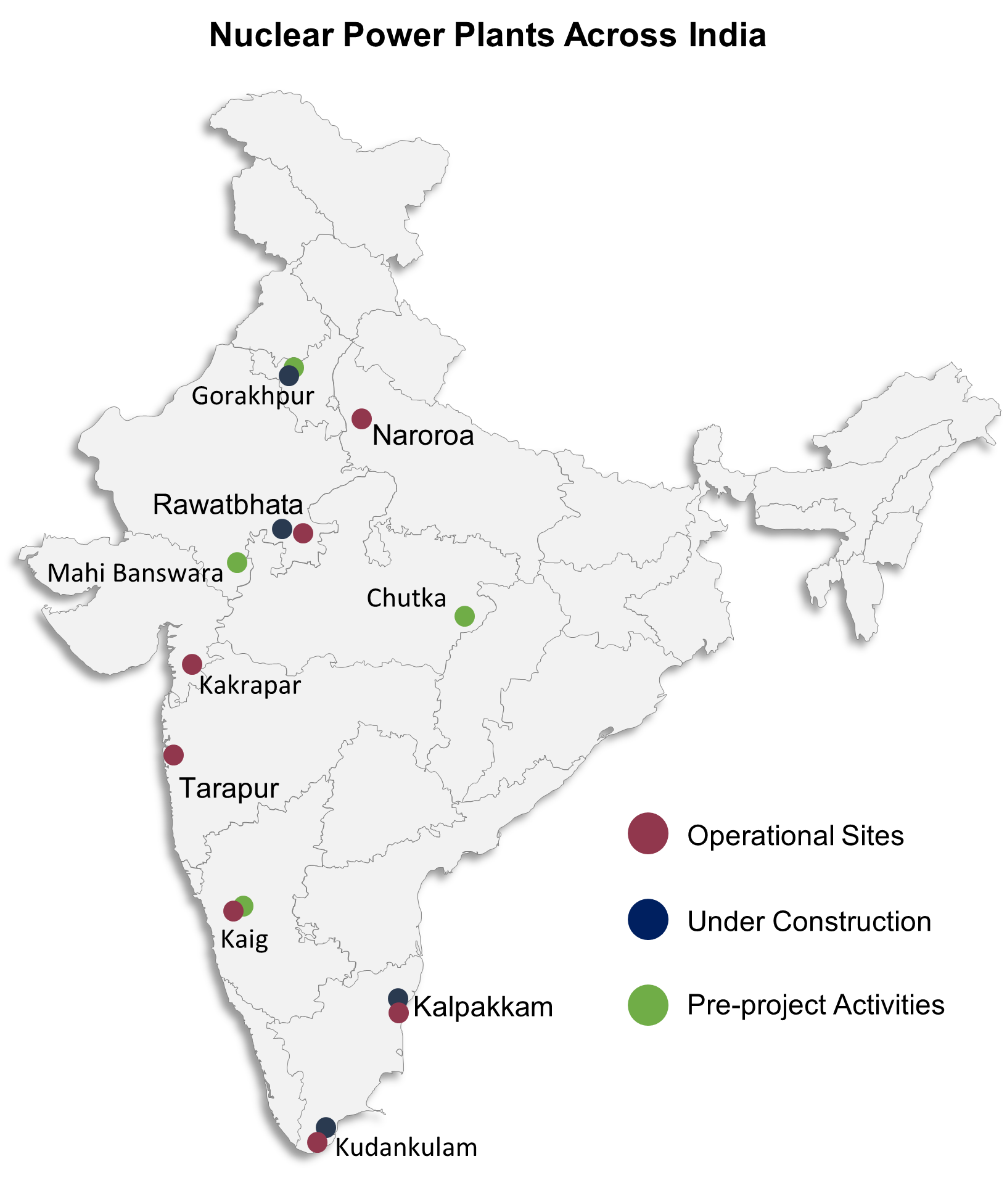
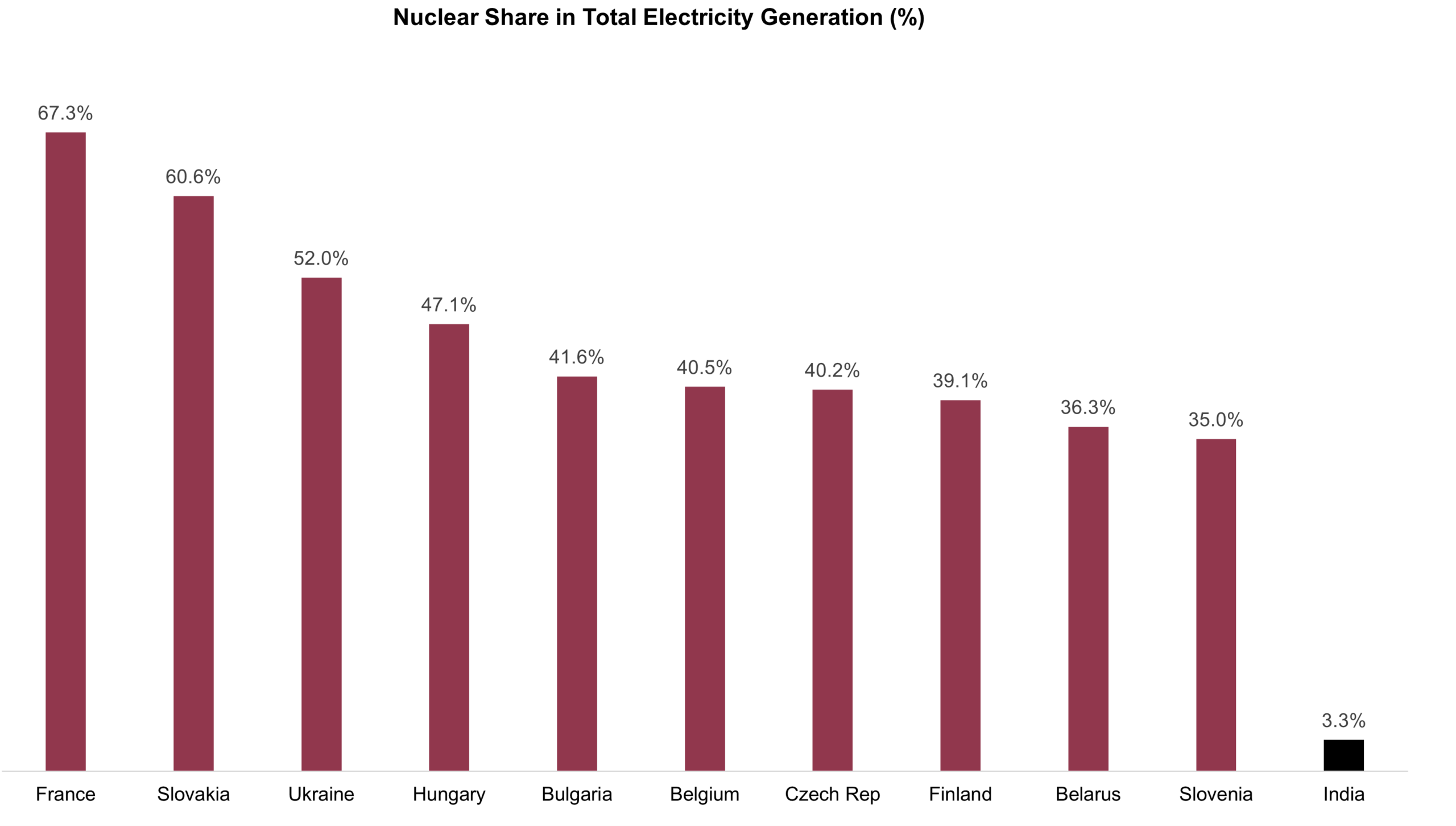
India’s current installed nuclear capacity stands at approximately 8,180 MW from 24 operational reactors, contributing just 3 per cent to total electricity generation. The government’s stated ambition is to reach 22,480 MW by 2031-32 and 100 GW by 2047. These are not small numbers. This India nuclear capacity target 2047 is not a small number. And the government has publicly acknowledged it cannot achieve this alone, which is precisely why the SHANTI Act now invites private capital and private expertise into what was the most closed sector in India’s economy.
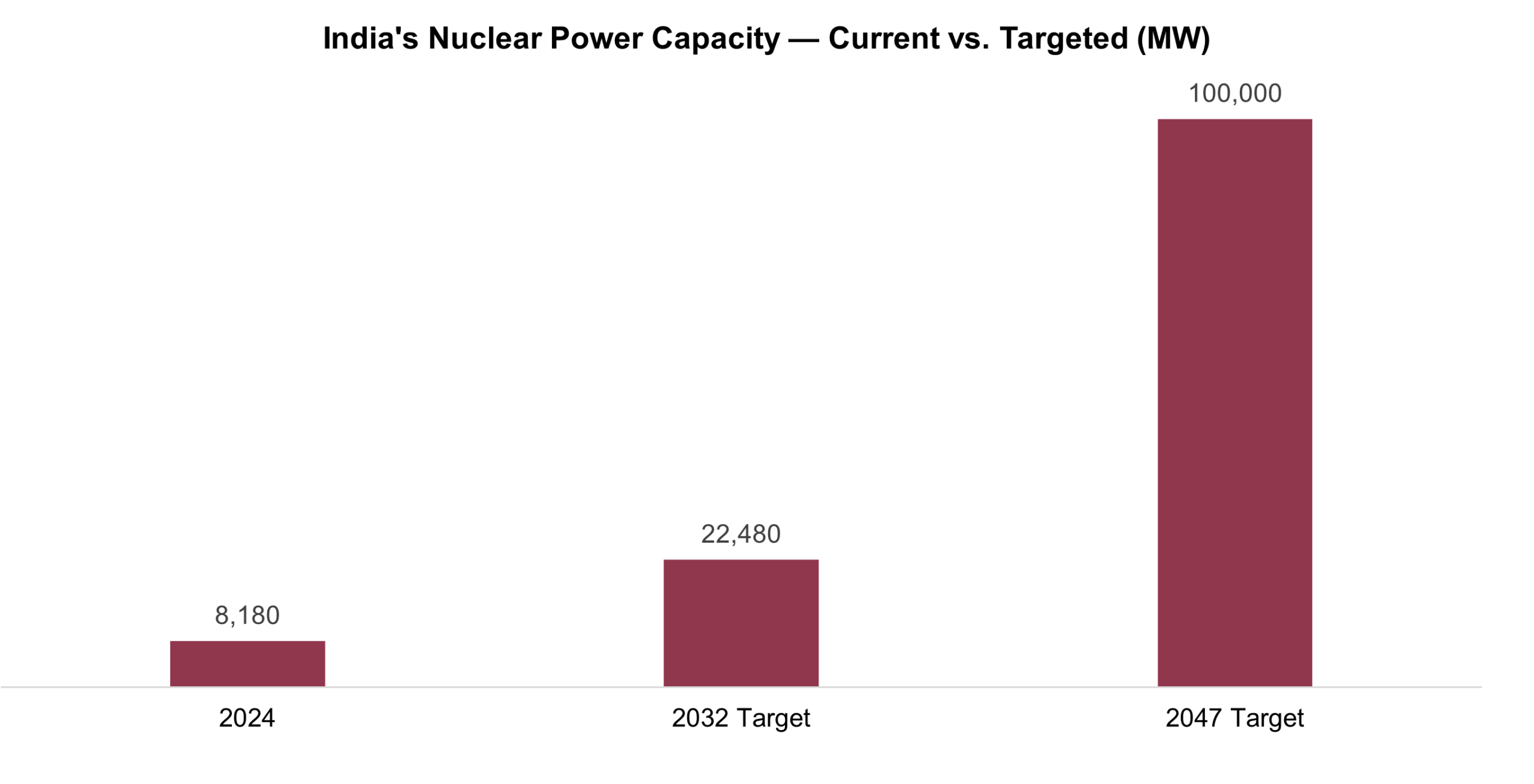
Chart 1: India’s Nuclear Power Capacity – Current vs. Targeted (MW), 2024–2047 (Source: Department of Atomic Energy- Press Release)
Why This Reform Was Unavoidable: The Structural Gap in India’s Clean Energy Ambitions
India has committed to achieving 500 GW of non-fossil fuel electricity capacity by 2030 and net-zero emissions by 2070. Solar and wind have received enormous policy support and private investment over the last decade. But there is a fundamental problem nobody in the renewable energy conversation likes to discuss openly: intermittency. Solar generates zero power at night. Wind is seasonal. Battery storage at grid scale remains prohibitively expensive for a country that needs to electrify at India’s pace.
Nuclear energy is the only large-scale, zero-carbon, baseload power source that can run 24 hours a day, 365 days a year, with capacity factors exceeding 80 per cent. This makes India clean energy baseload power a central part of the country’s long-term decarbonization strategy.
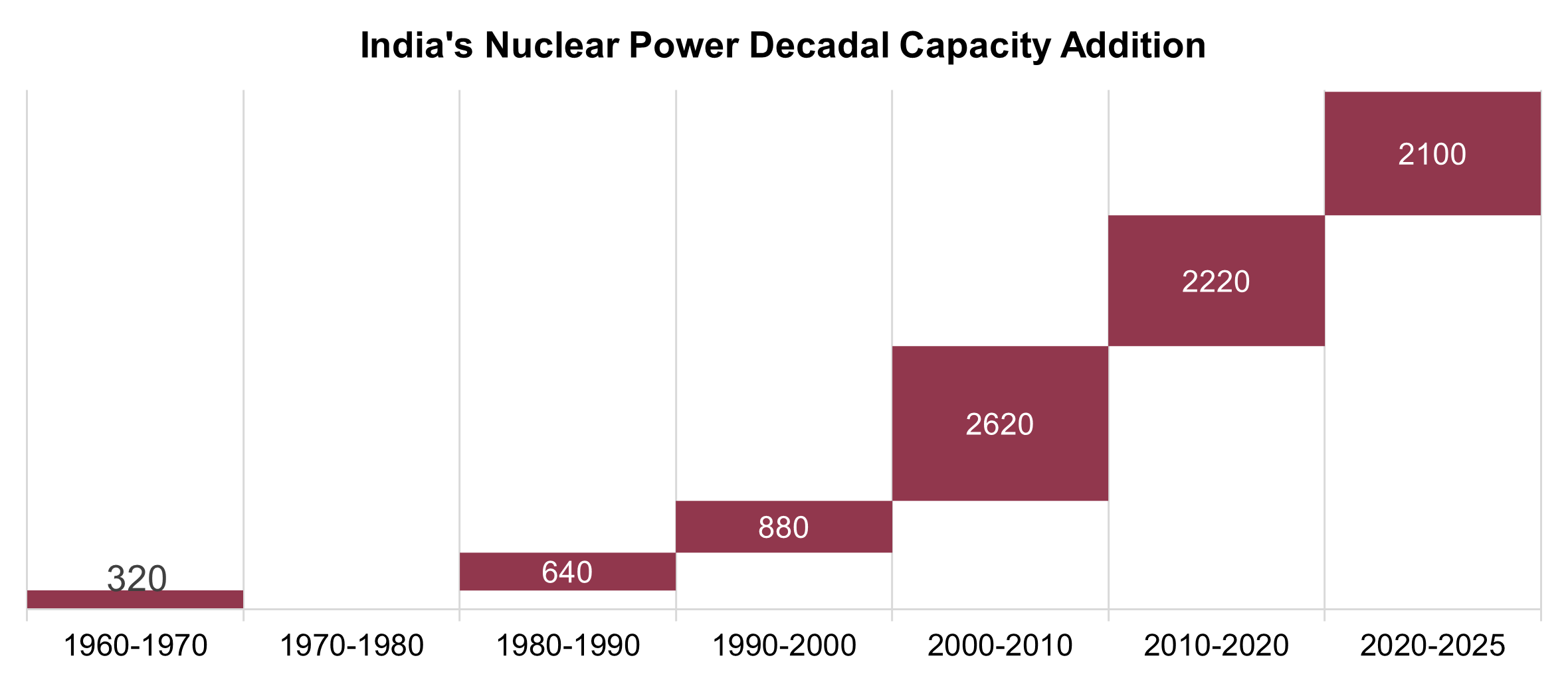
Yet, India’s nuclear power programme has been painfully slow. The country added only about 4,820 MW of nuclear capacity in the last two decades(2000 to 2020), roughly equivalent to what a single large private thermal power company commissions in a maximum of five years. The reasons are well known: chronic funding constraints, bureaucratic project execution timelines, land acquisition delays, and a legal framework that kept the entire sector under government monopoly. NPCIL, despite being technically competent, has operated under severe capital constraints. The Department of Atomic Energy’s budget allocation for FY2024-25 was approximately ₹19,250 crore (~2.3 billion USD), a fraction of what is needed to build a 100 GW nuclear fleet. The estimated capital requirement for reaching the 2047 target ranges approximately 950 trillion USD (Estimated, based on Data from the IEA World Energy Investment Report, 2024). No government budget can absorb this alone.
The SHANTI Act is not just a policy choice born from ideology. It is an act of fiscal and engineering pragmatism. India’s clean energy maths simply does not add up without nuclear. And India’s nuclear maths does not add up without private capital. This reform was overdue by at least a decade, and the fact that it happened now reflects the urgency of the 2047 net-zero pathway rather than any sudden love for deregulation. It also creates a major nuclear power investment opportunity India for companies that can bring capital, execution capability, and long-term operational discipline.
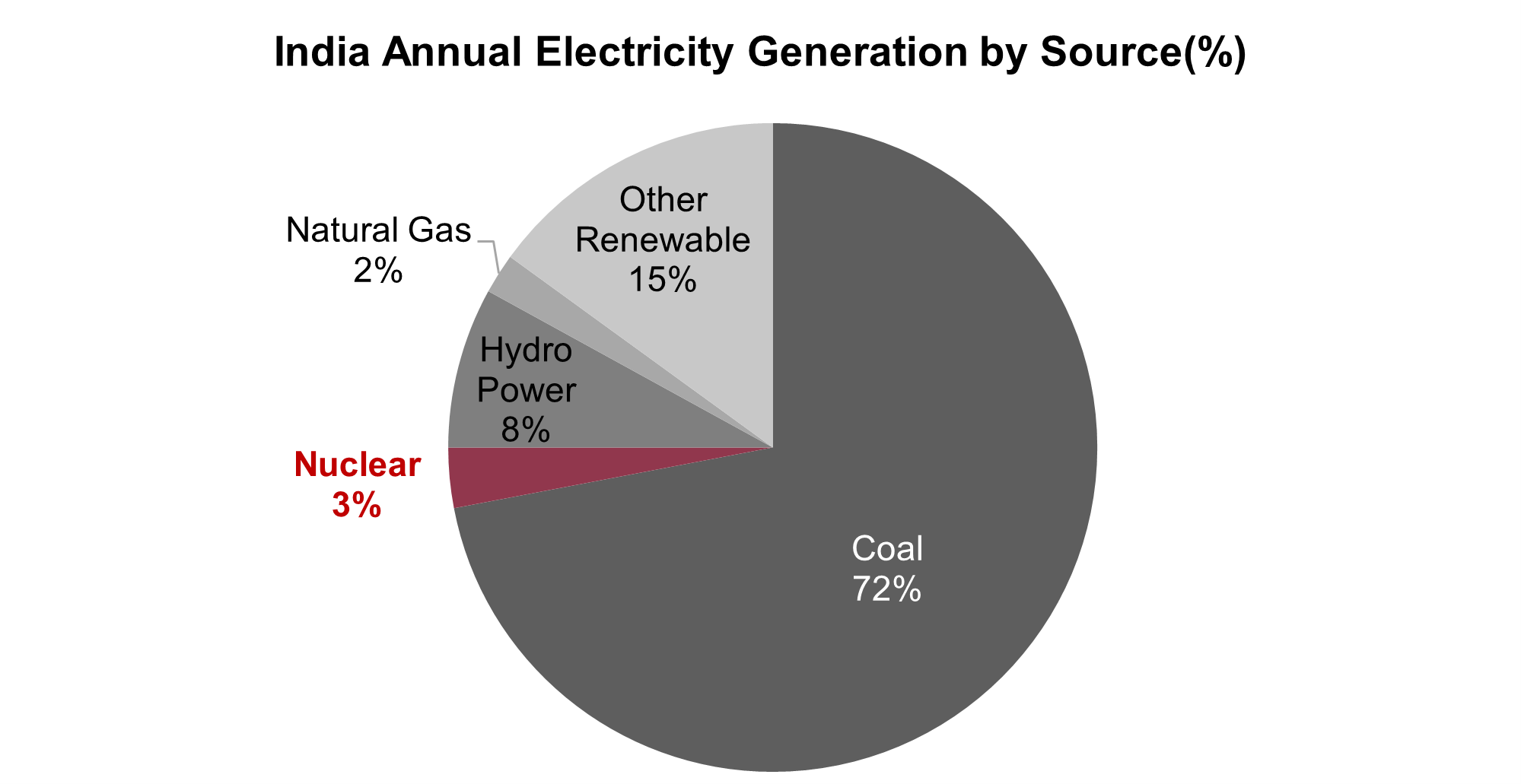
(Source: Central Electricity Authority – Load Generation Balance Report 2024-25)
(Source: NITI Aayog – India Climate & Energy Dashboard)
What Leading Players Are Already Doing: Adani, Tata, and the New Nuclear Race
The ink on the SHANTI Act was barely dry when the first major private sector move came. Adani Power Limited incorporated Adani Atomic Energy Limited (AAEL) as a wholly owned subsidiary on February 11, 2026, with a stated focus on generating and distributing electricity from atomic energy. This is not a speculative venture. The Adani Group already operates over 15,000 MW of renewable energy and 18,150 MW of thermal power capacity and has deep experience in large-scale infrastructure execution. Nuclear is a logical extension for a group that has built ports, airports, and transmission networks at a pace few Indian companies can match.
Reports also indicate that Tata Power, which has its own historical connection to nuclear through the Tata Memorial legacy and deep engineering capabilities, is evaluating entry into the sector. Together, these developments show how private sector nuclear power in India could move from policy discussion to actual project formation over the next few years.
Globally, the pattern is instructive. In the United States, companies like TerraPower (backed by Bill Gates) and NuScale Power are driving the next generation of small modular reactors (SMRs) with significant private capital. France’s EDF, South Korea’s KHNP, and Russia’s Rosatom have all demonstrated that public-private collaboration accelerates nuclear deployment. India is now adopting a similar model late, but with clear intent. Over time, SMRs in India could become part of this strategy, especially for industrial power demand, remote locations, and modular clean energy deployment.
(Source: Central Electricity Authority – Nuclear Roadmap Report)
(Source: World Nuclear Association)
The Gaps Nobody Is Talking About: Fuel, Talent, and the Missing Supply Chain
Everyone is talking about investment opportunities and capacity targets. Very few are talking about the three structural constraints that will determine whether India’s nuclear ambition actually materializes.
First, fuel security. India has limited domestic uranium reserves. The country depends heavily on uranium imports from Kazakhstan, Canada, and Australia under bilateral agreements enabled by the Indo-US Civil Nuclear Agreement of 2008 and subsequent Nuclear Suppliers Group waivers. As private players enter and capacity scales, fuel demand will increase dramatically. This makes uranium fuel security in India a critical issue for long-term project bankability. India’s thorium-based advanced fuel cycle programme, the long-term answer, is still decades away from commercial deployment. Without a clear fuel allocation framework for private operators, investment commitments could stall.
Second, the talent gap. India produces approximately 300 to 400 nuclear engineers per year from specialized programmes. Building a 100 GW fleet requires tens of thousands of trained nuclear professionals, reactor operators, radiation safety experts, project engineers, and regulatory specialists. There is no national nuclear workforce development plan that matches the scale of the ambition.
Third, the supply chain. A nuclear power plant requires highly specialized forgings, reactor pressure vessels, steam generators, and instrumentation and control systems. India’s indigenous capability, centered around Larsen & Toubro and Bharat Heavy Electricals Limited (BHEL), is competent but capacity-constrained. Scaling private nuclear construction will require a massive expansion of the domestic nuclear supply chain in India or dependence on foreign vendors, which carries its own geopolitical risks.
The SHANTI Act opens the front door. But the house behind it is not yet fully built. The biggest risk to India’s nuclear ambition is not policy or capital; both are now available. It is the hard, unglamorous work of building fuel supply chains, training a workforce at scale, and creating a domestic manufacturing ecosystem for nuclear-grade components. The companies that invest in these enablers, not just in reactors, will be the ones that truly profit from this reform.
Where This Goes from Here: India’s Nuclear Decade Begins Now
The SHANTI Act 2025 will be remembered as the single most important energy policy reform in India since the Electricity Act of 2003. Just as the 2003 Act opened generation and distribution to private players and triggered the massive expansion of India’s thermal and renewable capacity, the SHANTI Act will trigger a multi-decade nuclear construction cycle. The first private sector nuclear projects will likely break ground by 2029-30, with initial commissioning expected by 2034-35. Nuclear projects have inherently long gestation periods, and there is no shortcut. But the capital formation, land acquisition, licensing applications, and joint venture negotiations will begin now, in 2026 and 2027. Adani Atomic Energy’s incorporation is the first signal, not the last. Within 18 months, expect at least three to four more major industrial groups to announce nuclear energy subsidiaries. Within five years, expect India’s nuclear order book to rival its renewable energy pipeline in total committed capital.
The companies and investors who position themselves now in fuel supply, reactor technology partnerships, nuclear-grade manufacturing, specialized workforce development, and private nuclear investment in India will capture disproportionate value. Those who wait for the sector to mature before entering will find the best sites taken, the best technology partners committed, and the regulatory learning curve steeper. India’s nuclear decade is not coming. It has begun.
FAQs
- What is the SHANTI Act 2025?
The SHANTI Act 2025 is India’s new nuclear energy reform law that allows private capital and private expertise to participate in the nuclear power sector. It marks a major shift from the earlier government-only model for building, owning, and operating nuclear power plants.
- Why is the SHANTI Act important for India’s nuclear energy sector?
The SHANTI Act is important because it represents the most significant India nuclear energy reform since the Atomic Energy Act of 1962. It helps India address funding, execution, and capacity gaps that cannot be solved by government investment alone.
- How does the SHANTI Act create private nuclear investment opportunities in India?
The Act creates private nuclear investment India opportunities by opening the sector to companies that can bring capital, infrastructure execution, technology partnerships, and supply-chain capabilities. This makes nuclear power a new long-term investment theme within India’s clean energy transition.
- Can private companies now enter India’s nuclear power sector?
Yes, the reform enables private sector nuclear power in India by allowing private players to participate in nuclear generation, project development, and related ecosystem opportunities. The exact project structures will still depend on licensing, regulation, safety approvals, and government frameworks.
- What is India’s nuclear capacity target for 2047?
The India nuclear capacity target 2047 is 100 GW, compared with the current installed capacity of around 8,180 MW. The interim target is 22,480 MW by 2031-32, which shows how sharply India plans to scale nuclear power over the next two decades.
- What are the biggest risks for India’s nuclear expansion?
The biggest risks are fuel availability, skilled talent, long project timelines, and the readiness of the nuclear supply chain India. Uranium fuel security India will also be critical because higher nuclear capacity will require reliable long-term fuel sourcing.