In the last year, the India semiconductor industry conversation has changed in a very practical way. Earlier, most leadership teams evaluating the India semiconductor industry would ask, “Can India realistically build semiconductor manufacturing capacity?” Today the question we hear more often is, “Which part of the semiconductor value chain can India scale reliably in the next 24-36 months, and what will it take to make the business case work?” That shift matters because it moves the discussion from ambition to execution: capacity, qualification, uptime, and customer confidence.
This article takes a market-oriented perspective, focusing not on what India should do, but on what is becoming investable, what remains fragile, and how global companies can participate through calibrated risk exposure. India’s semiconductor growth is unlikely to be driven by a single large fab announcement; rather, it will depend on the development of credible semiconductor manufacturing clusters in India where demand, manufacturing capability, and supply chain depth reinforce one another. Together, these forces are strengthening the India semiconductor ecosystem and creating a more practical foundation for long-term manufacturing scale-up.
India Semiconductor Policy Push: From ISM 1.0 to ISM 2.0
One of the key reasons the conversation has accelerated is that India semiconductor policy framework has moved from broad intent to targeted execution, making boardroom discussions increasingly about commercial viability rather than policy uncertainty. In February 2026, the Government launched India Semiconductor Mission 2.0 (ISM 2.0) with a ₹1,000 crore immediate allocation and an ₹8,000 crore outlay for the broader semiconductor ecosystem India. This is not just about fiscal support anymore, it is about filling specific gaps: equipment and materials manufacturing, semiconductor design IP creation, and building a future-ready workforce.
The shift from ISM 1.0’s fab-centric approach to ISM 2.0’s full-stack semiconductor ecosystem view signals that policymakers have internalized a key lesson from client projects we have run: incentives reduce capex burden, but they do not reduce the time needed for customer qualification, yield stabilization, or supplier maturity. These are not minor footnotes; they often decide whether a project becomes a stable revenue engine or stays in “permanent ramp-up mode.” Well-structured programs treat incentives as just one component of a broader execution strategy, supported by clear milestones, operational readiness, and a realistic timeline for localization.
Where India Semiconductor Demand Is Growing?
A market-centric view starts with demand pools. India’s electronics and semiconductor manufacturing is expanding, but India semiconductor demand is not one homogeneous bucket. In ecosystem mapping projects, what we often see is real demand that is fragmented across OEMs, EMS players, and product categories. The unlock is not only capacity, it is aggregation: anchor customers, long-term programs, and a predictable qualification pipeline.
This is why “what to build” matters as much as “where to build.” Portfolios aligned to automotive, industrial, power management, and broader embedded applications typically have a clearer path in the early years because the node requirements and packaging needs can match what new clusters can industrialize step-by-step. On the other hand, chasing the most advanced nodes too early can create a mismatch between ambition and ecosystem depth, especially when local support for materials, spares, and process talent is still developing.
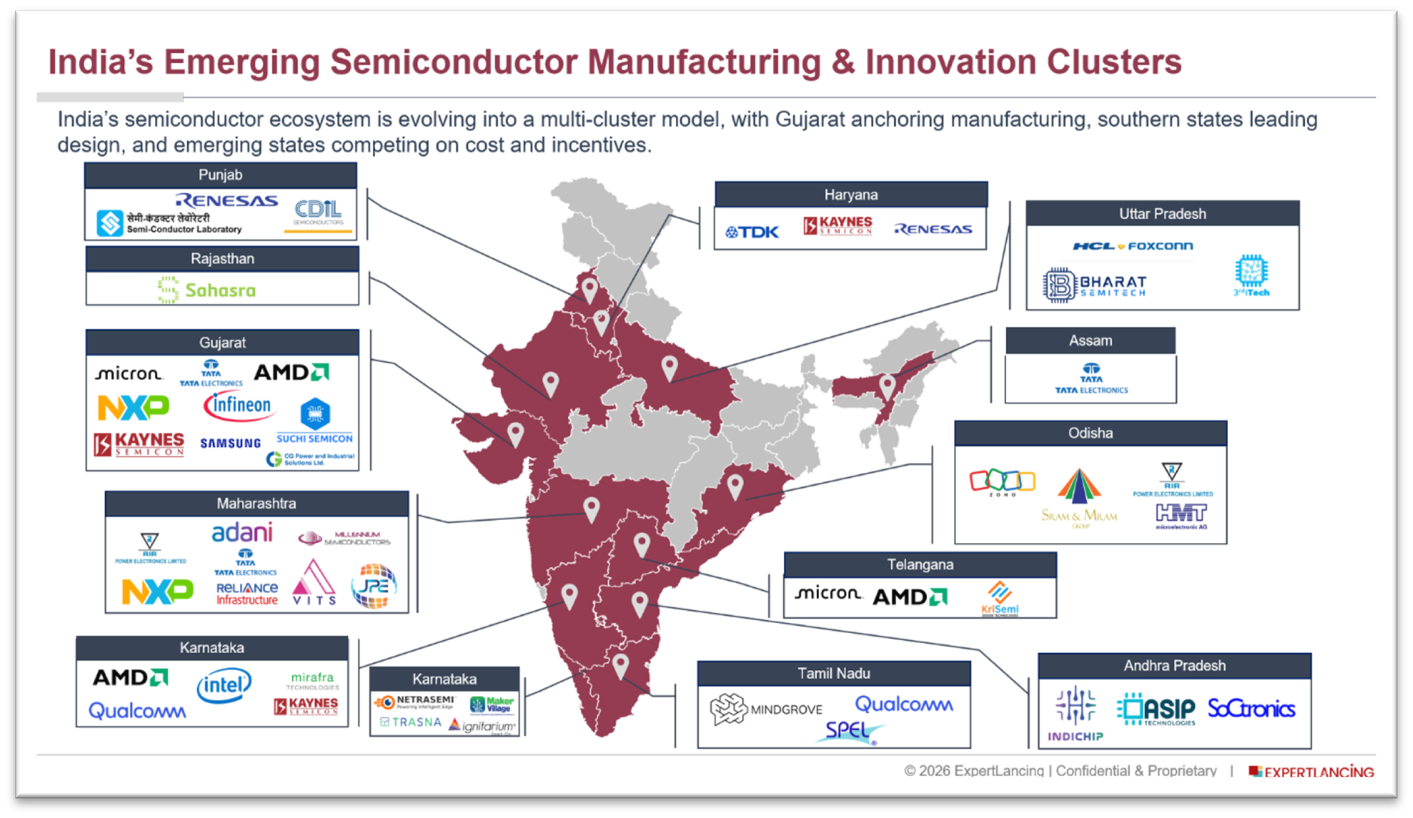
Another emerging pattern is the gradual formation of semiconductor clusters India rather than isolated projects. Gujarat, for instance, is beginning to position itself as an assembly, test, and fabrication hub with projects from Micron, CG Power, and Tata Electronics. This evolving Gujarat semiconductor cluster is important because it can create supplier proximity, operational learning, and shared infrastructure advantages over time. Meanwhile, states such as Karnataka and Tamil Nadu continue to strengthen their semiconductor design and electronics manufacturing ecosystems. Over time, these clusters can create the network effects like supplier proximity, specialized talent pools, and logistics efficiency that make semiconductor operations more sustainable beyond the initial incentive period.
2026: A Turning Point For Semiconductor Manufacturing In India
If there is one “practitioner takeaway” today, it is this: 2026 is the year India moves from pilot to commercial semiconductor production. Four semiconductor plants: Micron, CG Power, Kayne’s Technology, and Tata Electronics are commencing commercial manufacturing this year. This is not a projection; it is happening now, making semiconductor commercial production India in 2026 a key milestone for the country’s manufacturing roadmap.
Micron’s Sanand facility, which opened in early 2026 with a $2.75 billion investment, is already ramping semiconductor assembly and testing operations. This Sanand semiconductor facility is strategically important not only because of its scale, but also because it strengthens the case for semiconductor assembly and testing in India as a practical near-term entry point into the global semiconductor value chain. For the ecosystem, the strategic signal is not only the scale but the fact that India can host world-class cleanroom-backed assembly and test operations, creating pull for adjacent suppliers and services. The strategic signal for the ecosystem lies less in the number itself and more in what it validates: India’s readiness to operate at global semiconductor manufacturing standards. This matters because packaging and test can become a practical entry point: it creates jobs, develops manufacturing muscle, and builds “audit culture”, often before the country tries to climb too many steps at once. The CG Power–Renesas–Stars Microelectronics JV in Sanand, Gujarat, with its substantial investment plan, is moving from pilot to commercial production alongside Kayne’s Technology. Meanwhile, Tata’s ₹27,000 crore facility in Assam is scheduled to begin pilot production by mid-2026 and scale up to commercial manufacturing by year-end. These projects matter because they help create repeatable manufacturing discipline and supplier development pressure in a way that presentations alone cannot.
India’s Fab Ambitions Take Shape
India semiconductor manufacturing ambition is also getting more grounded. Tata Electronics’ agreement with Power chip Semiconductor Manufacturing Corporation (PSMC) includes an intended capacity of up to 50,000 wafers per month, targeting power management ICs, display drivers, and microcontrollers, exactly the kind of portfolio that can connect to domestic and global semiconductor demand without forcing the most bleeding-edge bet on day one. The Tata Electronics semiconductor fab is therefore significant not only as a headline investment, but as a test of India’s ability to translate fab ambition into repeatable, commercially qualified production. The first commercial chips are expected by December 2026.
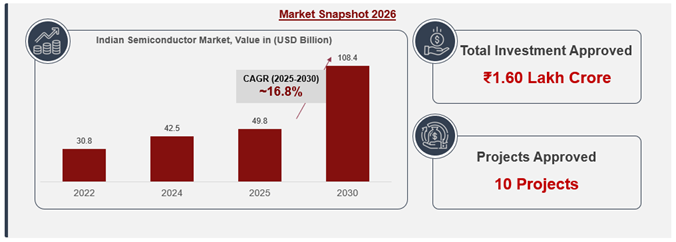
That said, for any semiconductor fab program, the hardest work begins after the signing: tool installation, process integration, yield learning, and customer qualification, all while building a dependable ecosystem of materials, utilities, and maintenance capability. The 10 approved projects worth over ₹1.60 lakh crore across six states show momentum, but the next 18-24 months will test execution discipline.
How Global Companies Can Participate?
For global semiconductor and electronics value-chain players, India semiconductor market opportunity is real, but the smartest approach is staged. Many companies can start with packaging/test partnerships, reliability services, and India-specific product programs that create early revenue and learning loops, while the broader ecosystem matures. They can also build two layers of partnerships: one with the manufacturing asset, and another with enabling suppliers: materials, spares, metrology, training, and logistics SOPs. because these “unseen layers” often decide ramp success.
Most importantly, treat India as an execution program, not a headline. The winners will be those who plan for qualification timelines, supplier development, and operating discipline from day one and who pick market segments where demand pull can sustain the cluster beyond subsidies.
FAQs
- What is driving growth in the India semiconductor market?
Growth in the India semiconductor market is being driven by rising electronics demand, policy incentives, and global supply-chain diversification. The opportunity is strongest where demand, manufacturing capability, and supplier depth can develop together.
- What is India Semiconductor Mission 2.0?
India Semiconductor Mission 2.0 is the next phase of India’s semiconductor policy push. It focuses not only on fabs, but also on equipment, materials, design IP, workforce development, and broader ecosystem readiness.
- Which semiconductor manufacturing clusters in India are becoming important?
Key semiconductor manufacturing clusters in India are emerging around Gujarat, Karnataka, Tamil Nadu, and Assam. Gujarat is gaining strength in assembly, testing, and fabrication, while Karnataka and Tamil Nadu continue to support design and electronics manufacturing.
- Why is Gujarat important for semiconductor manufacturing in India?
The Gujarat semiconductor cluster is important because projects in Sanand are creating momentum around assembly, testing, fabrication, and supplier development. This can help build shared infrastructure, skilled talent pools, and stronger local supply-chain support.
- Which parts of the semiconductor value chain can India scale first?
India can scale packaging, testing, reliability services, and semiconductor assembly and testing India capabilities first. These areas are practical entry points because they build manufacturing discipline before the ecosystem moves deeper into complex fab operations.
- What challenges can slow semiconductor manufacturing projects in India?
Semiconductor projects can slow down because of long customer qualification cycles, yield stabilization, equipment readiness, and supplier maturity. These execution factors often determine whether a project becomes commercially reliable or remains stuck in ramp-up mode.